

Tracking local rankings means regularly checking where your business appears in Google Search and Google Maps for the keywords your customers actually use, by location. The fastest way to start is to pick 8 to 12 priority keywords, define a few target locations, and run a baseline scan today. That single step gives you the starting line everything else builds from.
TL;DR:
- Search Console tracks website page rankings, while Google Business Profile insights measure profile views and actions; proximity weighs more heavily in Maps than organic Search.
- A location grid scan samples 9, 16, or 25 points across a service area, exposing neighborhood visibility gaps that personalized phone searches can miss.
- Compare weekly or biweekly trends rather than daily shifts; a position drop sustained for three weeks deserves investigation, while one day’s decline may be noise.
- When map pack rank and profile views move in opposite directions for more than two reporting cycles, investigate reviews and prominence before changing content.
- Correct inaccurate profile categories, addresses, hours, and review responses before investing in content or backlinks; if drops persist after two cycles, run a broader audit.
Table of Contents
- What Local Rank Tracking Measures and Why It Matters for Your Business
- How Google Search and Google Maps Differ in What They Rank
- Practical Tracking Methods: Manual Checks, Geo-Grids, and APIs
- Key Metrics to Monitor and How to Read Them
- How to Set Up a Repeatable Local Ranking System
- Turning Tracking Data into Action
- How Stellor Automates the Tracking and Actions Above
- Tracking Local Rankings Beyond Google: Bing, Apple Maps, and Others
- Best Practices for Tracking Competitor Local Rankings
- Connecting Ranking Changes to Offline Events
- Steady Tracking Beats Chasing Daily Noise
- Getting Started With Automated GEO + SEO Tracking
- FAQ
- Sources
What Local Rank Tracking Measures and Why It Matters for Your Business
Local rank tracking tells you where you show up when someone searches for what you sell, in the place they’re searching from. That’s different from your overall SEO health. You can have a technically sound website and still lose the map pack to a competitor three blocks away with more reviews.
Google itself is fairly direct about what drives local placement. According to Google Business Profile guidance, local rankings come down to three factors: relevance, distance, and prominence. Relevance is how well your profile matches what someone typed. Distance is how close you are to the searcher or the area they searched. Prominence is how well-known your business is, both online and offline, based on signals like reviews, links, and citations.
Tracking exists to turn those three abstract factors into something you can watch move over time. Here’s what that looks like in practice:
- Position tracking shows whether you’re climbing or sliding for specific keyword and location pairs.
- Impressions tell you how often your listing or page was shown, even if nobody clicked.
- Clicks and calls show whether visibility is actually converting into contact.
- Map pack appearances reveal whether you’re in the three-listing block most local searchers see first.
Impressions and position aren’t the same signal, and conflating them is a common mistake. You can rank well for a keyword that almost nobody searches, which means high position but low impressions. Or you can show up often in searches, meaning high impressions, but sit in position six or seven, below the fold, where clicks drop fast. Watching both together tells you whether a ranking gain is actually worth anything.
The business outcome that matters isn’t the position number itself. It’s whether tracking helps you spot the moment a competitor opens two miles away and starts eating your map pack share, or whether a review dip quietly started pulling your prominence score down three weeks before you noticed fewer calls.
How Google Search and Google Maps Differ in What They Rank
Search and Maps are not the same contest, and treating them as one is why a lot of tracking setups give misleading results. They pull from overlapping signals but score them differently.
Organic Search ranks your website pages. A service page or location page competes on-page content, backlinks, and technical SEO, the same levers that drive any organic ranking. You can monitor this directly through Search Console’s performance report, which tracks clicks, impressions, and average position by query, page, country, and device.
Maps and the local pack rank your Google Business Profile, not your website. Distance matters far more here. A profile a half-mile from the searcher often beats a stronger, better-reviewed business four miles away, because proximity is baked directly into the scoring. You track this through Google Business Profile insights, which show profile views, search queries, and actions like calls or direction requests, rather than through Search Console.
- Organic Search: page-level competition, tracked through Search Console metrics tied to specific URLs.
- Maps/local pack: profile-level competition, heavily weighted by proximity, tracked through GBP insights.
- Personalization: the same keyword can produce different results for two people standing on the same block, depending on their search history and device location settings.
That last point explains why two employees at your own business sometimes see different rankings when they check from their phones at lunch. Personalization and granular location data mean no single search is the “true” ranking. That’s exactly why rank tracking tools exist: to standardize the viewpoint so you’re comparing apples to apples week over week, instead of chasing whatever one browser happened to show one person at one moment.
Practical Tracking Methods: Manual Checks, Geo-Grids, and APIs
Most small-business owners start with manual checks, and most manual checks mislead them. Here’s why, and what to do instead.
- Manual search from your own phone or laptop feels like the obvious move, but your search history, saved locations, and login state all skew the result. You’re seeing a personalized version of the results, not what a new customer three miles away would see.
- Incognito mode strips out your login and some history, which helps, but it still uses your device’s actual GPS or IP location. Opening an incognito window in your office doesn’t tell you how you rank for someone searching from the neighborhood across town.
- Geo-grid tracking solves the location problem directly. A geo-grid tool simulates searches from a set of points spread across your service area, often arranged in a grid of 9, 16, or 25 points per city, then plots the results into a heatmap. This is how you discover that you dominate the map pack downtown but disappear entirely six miles north, a pattern a single manual search would never reveal.
- APIs and automated platforms scale the process so you’re not manually running dozens of searches every week. The Search Console API documentation outlines how query-level performance data can be pulled programmatically, and the Google Business Profile API can surface the same profile insights without manual exports. For a business tracking even a modest set of keywords across multiple locations, automation stops being a convenience and starts being the only realistic option.
Personalization is well documented as a factor that skews individual search results, which is part of why simulated or location-proxied searches have become the standard way practitioners check local rankings at scale rather than relying on one person’s live browser.
Pro Tip: If you only have fifteen minutes a week, skip the manual phone checks entirely and run one small geo-grid scan instead. It replaces a dozen unreliable individual searches with one consistent, comparable snapshot.
Key Metrics to Monitor and How to Read Them
Once you’re tracking consistently, the next skill is knowing which numbers deserve your attention and which are just noise.
The core metrics worth watching every reporting cycle:
- Average position: your typical rank for a keyword, best read as a trend line, not a single day’s snapshot.
- Impressions: how often you appeared in results, a proxy for total visibility.
- Clicks and click-through rate: whether that visibility is translating into traffic.
- Map pack rank: your position in the three-listing local block, tracked separately from organic position.
- Review volume and rating: a prominence signal that moves slower but compounds over months.
Search Console’s performance report explicitly supports grouping data by week or month rather than day, which matters more than it sounds. Daily rankings bounce around constantly due to algorithm testing, personalization, and normal search volatility. A single day’s drop from position 3 to position 7 usually means nothing. The same drop sustained across three weeks of weekly data means something changed and needs a look.
One pattern worth tracking closely: when map pack rank and GBP profile views move in opposite directions for more than two reporting cycles, it usually signals a prominence issue, like a review slowdown, rather than a relevance or distance problem, since relevance and distance tend to move position and views together.
The practical rule is simple: set your primary reporting cadence to weekly or biweekly, and reserve daily checks for situations where you already suspect something broke, like after a Google Business Profile edit or a sudden review cluster. Daily tracking as a default habit mostly just generates anxiety over noise.
How to Set Up a Repeatable Local Ranking System
Building a tracking system that survives past week one comes down to four decisions made once and revisited quarterly.
Choosing your keywords:
- Start with your core services paired with intent modifiers: “emergency plumber,” “same-day HVAC repair,” “divorce lawyer consultation.”
- Add location modifiers for each neighborhood or city you actually serve, not just your headquarters city.
- Include long-tail variations a real customer would type, like “24 hour locksmith near downtown,” rather than only short head terms.
- Cap your initial list at 8 to 12 terms. A longer list dilutes your attention before you’ve even established a baseline.
Choosing location targets depends on how your service area is shaped. A single-location retail business can usually track at the city level. A service-area business covering a metro with distinct neighborhoods, the kind of setup covered in our service area business SEO guide, typically needs a GPS grid instead, since a city-level check can hide the fact that you’re invisible in half your coverage zone.
Once keywords and locations are set:
- Run your baseline scan and save it as the reference point for every future comparison.
- Set a recurring cadence, weekly for active campaigns or competitive markets, biweekly for stable ones.
- Build a simple report template with three sections: top movers (up or down more than a few positions), rankings lost entirely from the map pack or page one, and review count or rating changes.
That report doesn’t need to be elaborate. A spreadsheet with four columns, keyword, location, this period’s position, last period’s position, catches the vast majority of what you need to notice.
Turning Tracking Data into Action
Data without a decision attached to it is just a dashboard you check out of habit. The move from tracking to action starts with a change log.
Keep a running note of every Google Business Profile edit, every batch of new reviews, and every content or backlink change you make. When a ranking shifts, check that log first. Rank fluctuations line up with real causes more often than they seem to: a profile edit from two weeks ago, a competitor’s sudden review burst, or a new service page that just got indexed.
- Fast, high-leverage moves: fixing an outdated Google Business Profile category, responding to recent reviews, correcting an address or hours error.
- Medium-effort moves: adding a location-specific service page, which our guide to improving local rankings covers in more depth.
- Heavier investment: backlink building and broader content expansion, which pay off but take longer to register in your tracking data.
The prioritization rule worth following: fix the quick GBP and review issues before committing to a content or backlink push. They’re faster to execute and faster to measure.
Pro Tip: If a ranking drop doesn’t resolve within two tracking cycles after your quick fixes, that’s your signal to stop guessing and run a fuller technical and competitive audit instead of continuing to make small adjustments.
How Stellor Automates the Tracking and Actions Above
Everything above is manageable by hand for a single location with a short keyword list. It gets harder fast once you’re tracking multiple services, neighborhoods, or locations, which is the exact workload we built Stellor to absorb.
We run weekly AI visibility checks across ChatGPT, Claude, Perplexity, and Gemini, reporting back exactly when your business gets mentioned and which competitors are showing up in your place. On the content side, we publish 30 GEO and SEO-optimized articles a month, service pages, location pages, and comparison guides, reinforced by a 4,000-site backlink network that builds the prominence signal Google weighs so heavily.
Weekly technical audits catch schema gaps, page speed issues, and structured data problems before they quietly erode your rankings. Our Reddit engagement module surfaces high-intent threads where AI tools are already pulling recommendations from. Every new account starts with a free AI Visibility Audit delivered within 48 hours, covering your current citation status, a competitor benchmark, and a 90-day action plan, yours to keep even if you cancel.
Tracking Local Rankings Beyond Google: Bing, Apple Maps, and Others
Google dominates local search volume, but it’s not the only surface customers use to find you, and treating it as the only one worth tracking leaves gaps.
Bing Places for Business runs its own local ranking system, and Bing Maps results feed into both Bing’s search results and some voice assistant responses. Apple Maps has grown into a meaningful discovery channel too, particularly for iPhone users navigating by voice or searching directly within the Maps app rather than a browser.
The practical approach for most small businesses: claim and fully complete your profile on each platform using consistent name, address, and phone information across all of them, then check your standing periodically rather than daily. These platforms generally see less day-to-day volatility than Google, so a monthly spot check is usually enough unless you notice a sudden drop in traffic from one of these sources specifically.
The bigger shift worth planning for now is that AI answer engines like ChatGPT, Claude, Perplexity, and Gemini are becoming a parallel discovery layer that sits alongside traditional search and Maps. A customer asking an AI assistant for “a plumber near me” is pulling from a different set of signals than a Google Maps search, and tracking whether you get cited in those answers is quickly becoming as relevant as tracking your map pack position.
Best Practices for Tracking Competitor Local Rankings
Your own position numbers only tell half the story. Watching how competitors move is what turns tracking data into strategy instead of just a scoreboard.
Pick 3 to 5 direct competitors, the businesses actually showing up in the map pack alongside you for your core keywords, and track their positions using the same keyword and location set you use for yourself. Consistency here matters: comparing your weekly data to their monthly spot-check isn’t a real comparison.
Pay particular attention to review velocity and rating changes among competitors. A business that jumps from 40 reviews to 90 reviews in two months is actively investing in prominence, and you’ll likely see their map pack position rise to match. Watching that trend early gives you time to respond with your own review outreach before the gap widens.
Also track what competitors are doing on their Google Business Profile itself: new categories added, new photos, new services listed. Profile completeness is a factor Google can read directly, and a competitor filling in gaps you’ve left empty on your own profile is an easy, specific thing to fix once you notice it.

Avoid the trap of tracking every competitor in your category. Five relevant, actively ranking competitors give you a usable signal. Twenty competitors give you a spreadsheet nobody reads.
Connecting Ranking Changes to Offline Events
Rankings don’t move in a vacuum, and some of the biggest swings in your data trace back to something that happened offline, not to anything Google changed.
A promotion that drives a cluster of new customers often produces a review burst two to three weeks later, since most customers who leave reviews do so shortly after a positive experience, not the same day. That review burst then shows up as a prominence bump in your tracking data, sometimes with a delay long enough that the cause isn’t obvious unless you’re logging dates.
Seasonal events matter too. A local business tied to weather, holidays, or a recurring community event, a landscaping company before spring, a tax preparer in early spring, a retailer before the holidays, will often see search volume and impressions shift even when their actual ranking position hasn’t changed at all. Reading that as a ranking win or loss when it’s really a demand shift leads to the wrong conclusion.
The fix is the same change log discussed earlier, extended to include offline activity: note the dates of promotions, major events, press mentions, or seasonal campaigns alongside your edit history. When a ranking or traffic shift shows up, check that combined log before assuming it’s purely algorithmic. More often than not, the real cause is sitting right there in your own calendar.
Steady Tracking Beats Chasing Daily Noise
The businesses that get the most out of rank tracking aren’t the ones checking positions every morning. They’re the ones who picked a cadence, usually weekly, and stuck with it long enough to see real patterns instead of algorithmic jitter.
Someone on your team, whether that’s you, a marketing hire, or an agency partner, should own the report and review it on a fixed schedule rather than reactively. Daily checking almost always leads to overreacting to swings that reverse themselves within a week.
The honest line for when to stop doing this by hand: once you’re tracking more than a handful of keywords across more than one location, the spreadsheet starts costing you more time than it saves. That’s the point where automation earns its keep.
— Cole
Getting Started With Automated GEO + SEO Tracking
Everything in this guide is doable manually for one location and a short keyword list. It stops being practical the moment you add a second location, a longer keyword set, or AI visibility tracking on top of traditional rank tracking, which is exactly the gap Stellor was built to close.
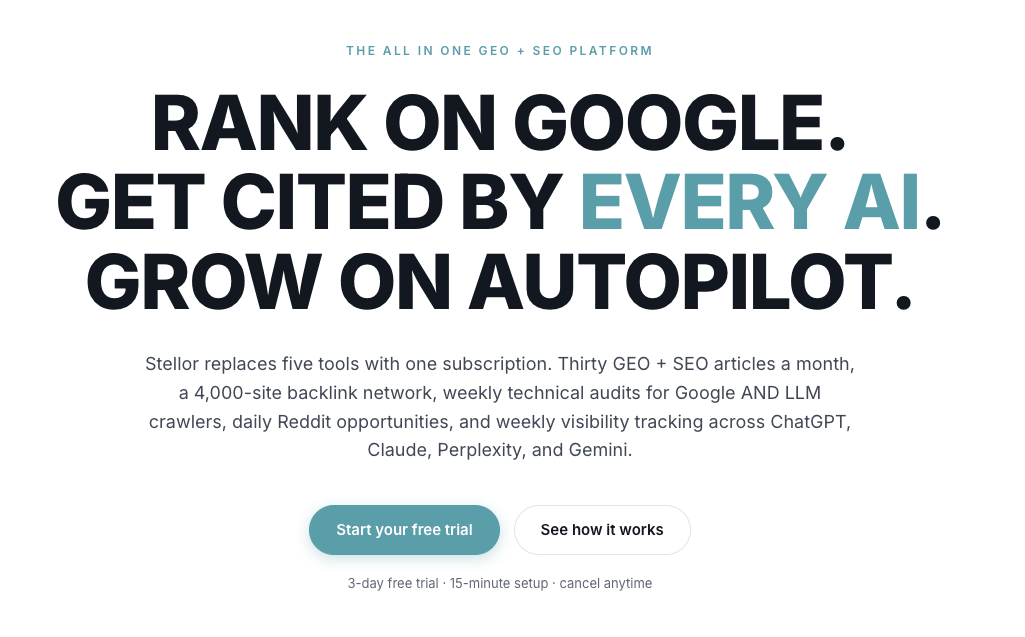
We combine content, backlink, audit, and tracking work into one managed subscription instead of multiple separate tools or vendors:
- Weekly AI visibility tracking across major AI platforms, with reports showing exactly where you’re cited and who is being cited instead.
- 30 GEO and SEO-optimized articles published monthly, backed by a 4,000-site backlink network that builds the prominence signal local rankings depend on.
- Weekly technical audits and a Reddit engagement module that surfaces high-intent threads in real time.
Every new account starts with a free AI Visibility Audit delivered within 48 hours, plus a 3-day free trial with no card required. If you want to see what improved local and AI visibility could mean in real numbers first, our ROI calculator gives you a projection based on your own numbers. When you’re ready to put the system on autopilot, get started here.
FAQ
How do I check my website’s ranking on Google?
Use Search Console to see your actual average position, impressions, and clicks for specific queries, since a manual search shows you a personalized result that may not match what other searchers see. For local rankings specifically, a geo-grid or location-simulated tool gives a more accurate picture than checking from your own phone.
Is an SEO score of 92 good?
SEO scores come from third-party tools using their own scoring systems, so there’s no universal standard that defines “good.” A high score from one tool is only meaningful relative to that same tool’s scale over time, and it should never replace tracking real metrics like clicks, impressions, and position from Search Console.
What is the best rank tracker software for SEO?
The right choice depends on whether you need organic Search tracking, local map pack tracking, or both, since these measure different things. Look for a tool that supports geo-grid tracking for local businesses and pulls data directly from sources like Search Console rather than relying only on manual checks.
How do I increase my Google rankings?
For local rankings, focus first on the three factors Google names directly: relevance, distance, and prominence, which means a complete, accurate profile and a steady flow of reviews. Fast fixes like correcting profile categories and replying to reviews typically show results faster than larger projects like new content or backlinks.
How often should I check my local rankings?
Weekly or biweekly tracking is enough to catch real trends without reacting to normal day-to-day fluctuations, which Search Console’s own reporting options are built to smooth out through weekly and monthly groupings. Reserve daily checks for specific moments, like right after a profile edit or a sudden review cluster, when you already suspect something changed.