
Running a plumbing company, dental practice, or HVAC business in a competitive city means you’re fighting for the same local customers as a dozen other providers within a few miles. Knowing how to improve Google rankings is no longer optional — it’s the difference between your phone ringing consistently and watching your competitors take jobs you could have won. Google’s local search now layers AI Overviews (summaries generated by Google’s AI) on top of traditional results, making visibility harder to earn and easier to lose. This guide walks you through every practical step, from your Google Business Profile to content strategy and tracking, so you can rank higher and stay there.
Table of Contents
- Preparing for success: fix your Google Business Profile and website foundation
- Ensuring your pages get discovered: indexing and technical SEO checks
- Building prominence: reviews, backlinks, and online reputation signals
- Creating content that matches local search intent and builds authority
- Tracking results and continuous improvement with Google Search Console and analytics
- Why focusing solely on distance or keywords is a flawed strategy in 2026
- Simplify improving Google rankings with Stellor’s all-in-one platform
- Frequently asked questions
Key Takeaways
| Point | Details |
|---|---|
| Complete your Google Business Profile | Accurate, detailed business information and regular updates improve local search relevance. |
| Confirm indexing with Search Console | Use URL Inspection and sitemaps to ensure Google indexes your key pages promptly. |
| Build review volume and backlinks | Online reviews and quality backlinks boost prominence, a key local ranking factor. |
| Match user search intent | Create content that directly answers local search queries and builds topical authority. |
| Measure and update regularly | Track performance continuously and refresh content every 6–12 months to sustain rankings. |
Preparing for success: fix your Google Business Profile and website foundation
Your Google Business Profile (GBP) is the single most important asset for local visibility. Think of it as the plumbing behind the walls of your digital presence — when it works correctly, everything downstream flows. When it’s broken or incomplete, nothing else you do will fully compensate.

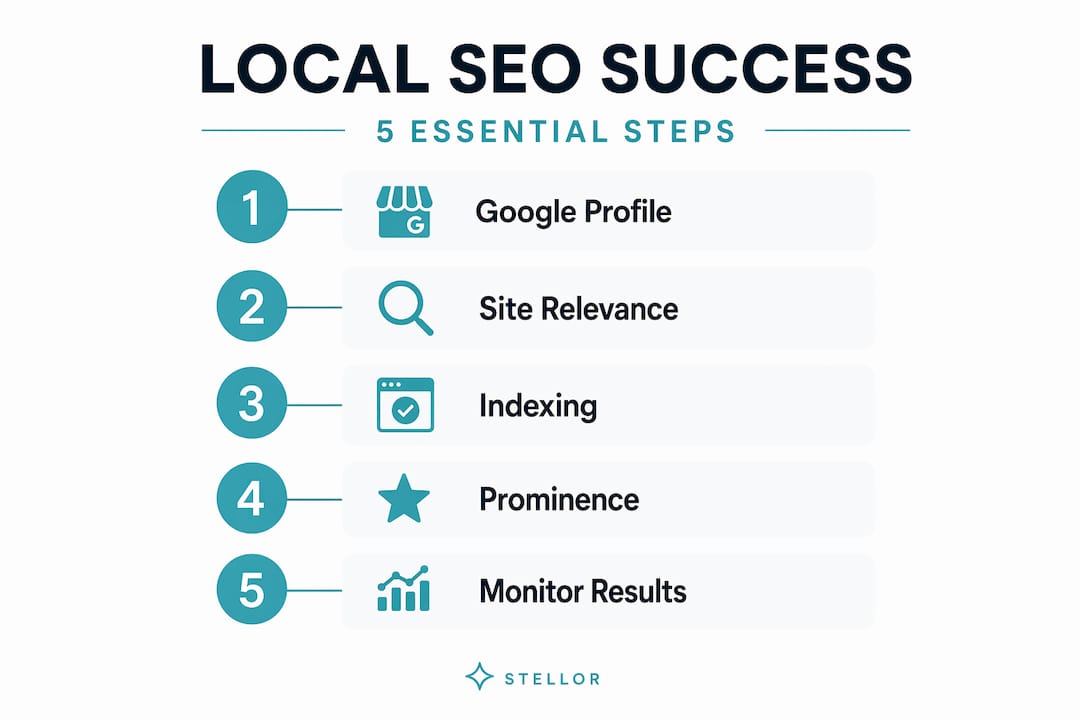
Local search results are based on three factors: relevance, distance, and prominence. You directly control relevance and prominence. Start by completing every field in your GBP: full business name, address, phone number, service categories, business description, service areas, hours (including holiday hours), and photos updated at least monthly. A partially completed profile leaves Google guessing, and Google doesn’t rank what it doesn’t understand.
Your website and GBP must work as a unified relevance system. Each of your main service pages should match the categories you list in your GBP. If you list “emergency electrical repair” as a category, that phrase needs to appear naturally in your website copy, page titles, and meta descriptions. Google cross-references both signals to confirm you are what you claim to be.
The technical foundation of your website matters too. Run through your SEO audit checklist to catch issues that silently hurt your rankings.
| GBP optimization element | Website foundation factor | Relevance impact |
|---|---|---|
| Complete business categories | Matching service page content | High |
| Accurate address and phone | NAP (name, address, phone) consistency | High |
| Business description with services | Title tags and meta descriptions | Medium-High |
| Updated photos (monthly) | Fast page load times (under 3 seconds) | Medium |
| Verified GBP listing | Mobile-friendly design | High |
| Regular post updates | Internal linking between service pages | Medium |
Key actions to complete right now:
- Verify your GBP if you haven’t already. An unverified profile ranks significantly lower.
- Add at least 10 photos showing your team, work, and location.
- List every service you offer as a separate GBP service with a description.
- Check that your address and phone number match exactly across your website, GBP, and any directory listings.
Pro Tip: Respond to every customer review within 24 hours. Google tracks engagement signals on your GBP, and businesses that respond to reviews consistently tend to rank higher in the local map pack (the three-business listing that appears at the top of local search results). Even a simple “Thank you for choosing us” counts.
Good local SEO optimization starts here. With your foundational relevance set, the next step is to address how Google indexes your presence effectively.
Ensuring your pages get discovered: indexing and technical SEO checks
Publishing a new service page doesn’t mean Google automatically finds it. Google crawls the web on its own schedule, which can take days or weeks for a new page. You can speed that up significantly with a few deliberate actions.
Google Search Console gives you a URL Inspection tool and sitemap submission feature to ensure your important pages are crawled and indexed. Without indexing, a page simply cannot rank. Here’s the process to follow every time you publish or update a key page:
- Log into Google Search Console and select your property.
- Paste your page URL into the URL Inspection bar at the top.
- Click “Request Indexing” if the page shows as not indexed or hasn’t been crawled recently.
- Submit or update your sitemap by going to Sitemaps in the left menu and entering your sitemap URL (usually yourdomain.com/sitemap.xml).
- Check back in 48 to 72 hours using the same URL Inspection tool to confirm the page has been indexed.
- Review the Coverage report weekly to catch any new pages that fail to index or show crawl errors.
Common mistakes that stall indexing: accidentally blocking pages with a “noindex” tag, leaving a page out of your sitemap, and having internal links pointing to redirected or broken URLs. These are surprisingly common on local business websites that have been updated over the years without a consistent technical review process.
Understanding why you should prioritize Google rankings matters here. Every page that fails to index is a missed opportunity for a potential customer to find you.
Pro Tip: Set a weekly calendar reminder to check the Coverage report in Search Console. New crawl errors appear quietly — you won’t get an alert unless you look for them. Catching an indexing problem in week one beats discovering it three months later after a ranking drop.
Once you confirm your pages are indexed, the focus shifts to boosting your local prominence to stand out in search results.
Building prominence: reviews, backlinks, and online reputation signals
Prominence is Google’s measure of how well-known and trusted your business is, both online and offline. In a competitive market where every plumber and chiropractor within five miles offers similar services, prominence is often the deciding factor in who takes the top spot.
Review quantity and ratings, along with backlinks from other websites, directly influence your GBP prominence score. A business with 200 genuine four-star reviews and citations from local news sites, chamber of commerce pages, and industry directories will consistently outrank a competitor with 20 reviews and no backlinks, even if that competitor is physically closer to the searcher.
“In competitive local markets, proximity is largely out of your control. Prominence is not. Your reviews, backlinks, and online reputation are the variables that actually move your local ranking.”
Effective review practices:
- Ask every satisfied customer for a review within 24 hours of completing the job, while the experience is fresh.
- Send a direct link to your Google review page via text message. Fewer steps means more completions.
- Train your team to mention reviews at the end of each service call naturally, not as a script.
- Never offer discounts or incentives for reviews. Google can detect patterns and may remove them.
- Respond to negative reviews professionally and offer to resolve the issue offline.
Backlink acquisition methods for local businesses:
- Get listed on relevant local directories: your city’s chamber of commerce, local business associations, and trade-specific directories (for example, Angi for home services or Avvo for legal).
- Sponsor local community events or youth sports teams. These often generate a backlink from the event’s website.
- Write a guest post or be quoted in a local news article. Journalists regularly look for expert sources.
- Partner with complementary local businesses for mutual mentions on each other’s websites.
Tracking your measurable SEO results will show how quickly these prominence signals translate into ranking improvements. For a faster path, these local SEO ranking tips give you a more complete playbook.
Creating content that matches local search intent and builds authority
Most local service websites have a homepage, an about page, and maybe a contact page. That structure leaves enormous ranking potential untapped. Google rewards websites that demonstrate deep knowledge across a topic area, not just a single keyword on a single page.
Matching search intent and building topical authority is what separates businesses that rank consistently from those that drift in and out of the first page. Here’s how to build that authority deliberately:
- Research local queries using Google’s autocomplete and the “People also ask” section. These reveal exactly what your customers type when they’re looking for services like yours.
- Map one primary keyword to each page. A page trying to rank for “HVAC repair,” “furnace installation,” and “air conditioner maintenance” simultaneously tends to rank for none of them well.
- Use supporting keywords in subheadings (H2 and H3 tags) within each page to signal depth and context to Google.
- Build a content hub by creating a central “HVAC services in [city]” page that links to individual pages for each service type. This internal linking structure signals topical authority.
- Refresh content every 6 to 12 months by updating prices, adding new FAQs, and incorporating any service changes.
| Poor keyword stuffing approach | Intent-driven content strategy |
|---|---|
| Repeating “best plumber Chicago” 15 times per page | One naturally placed keyword per paragraph |
| Generic service descriptions copied from competitors | Specific answers to common customer questions |
| No internal links between related service pages | Hub and spoke structure linking all service pages |
| Single long page covering all services | Individual pages targeting one service each |
| No FAQs or customer-focused sections | FAQ section addressing real search queries |
Pro Tip: Find question-based keywords by typing “how do I” or “what does it cost to” into Google’s search bar with your service type added. These long-tail queries (specific, longer search phrases) often have lower competition and very high buying intent. A page answering “how much does a roof replacement cost in [city]” can generate qualified calls within weeks of ranking.
Your local SEO strategies should also account for AI search, since tools like ChatGPT and Perplexity are increasingly answering buyer questions. These AI SEO strategies explain how to position your content for both Google and AI citation.
Tracking results and continuous improvement with Google Search Console and analytics
Improving your rankings without measuring what’s working is just guessing. Tracking indexing and rankings in Google Search Console helps identify gaps and gives you data to act on instead of hunches.
Key metrics and indicators to monitor:
- Impressions: How many times your pages appear in search results. A rising impressions trend confirms Google is seeing your content.
- Click-through rate (CTR): The percentage of searchers who click your result. If impressions are high but CTR is low, your title tags and meta descriptions need work.
- Average position: Where your pages typically rank for their target keywords. Track movement on your top 10 to 20 most important keywords monthly.
- Crawl errors: Pages Google tried to access but couldn’t. Each error is a page that can’t rank.
- Mobile usability issues: Google uses mobile-first indexing, meaning it judges your site primarily by how it performs on a phone.
- Core Web Vitals: Google’s measure of page loading speed, visual stability, and interactivity. Failing these scores can suppress rankings even on well-optimized pages.
Use Search Console to identify pages stuck on page two or three of Google results. These are your best opportunities. A page ranking at position 15 is closer to page one than you might think. A targeted content update, an added FAQ section, or three new backlinks can push it into the top 10.
Monitor your SEO health consistently to avoid the slow ranking decline that happens when technical issues go unnoticed.
Pro Tip: Set a calendar reminder every 6 months to review your top 20 pages. Update statistics, add new customer questions to your FAQ sections, and expand any thin sections. Google notices freshness signals, and a page you refresh in January can see ranking improvements by March.
Why focusing solely on distance or keywords is a flawed strategy in 2026
Here’s something most SEO advice gets wrong: it treats all ranking factors as equally actionable. They’re not.
Distance is fixed. If a customer in the north side of your city searches for a dentist, and your practice is on the south side, you cannot change that gap. You can’t cheat local ranking by manipulating proximity, no matter what shortcuts you try. Trying to “optimize for distance” by listing fake addresses or misleading service areas will earn you a penalty, not a ranking boost.
Keyword stuffing is equally outdated and actively counterproductive. Google’s algorithms have penalized keyword manipulation for years. A page that repeats “emergency plumber Dallas” 20 times reads like spam to both Google’s crawlers and your actual customers.
What actually moves rankings in 2026 is a combination of three things working together: a complete, verified GBP aligned with your website content; consistent review velocity (a steady stream of new reviews, not a one-time burst); and a backlink profile that grows gradually from credible, relevant sources. None of these are quick fixes, but all of them are fully within your control.
“The businesses that dominate local Google rankings aren’t the closest to every customer. They’re the ones with the strongest combined relevance and prominence signals.”
The uncomfortable truth is that most local competitors haven’t done the work described in this guide. That means a focused effort over 90 to 180 days can realistically move you from page two to the local map pack in most markets. The truth about local SEO is that consistency beats cleverness every time.
Simplify improving Google rankings with Stellor’s all-in-one platform
Doing all of this well requires consistent execution across content, technical SEO, backlinks, reputation management, and now AI search visibility. Most local service businesses don’t have the bandwidth to manage five separate vendors for each piece of that puzzle.
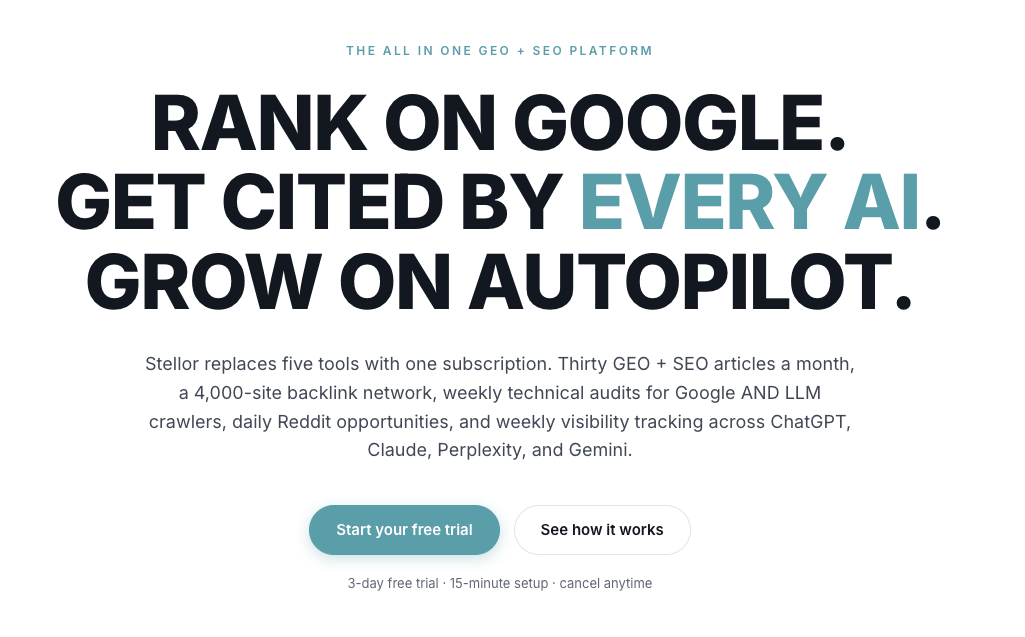
Stellor is built specifically for this situation. For $199 per month, you get 30 SEO and GEO (generative engine optimization) articles published to your CMS monthly, access to a 4,000-site backlink network, weekly technical audits covering both Google and AI crawler requirements, daily Reddit opportunity surfacing in subreddits your buyers actually use, and weekly tracking of how your business appears in ChatGPT, Claude, Perplexity, and Gemini.
That replaces what would otherwise cost $3,600 to $13,500 per month across separate vendors. Stellor serves professional services firms and every other local service vertical. Start with a 3-day free trial, no credit card required. Explore everything available on the Stellor blog to see the depth of content and strategy support included.
Frequently asked questions
How important is my Google Business Profile for local Google rankings?
Your Google Business Profile is critical for local rankings because local results rely on relevance, distance, and prominence, all of which a complete and accurate GBP directly influences. An incomplete profile leaves ranking signals on the table that your competitors are likely capturing.
What is the fastest way to get new pages indexed by Google?
Using Google Search Console’s URL Inspection tool to request indexing immediately after publishing is the most reliable fast-track method. Combining that with an updated sitemap submission gives Google two clear signals to crawl your new content.
Can I improve rankings by just focusing on backlinks?
Backlinks help only when your page is well-structured and relevant to the searcher’s query. Links alone won’t rank a weak or thin page, but strong content supported by quality backlinks consistently outperforms content with no link signals.
Why should I focus on search intent rather than exact keywords?
Google prioritizes content that answers what the user actually wants, not just pages that repeat a keyword phrase. Matching user intent drives better rankings and keeps visitors on the page longer, which reinforces those rankings over time.
How often should I update my website content to maintain rankings?
Review and refresh your key service pages every 6 to 12 months to keep content accurate and current. Fresh, accurate content is a ranking signal Google explicitly values, and outdated information tends to lose positions gradually to competitors who update more regularly.