

TL;DR:
- Ranking well in Google’s organic search results is essential for AI Overview appearances.
- Author attribution with full credentials significantly increases chances of being cited in AI-generated summaries.
Getting cited in AI Overviews means ranking well in Google’s core organic search results and formatting your content so AI systems can extract direct answers easily. AI Overviews trigger on approximately 13% of US Google search queries as of Q2 2026, processing 1.2 billion queries globally every day. That scale makes AI Overview participation one of the most valuable visibility channels a business can pursue right now. The good news is that how to get on AI Overviews follows the same fundamentals as strong SEO, with a few critical additions around content structure, author credibility, and technical readiness.
How to get on AI Overviews: what you need to know first
Google’s AI Overviews are AI-generated summaries that appear at the top of search results for qualifying queries. Google’s official guidance confirms that no unique AI algorithm or additional optimization beyond core quality and ranking systems is required to appear in them. Ranking well in normal Search is the prerequisite. That means your path to AI Overview participation runs directly through your existing SEO performance.
The system works through a process called retrieval-augmented generation combined with query fan-out. Google’s AI Overview selection pulls from multiple subtopic-relevant pages to synthesize a holistic answer. Complex queries trigger several related sub-queries searched in parallel. Modern AI Overviews synthesize data from 3–8 distinct source pages, which means your content competes with several other sources every time an Overview appears. Consistent quality across your full site matters more than perfecting a single page.
Understanding this architecture changes how you approach content. You are not trying to game a separate AI system. You are building a site that Google already trusts, then making sure your content is formatted for easy extraction.
What technical foundations must be in place first?
Your pages must be crawlable, indexable, and snippet-eligible before any content strategy matters. Pages with noindex or nosnippet tags are blocked from AI Overview eligibility entirely. Google explicitly states that pages must be snippet-eligible to be cited. Run a full technical SEO audit before investing in content improvements.
Beyond crawlability, these technical factors directly affect your eligibility:
- Page speed and Core Web Vitals. Slow pages rank lower. Lower rankings mean lower AI Overview eligibility.
- Semantic HTML structure. Use proper heading hierarchy (H1, H2, H3) so AI systems can parse your content accurately.
- Schema markup. Schema markup using Article, FAQ, and HowTo types increases eligibility for AI Overview inclusion. Pages without schema are significantly less likely to appear.
- Author attribution. Author attribution with name, bio, and linked credentials increases AI Overview citation likelihood by 4x as of march 2026. This is one of the highest-impact changes you can make today.
- Mobile responsiveness. Google indexes mobile-first. A site that breaks on mobile loses ranking signals across the board.
Two tactics you can skip entirely: custom llms.txt files and forced content chunking. No custom machine-readable files like llms.txt are needed to appear in AI Overviews. Existing SEO practices are sufficient. Splitting articles into tiny fragments also hurts more than it helps. Well-structured, comprehensive content is what Google’s systems prefer.
Pro Tip: Add a dedicated author bio page for each content contributor on your site. Link every article to its author’s bio. This single change can multiply your citation rate more than any content tweak.
How do you structure content for AI extraction?
Content structure is where most businesses lose their AI Overview citations. AI systems need to lift a precise, self-contained answer from your page without reading the entire article. If your answer is buried under three paragraphs of context, it will not get cited.
Follow these steps to structure every major section for extraction:
- Open each section with a 50–70 word standalone answer. Placing a direct answer within the first 50–70 words of a section improves an AI system’s ability to extract and cite it. Write the answer as if someone asked the question and you had 20 seconds to respond.
- Use question-format H2 headings. Mirror the natural language queries your audience types. “How do I fix a leaking pipe?” outperforms “Pipe Repair Overview” every time.
- Support every claim with specific data. Include units, dates, and source references. Vague claims are not quotable. Specific, verifiable facts are.
- Use short paragraphs, bullet points, and tables. Dense walls of text reduce extractability. Break information into scannable units.
- Build content clusters around your core topics. Content clusters covering a main topic and its subtopics increase the likelihood of citations across multiple AI Overview fan-out queries by more than 160%. One strong pillar page supported by five to ten related articles outperforms ten disconnected pages every time.
Here is how different content approaches compare for AI Overview eligibility:
| Content approach | AI extractability | Citation likelihood |
|---|---|---|
| Direct answer in first 70 words | High | Strong |
| Answer buried after long intro | Low | Weak |
| Vague, unsupported claims | Very low | Very weak |
| Specific data with source references | High | Strong |
| Comprehensive topic cluster | High | Very strong |
| Single isolated page, no internal links | Medium | Weak |
Pro Tip: Write your opening paragraph as if it will appear as a standalone quote in a Google result. If it reads clearly without any surrounding context, it is ready for AI extraction.

Covering related subtopics matters as much as the main answer. AI Overviews increasingly favor original, first-hand content with unique insights. Commodity content that recycles information from other sources gets excluded. Your content needs a perspective, a data point, or an example that readers cannot find on the next page.
For local service businesses, this means writing about your specific market, your actual process, and your real results. A plumber in Denver writing about Denver water pressure issues will outperform a generic plumbing guide every time. Pair this with a strong local SEO foundation and your content becomes both rankable and citable.
How do you monitor your AI Overview presence?
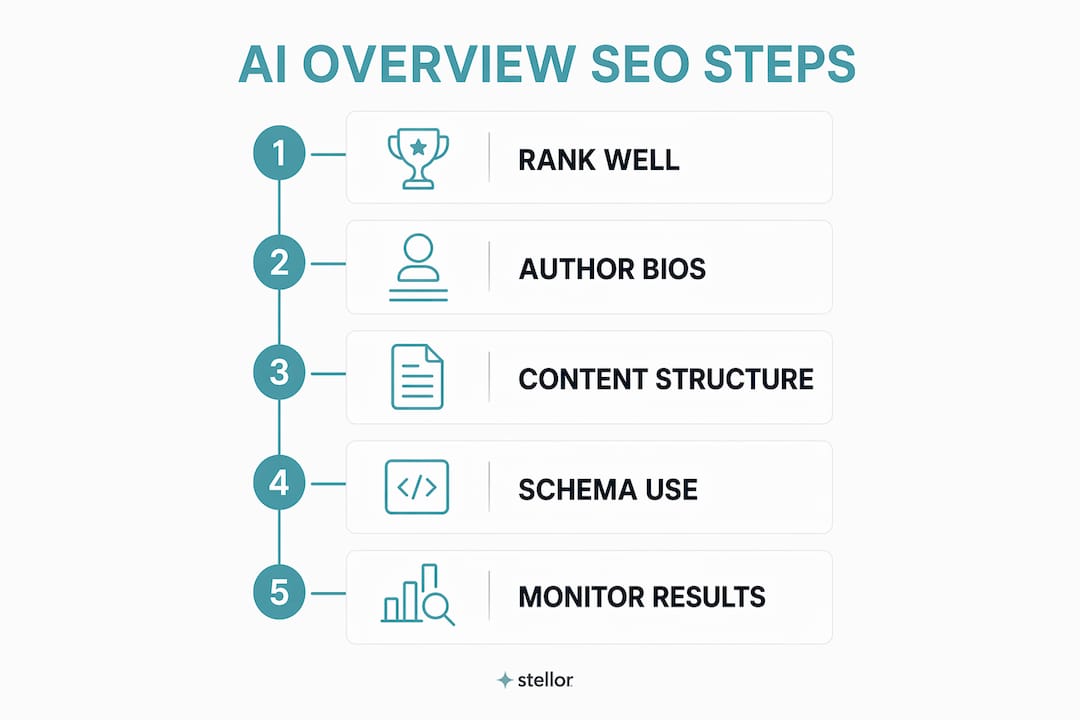
You cannot improve what you do not measure. Google Search Console now includes an AI Overview filter that shows impressions and clicks attributed to AI-generated summaries. Use it to identify which queries are triggering Overviews and whether your pages are appearing in them.
Build a monitoring routine around these actions:
- Filter Search Console by AI Overview impressions. Identify your top 20 queries that trigger Overviews. Check whether your pages rank in the top 10 for those queries.
- Find the gap between ranking and citation. If you rank on page one but are not cited in the Overview, your content structure is the problem. Rewrite the opening section with a direct standalone answer.
- Track brand mentions from AI sources. Set up Google Alerts for your brand name alongside terms like “recommended” or “cited.” This captures referral traffic patterns that Search Console may not fully attribute.
- Separate citation share from click data. An AI Overview citation may generate impressions without clicks, because the user gets their answer in the Overview itself. Track both metrics separately to understand your true visibility impact.
- Review your measurable SEO results monthly. Citation rates shift as Google updates its systems. Monthly reviews catch drops before they compound.
Prioritize rewriting the pages that already rank in positions 1–5 for Overview-triggering queries. These pages are closest to citation. A structural improvement to the opening section often moves a page from “ranked but not cited” to “cited” within weeks.
Common mistakes that block AI Overview citations
Most businesses that fail to get cited make the same avoidable errors. Recognizing them early saves months of wasted effort.
- Burying the answer. Opening with company history, background context, or a definition of the problem before answering the question is the single most common mistake. AI systems scan for the answer, not the setup.
- Vague or unsupported claims. “We provide excellent service” is not citable. “Our response time averages under two hours” is. Every claim needs a number, a source, or a specific example.
- Blocking crawlers accidentally. A misconfigured
robots.txtfile or a staging environment setting left on a live page can silently exclude your entire site from AI Overview eligibility. - Skipping schema markup. Pages without Article, FAQ, or HowTo schema are at a significant disadvantage. Schema is not optional for businesses serious about AI visibility.
- Publishing recycled content. Paraphrasing competitor articles produces commodity content. AI Overviews favor original, first-hand content with unique insights. Recycled content is typically excluded.
- Ignoring author attribution. A byline with no bio, no credentials, and no linked profile signals low authority. Add full author information to every published page.
Pro Tip: Run your top five pages through Google’s Rich Results Test at search.google.com/test/rich-results. If schema errors appear, fix them before any other content work. Broken schema silently suppresses eligibility.
For home services businesses, structured answers to common service questions also improve your chances of appearing in AI Overviews for local queries. A practical SEO guide for fitted carpentry demonstrates how structuring answers around specific trade questions increases citation potential, a model that applies across any service category.
Key Takeaways
Getting cited in AI Overviews requires strong organic rankings, technically sound pages, and content structured with direct answers that AI systems can extract without context.
| Point | Details |
|---|---|
| Organic ranking is the prerequisite | Pages must rank well in Google Search before they can appear in AI Overviews. |
| Author attribution multiplies citations | Adding name, bio, and linked credentials increases citation likelihood by 4x. |
| Direct answers must come first | Place a standalone 50–70 word answer at the start of each section for AI extraction. |
| Schema markup reduces exclusion risk | Article, FAQ, and HowTo schema significantly improve eligibility for AI Overview inclusion. |
| Content clusters compound citation rates | Covering a topic and its subtopics increases fan-out query citations by more than 160%. |
What I have learned after watching hundreds of sites chase AI Overviews
The businesses that get cited fastest are not the ones obsessing over AI-specific tactics. They are the ones that fixed their SEO fundamentals first and then made one structural change: they put the answer at the top.
What surprises most marketers is how little the AI-specific layer actually requires. There is no secret submission process, no special file to upload, no API to connect. The path to AI Overview participation runs through the same work that has always driven search visibility: authoritative content, clean technical infrastructure, and genuine topical depth. The businesses that treat AI Overviews as a separate channel to “hack” consistently underperform the ones that treat it as a natural extension of good SEO.
Author attribution is the one area where I have seen the biggest gap between what businesses know and what they actually do. Most sites still publish articles with no author name, no bio, and no linked credentials. That is a direct citation penalty. A four-times improvement in citation likelihood is not a marginal gain. It is the difference between appearing in Overviews regularly and almost never appearing at all.
The other underrated factor is original experience. AI systems are getting better at identifying content that adds nothing new. If your article covers the same ground as the top three results with no unique data, no first-hand example, and no specific insight, it will not get cited. Write from what you actually know. That is what makes content quotable.
Track your AI Overview impressions in Search Console every month. The data is there. Most businesses are not looking at it. The ones that do find opportunities their competitors are missing.
— Cole
Trystellor handles the heavy lifting for AI Overview visibility
Getting cited in AI Overviews requires consistent content output, clean technical infrastructure, and weekly monitoring across multiple AI platforms. Most businesses do not have the bandwidth to manage all three simultaneously.
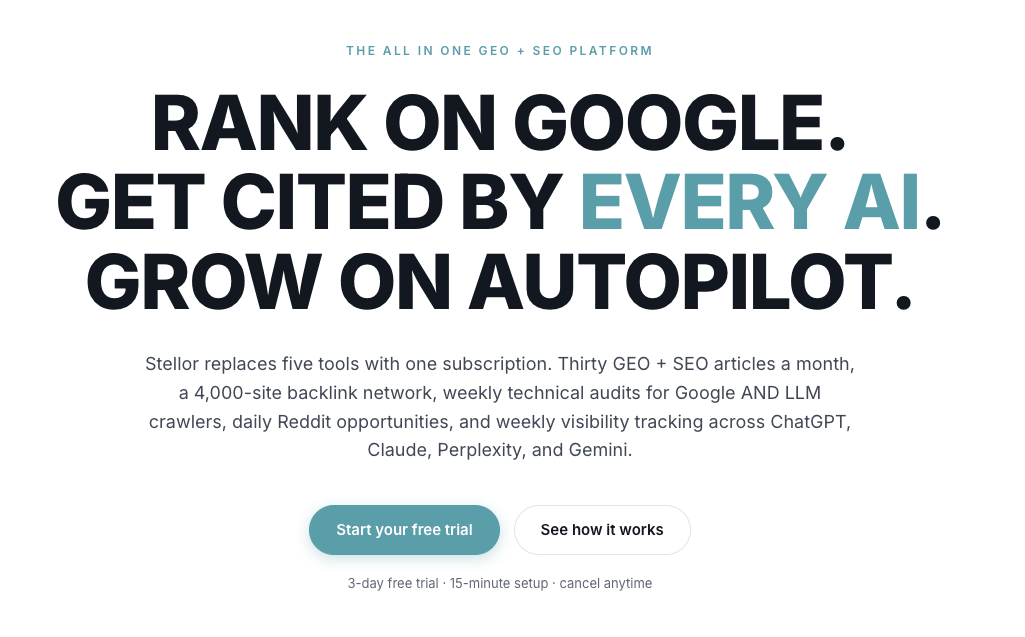
Trystellor is a GEO and SEO platform built to do exactly that. It publishes 30 schema-optimized articles to your site every month, runs weekly technical audits across 11 ranking factors, and tracks your citation status across ChatGPT, Claude, Perplexity, and Gemini every week. The 4,000-site backlink network builds the authority signals that make your content eligible in the first place. A free AI Visibility Audit, delivered within 48 hours of signup, shows exactly which queries you should be winning and which competitors are taking your citations. No credit card required for the three-day trial.
FAQ
What is an AI Overview in Google Search?
An AI Overview is a Google-generated summary that appears above organic results for qualifying queries. It synthesizes answers from 3–8 source pages using retrieval-augmented generation.
Do I need to submit my site to appear in AI Overviews?
No submission process exists. Pages that rank well in Google’s core organic results and meet snippet-eligibility requirements are automatically considered for AI Overview citations.
Does schema markup guarantee an AI Overview citation?
Schema markup increases eligibility but does not guarantee citation. Pages using Article, FAQ, or HowTo schema are significantly more likely to appear than pages without it.
How does author attribution affect AI Overview citations?
Author attribution with a name, bio, and linked credentials increases AI Overview citation likelihood by 4x. Sites without explicit author information experience significantly lower citation rates.
How do I track whether my pages appear in AI Overviews?
Use the AI Overview filter in Google Search Console to monitor impressions and clicks attributed to AI-generated summaries. Review which queries trigger Overviews and whether your ranked pages are being cited.