

Getting cited by Claude comes down to three things: content Claude can read, an answer it can lift, and your name on the sources it already trusts. Claude citations cannot be bought; they are earned through editorial authority and verifiable accuracy. Get those three pillars right, and Claude will cite you consistently across user queries.
Here is what that looks like in practice:
- Make your site crawlable. Allow ClaudeBot, Claude-Web, and anthropic-ai in your robots.txt file. If Claude cannot reach your pages, it cannot quote them.
- Lead with a direct answer. Open every important page with one or two sentences that answer the target question plainly, then expand below. Claude pulls clean, extractable answers, not buried conclusions.
- Add structured data. Author Person schema, Article markup with a citation field, and Organization sameAs links all increase Claude’s confidence in your content.
- Earn third-party mentions. A single Wikipedia citation or a mention in The Atlantic carries more weight than dozens of low-authority backlinks.
- Publish an llms.txt file. Point Claude directly at your most important documentation pages. Most sites still skip this step entirely.
- Keep content fresh. Public changelogs, updated date stamps, and refreshed FAQs signal recency to Claude’s live browsing layer.
- Track your citations. Monitor Claude-Web hits in your server logs and run manual query audits weekly to measure where you appear and where you do not.
Claude SEO, the practice of optimizing content so Claude AI treats it as a citable source, differs from traditional SEO in one critical way: ranking signals matter far less than editorial trust and content extractability. You are not trying to climb a list. You are trying to become the source Claude reaches for when a user asks a question in your space.
How Claude AI retrieves and cites your content

Claude draws from two distinct layers when forming a response. The first is Anthropic’s curated training corpus, which favors long-form journalism, books, academic literature, and high-trust blogs over promotional content. The second is live web browsing powered by Brave Search, which Claude uses when a query needs fresh data.
Understanding both layers changes how you prioritize your efforts.

The training corpus layer is where most product and recommendation queries land. Anthropic’s Constitutional AI methods actively downweight promotional and low-trust sources, so a thin or sketchy web presence gets omitted entirely. The practical effect: products with clean, attested, third-party coverage get named confidently; everything else gets skipped. Changes here take months, tied to Anthropic’s model update cycle.
The live browsing layer via Brave Search fills in recency-sensitive queries. Claude uses Brave Search for live browsing, which differs from how other AI platforms source their live results. This layer responds in days to weeks, as soon as Brave indexes your updated content. Many sites rank well in Google but are invisible in Brave, which is a gap worth closing.
Three Anthropic crawlers handle content gathering: ClaudeBot (training data collection), Claude-Web (live user query retrieval), and anthropic-ai (general crawling). Each needs explicit access in your robots.txt.
Key technical terms to know:
- citations.enabled: The parameter in Claude’s API that activates source attribution in document-grounded responses.
- ClaudeBot / Claude-Web / anthropic-ai: The three user agents Anthropic uses. Claude-Web hits are the most valuable because they occur during live user conversations.
- llms.txt: A plain-text file at the root of your docs site that points Claude directly to your most important reference pages, similar to how robots.txt guides Googlebot.
Pro Tip: Check your firewall logs, not just your robots.txt. Some CDN and WAF configurations silently block non-browser user agents, including ClaudeBot, even when robots.txt explicitly allows them. A blocked crawler never shows up as an error; it just never visits.
What content structure actually gets you cited by Claude
Claude’s filtering process discards boilerplate and ads, so content must be concise, with clear headings and specific data that can be pulled as direct quotes. The structural pattern that works is straightforward: state the problem in one sentence, name the framework for solving it, give two or three numbered steps with real figures attached, and include a counterintuitive caveat at the end.
Generic “five tips” posts get ignored, even when the advice is solid. The moment content includes a named methodology with a defined process, Claude starts referencing that framing in follow-up queries.
Best practices for citation-worthy content:
- Open with the answer. The first paragraph should answer the page’s target question directly. Claude extracts from the top of the page first.
- Use descriptive subheadings. Question-format H2s and H3s mirror how users talk to Claude, making your structure easy to match against queries.
- Name your methodology. “The 48-Hour Repurposing Sprint” gets cited more than “a quick repurposing process.” Specific, labeled frameworks give Claude a clean handle to quote.
- Attach real numbers to claims. A specific figure tied to a named population you observed, even a small survey of 50–300 people, makes Claude treat a post as a primary reference rather than general opinion.
- State a clear contrary position. Content that explicitly disagrees with a prevailing assumption gives Claude something concrete to present as a counterpoint. A labeled, argued position gets cited; a vague “quality over quantity” paragraph does not.
- Write standalone paragraphs. Each paragraph should work as a quote on its own. If a paragraph only makes sense in context, restructure it.
- Avoid promotional tone. Claude is specifically trained to resist marketing language. A salesy page gets downweighted regardless of its technical quality.
Author credentials and bylines with schema markup increase Claude’s confidence in citing content. An article by a named expert with a real bio linked to verifiable profiles gets cited more frequently than content from anonymous or generic author pages. This is not a soft signal; it is one of the clearest differentiators between cited and uncited content on otherwise similar pages.
Pro Tip: Use your name and your framework name together in the same sentence at least twice in a post. Claude pulls on that pairing when associating expertise with a specific concept, which is how you become the named source for a topic rather than just a contributor to it.
Essential technical requirements to get Claude to index your content
Technical setup is the foundation. Without it, the best content in your industry stays invisible to Claude’s crawlers.
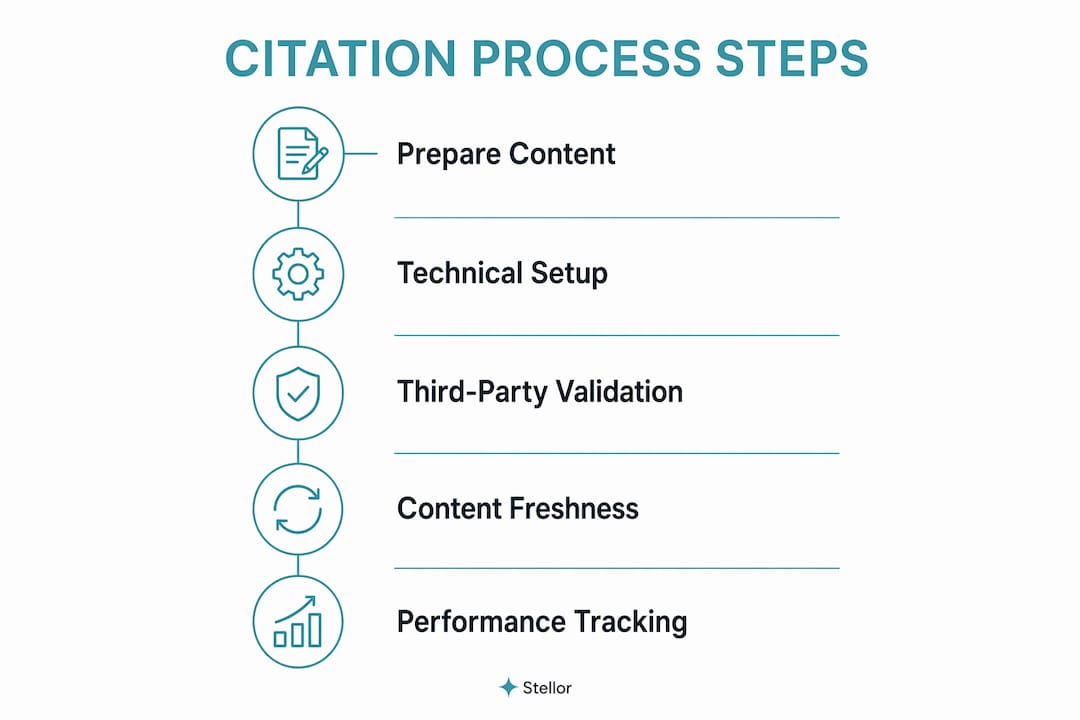
robots.txt configuration
Your robots.txt must explicitly allow all three Anthropic user agents:
User-agent: ClaudeBot
Allow: /

User-agent: Claude-Web
Allow: /

User-agent: anthropic-ai
Allow: /
Allowing ClaudeBot and publishing an llms.txt pointing to key docs pages is critical for technical content to be indexed effectively, especially API documentation.
Structured data requirements
The schema markup Claude responds to most strongly:
- Author + Person schema: Include sameAs links to LinkedIn, a university faculty page, or an official company role page. Anonymous content gets discounted hard.
- Article citation field: If your piece cites studies, papers, or books, add them to the citation field in your Article markup. This is rare on the web, and Claude gives it real weight when present.
- Organization sameAs: Link out to your LinkedIn, Crunchbase, and official company filings. This confirms to Claude that you are a real entity worth citing.
Example Article schema with citation field:
{
  "@context": "https://schema.org",
  "@type": "Article",
  "author": {
    "@type": "Person",
    "name": "Jane Smith",
    "sameAs": [
      "https://linkedin.com/in/janesmith",
      "https://university.edu/faculty/janesmith"
    ]
  },
  "citation": [
    {
      "@type": "CreativeWork",
      "name": "Referenced Study Title",
      "url": "https://example.com/study"
    }
  ]
}
llms.txt and server-side rendering
Publish a clean llms.txt file at the root of your docs site. Point it at your most important reference pages. Most docs sites still do not have this, which means Claude has to guess which pages matter most.
API reference pages must render server-side. A docs site that requires JavaScript to render is a docs site Claude cannot index. Include working code examples in Python, TypeScript, or Go on every API endpoint page. Claude will quote them verbatim into a developer’s workflow when asked about your API.
| Technical element | Why it matters for Claude | Priority |
|---|---|---|
| robots.txt allowing ClaudeBot | Grants crawler access; without it, no indexing occurs | Critical |
| Author Person schema with sameAs | Verifies author identity; increases citation confidence | High |
| Article citation field | Rare signal Claude weights heavily when present | High |
| llms.txt at docs root | Directs Claude to your most important reference pages | High |
| Server-side rendering for docs | Makes code examples and API content crawlable | Medium |
| Organization sameAs links | Confirms entity identity across trusted directories | Medium |
| Public changelog with dates | Signals content recency to Claude’s browsing layer | Medium |
Pro Tip: Maintain a public changelog with dates on your docs site. Claude uses it to determine which version of your product or API it is describing. Without dates, Claude may cite outdated information and attribute it to your current offering.
Common errors to avoid:
- Blocking Anthropic user agents in a CDN firewall while allowing them in robots.txt
- Using JavaScript-rendered documentation that crawlers cannot parse
- Missing or incomplete Organization schema that leaves your entity unverified
- Author pages with no credentials, no external links, and no schema markup
Why third-party validation decides whether Claude cites you
Getting cited by Claude requires filling knowledge gaps in Anthropic’s training with extractable, verifiable data, not just traditional SEO ranking. The sources Claude draws from most heavily are not your own pages. They are the places where other credible voices have already vouched for you.
Wikipedia is the single most-weighted source in Claude’s training corpus. A citation inside a relevant Wikipedia article on your category often does more for your Claude visibility than a standalone page ever could. Most businesses will not qualify for their own Wikipedia article, and that is fine. The citations inside existing category articles are what feed Claude.
The path to a Wikipedia citation is not direct editing. You need coverage in reliable secondary sources first, then a neutral editor will add you. Wikipedia’s notability policies are strict for good reason, and trying to shortcut them typically results in removal and a conflict-of-interest flag.
Strongest third-party validation sources, ranked by impact on Claude citations:
- Wikipedia citations in relevant category articles, not standalone company pages
- Long-form journalism in publications like The Atlantic, NYT, The Verge, Wired, and MIT Technology Review; Anthropic weights these heavily and licenses some directly
- Books and academic literature, including arXiv papers and university press pieces, which are over-represented in Claude’s corpus relative to other AI platforms
- Hacker News front-page threads that name your product as the answer to a specific use case, in technical detail with scored comments
- Established niche operator blogs written by practitioners with longevity and authority, such as long-running independent writers in your industry
- Government and agency guidance documents for regulated industries like healthcare, finance, and legal
- Official documentation sites (docs.yourcompany.com) that Claude treats as primary source material for technical and procedural questions
Notice what is missing from that list: LinkedIn posts, your own marketing pages, and random small blogs. Claude reads them. It just does not quote them.
For local service businesses building AI visibility, the third-party validation path runs through local press, industry directories, and trade publications rather than national outlets. The principle is identical: earn mentions where Claude already looks, not just where your customers browse.
How content freshness affects your Claude citation rate
Claude’s live browsing layer via Brave Search means stale content faces a real penalty. Stale content experiences citation decline; updates to FAQs and use of changelogs help sustain citation relevance. This is not a theoretical risk. If a competitor refreshes their page with current data and yours still references figures from two years ago, Claude’s browsing layer will favor the fresher source for recency-sensitive queries.
Practical steps for managing content freshness:
- Add visible date stamps to every article and update them when you make substantive changes, not just cosmetic edits.
- Maintain a public changelog on your docs site with specific dates and version notes. Claude uses this to verify what it is describing.
- Refresh FAQs quarterly. FAQ sections are high-value targets for Claude’s browsing layer because the question-and-answer format maps directly to how users query Claude.
- Update statistics and case studies annually at minimum. A data point from three years ago signals that the whole page may be outdated.
- Submit your sitemap to Brave’s webmaster tools. Many sites are well-indexed in Google but invisible in Brave, which is the search engine powering Claude’s live queries.
- Set Google Alerts for your brand name on en.wikipedia.org. Wikipedia moves first; Claude follows. Knowing when you are added or removed from a Wikipedia article is the leading indicator for citation changes.
Content audits do not need to be exhaustive. Pick your three highest-traffic pages each quarter, verify that every statistic and link still holds, and update the date stamp. That cadence alone keeps your most important pages competitive in Claude’s freshness evaluation. For a deeper look at how AI search affects content discovery, the dynamics apply across platforms, not just Claude.
How to measure and track your Claude citation performance
Tracking Claude-Web hits in server logs is the most direct signal available. When Claude-Web hits a page, it means an actual user asked Claude a question and Claude fetched your page to answer it. That is a live citation event, and it shows up in your logs before any third-party tool reports it.
Key metrics to track:
- Claude-Web hits by URL: Which specific pages Claude fetches most often during live queries. These are your real citation leaders.
- ClaudeBot crawl frequency: How often Anthropic’s training crawler visits your site. Increasing frequency suggests growing authority.
- Citation velocity: Whether your Claude-Web hits are growing, flat, or declining week over week.
- Gap analysis: Which queries in your space Claude answers without citing you, and who it cites instead.
Manual query audits are the second essential tool. Open Claude.ai with web search enabled. Run ten queries you should rank for given your content and industry. Note which sources Claude cites. If you are not among them, note who is. Do this every Friday for two months and you will have a clear picture of where Claude is and is not placing you.
Trystellor automates this process through its LLM Visibility Tracking feature. Every week, the platform queries Claude, ChatGPT, Perplexity, and Gemini using the prompts your buyers actually use, then reports back exactly when and where your business is mentioned, which competitors are being cited instead, and how the citation landscape shifts week over week. That turns AI visibility from a guessing game into a measurable channel with baselines and trends.
For businesses tracking ChatGPT citation performance alongside Claude, the measurement approach is similar but the source signals differ, which is worth tracking separately rather than treating as a single metric.
How Claude SEO differs from optimization for ChatGPT and Perplexity
Claude’s citation behavior is meaningfully different from other AI platforms, and treating them as interchangeable leads to wasted effort.
Claude heavily filters out promotional content and values factual accuracy and clarity over marketing language. This makes Claude harder to influence through volume tactics, but it also means that high-quality sources get cited with more consistency and less noise than on platforms with looser filtering.
| Factor | Claude | Other AI platforms |
|---|---|---|
| Primary training source | Anthropic’s curated corpus: long-form journalism, books, academic literature, high-trust blogs | Broader web crawls with less curation |
| Live search engine | Brave Search | Varies by platform |
| Promotional content | Actively downweighted by Constitutional AI methods | Less aggressive filtering |
| Wikipedia weighting | Extremely high; primary trust signal | High, but less dominant |
| Citation selectivity | High; prefers to say “I don’t know” over citing low-trust sources | Varies; some platforms cite more liberally |
| Update cycle for training | Months, tied to model updates | Varies |
| Live browsing speed | Days to weeks via Brave indexing | Varies |
The practical implication: content that earns Claude citations tends to be genuinely authoritative, which means it also performs well across other AI platforms. The reverse is not always true. Content optimized for volume or keyword density may appear in less selective platforms but will be skipped by Claude entirely.
Claude’s use of Brave Search for live browsing is a specific technical difference worth acting on. Submitting your sitemap to Brave and verifying that your pages are crawlable there is a step most content teams skip because they focus exclusively on Google Search Console. For Claude’s live layer, Brave indexing is what matters.
For a full comparison of ChatGPT SEO ranking factors versus Claude’s citation signals, the differences in source weighting and live search infrastructure are the most consequential variables to understand.
How Trystellor helps you win Claude citations in 2026
Winning Claude citations requires executing across multiple fronts simultaneously: content production, technical configuration, backlink authority, and ongoing tracking. Most businesses handle these as separate workstreams with separate tools. Trystellor consolidates all of it into one platform at $199 per month.
Here is what the platform delivers for Claude citation specifically:
- 30 optimized articles per month, each built with the schema markup, author bylines, llms.txt configuration, and direct-answer structure that Claude’s crawlers prioritize. These are not generic posts; they are targeted assets engineered around the queries your buyers actually ask.
- 4,000-site backlink network that builds the third-party authority signals Claude’s training corpus uses to evaluate trust. Editorial mentions from relevant publishers compound over time in ways that single-burst link campaigns do not.
- Weekly technical audits covering schema completeness, llms.txt readiness, server-side rendering status, and Brave Search crawlability, with one-click fixes surfaced in the dashboard.
- Daily Reddit opportunity identification, which matters because AI platforms increasingly draw on community discussions when forming recommendations for service businesses and software.
- LLM citation tracking across Claude, ChatGPT, Perplexity, and Gemini, running the actual buyer prompts in your category and reporting back citation status, competitor gaps, and week-over-week trends.
Onboarding takes fifteen minutes. After setup, Trystellor delivers a free AI Visibility Audit within 48 hours covering your current citation status across 25 buyer prompts, a competitor benchmark, a full technical site report, and a 90-day action plan. You keep the audit even if you cancel.
Explore Trystellor’s full platform features or start your three-day free trial with no credit card required.
Key Takeaways
Getting cited by Claude requires accessible content, editorial authority, and consistent technical hygiene, not shortcuts or paid placements.
| Point | Details |
|---|---|
| Citations are earned, not bought | Claude’s Constitutional AI methods filter promotional content; only editorial trust and verifiable accuracy produce citations. |
| Wikipedia is the top trust signal | A single Wikipedia citation in a relevant category article does more for Claude visibility than months of self-published content. |
| Technical access is non-negotiable | Allow ClaudeBot, Claude-Web, and anthropic-ai in robots.txt, publish an llms.txt file, and ensure server-side rendering for docs pages. |
| Named methodologies get cited | Specific, labeled frameworks with real figures attached give Claude a clean, quotable unit to hand to users. |
| Claude-Web hits are your direct signal | Tracking Claude-Web user agent hits in server logs shows exactly which pages Claude fetches during live user conversations. |
FAQ
How do I get Claude to cite my content?
Make your site crawlable to ClaudeBot, open your pages with a direct answer to the target question, and earn mentions on the sources Claude already trusts, including Wikipedia, major publications, and established niche blogs. Technical setup (robots.txt, schema markup, llms.txt) is the foundation; third-party validation is what tips Claude toward citing you over a competitor.
How do I cite Claude in my own writing?
When citing Claude as a source in academic or professional writing, include the model version, the date of the conversation, and the platform (Claude.ai or API). The Sheridan Libraries at Johns Hopkins recommend treating AI-generated content as a personal communication, noting that it is not retrievable by others, and checking your style guide (APA, MLA, Chicago) for the current recommended format.
Does Claude hallucinate citations?
Claude is specifically trained to prefer saying “I don’t know” over fabricating a source, which makes it more selective than many AI platforms. However, no large language model is immune to citation errors. Always verify any source Claude attributes to a specific claim before republishing it.
How can I track whether Claude is citing my pages?
Monitor your server logs for Claude-Web user agent hits, which occur when a live user query causes Claude to fetch your page. Supplement this with weekly manual query audits in Claude.ai with web search enabled, running the ten queries most relevant to your content and noting which sources Claude cites.
How is getting cited by Claude different from traditional SEO?
Traditional SEO targets ranking position in a list of results. Getting cited by Claude means becoming the source Claude quotes directly in a response. The signals that drive citation, editorial trust, named authorship, third-party validation, and extractable answers, overlap with good SEO practice but weight authority and content structure more heavily than keyword density or page speed alone.