

TL;DR:
- SEO pricing includes monthly retainers, hourly consulting, and project-based fees, with costs varying by scope and industry. Results typically take six to twelve months to materialize, requiring budgeting for tools, implementation, and sustained effort. Clarity on scope and actual costs is essential, and platforms like Trystellor offer simplified all-in-one subscriptions for smaller businesses.
SEO pricing is defined by three core models: monthly retainers, hourly consulting, and project-based fees. Monthly retainers typically run $500–$7,500 for most businesses, while average SEO projects cost around $3,199 per month based on 2026 Clutch marketplace data. Tools like Semrush, Ahrefs, and BrightLocal add another $100–$500 monthly on top of agency fees. Results take 6–12 months to materialize, so your budget needs to hold for at least two quarters before you judge performance. Platforms like Trystellor bundle content, backlinks, audits, and AI visibility tracking into one subscription starting at $199 per month, which changes the math considerably for small and mid-size businesses.
How much does SEO cost across different pricing models?
SEO service pricing falls into three distinct structures, and each one suits a different business situation. Understanding which model fits your needs prevents you from overpaying for flexibility you do not need or locking into a scope that does not cover your goals.
| Pricing model | Typical range | Best for | What’s usually included |
|---|---|---|---|
| Monthly retainer | $500–$7,500/mo | Ongoing growth | Strategy, content, reporting, link building |
| Hourly consulting | $50–$200+/hr | Audits, ad hoc support | Specific recommendations, reviews |
| Project-based | $1,000–$30,000 | Site migrations, one-time audits | Defined deliverables, fixed timeline |
| High-end hourly | $250–$400/hr | Enterprise consulting | Deep technical or strategic work |
Monthly retainers are the most common structure for businesses running ongoing SEO campaigns. They cover continuous strategy, content production, reporting, and execution. The tradeoff is that you pay whether the month is productive or not, so vetting the agency’s deliverables upfront is critical.
Hourly pricing works well for one-time audits or consulting sessions where you need expert input without a long-term commitment. Freelance SEO rates average around $21 per hour on platforms like Upwork, while established agencies charge $50–$200 or more depending on expertise. For project-based or enterprise-level consulting, high-end hourly rates reach $250–$400 per hour.
Project-based pricing suits defined scopes: a technical audit, a site migration, or a one-time content strategy build. You get a fixed price for a fixed output. The risk is scope creep if the deliverables are not spelled out clearly in the contract.
Pro Tip: Always request a line-item breakdown of what the retainer covers. Agencies that bundle everything into a single monthly fee often exclude content writing, developer tickets, and tool subscriptions. Those add-ons can push your real monthly cost 20–30% higher than the quoted retainer.
What factors drive the cost of SEO services?
The cost of SEO services is not arbitrary. It reflects real variables in your business situation, your market, and the scope of work required to move the needle.
-
Industry competitiveness. A personal injury law firm in Los Angeles competes against hundreds of well-funded websites. An HVAC company in a mid-size city faces far less competition. Competitive industries require more content, more backlinks, and more technical precision, which drives up cost.
-
Local vs. national scope. Local SEO packages often run $500–$4,000 per month, with per-location fees affecting total cost for multi-location businesses. National campaigns targeting broad keywords require significantly more investment to rank against established domains.
-
Agency location and expertise. A boutique agency in New York charges more than a generalist firm in a smaller market. Specialized agencies with a track record in your industry command premium rates because their work converts faster.
-
What is actually included. Content creation, technical SEO, link building, and reporting are not always bundled together. Many agencies price these as separate line items. Clarifying inclusions upfront prevents unexpected billing for call tracking, paid search integration, or CMS access.
-
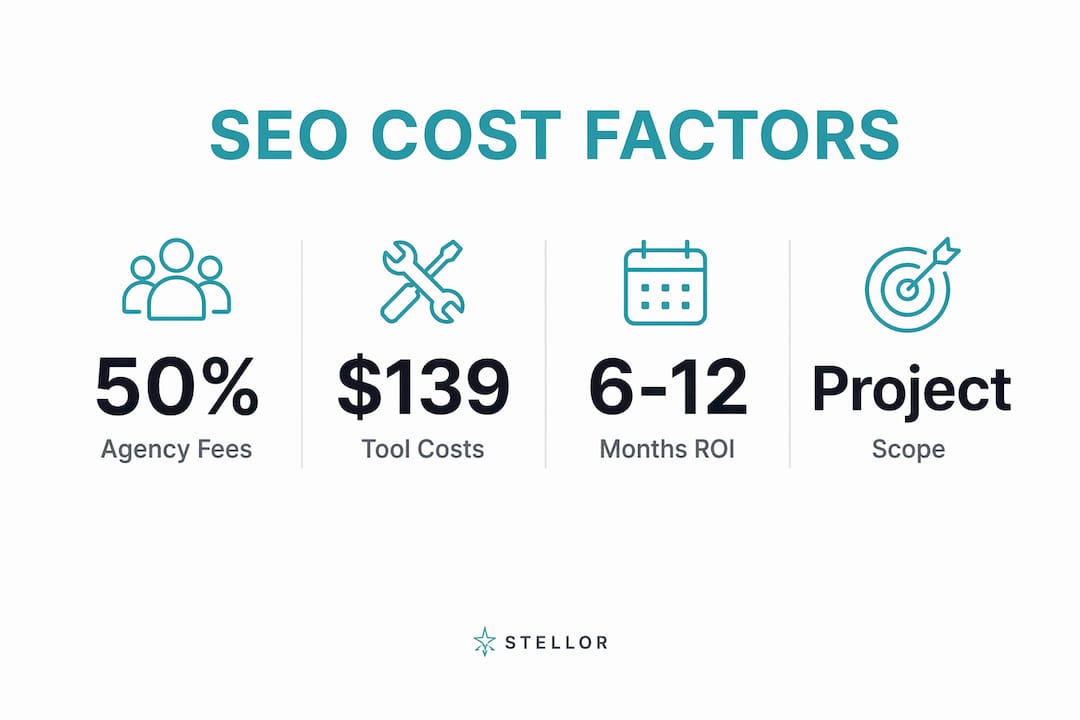
Tool subscriptions. Semrush costs $139.95 per month. Screaming Frog’s crawler license runs $23.25 per month. Google Search Console is free and indispensable for first-party performance data, but most agencies use paid tools on top of it. These costs are often passed to the client.
-
Developer time. Technical SEO recommendations require implementation. If your agency identifies site speed issues or schema errors, fixing them requires a developer. That labor is rarely included in the base retainer.
Pro Tip: Ask every vendor directly: “What is not included in this price?” The answer tells you more about the real cost than the quoted number does. A $2,000 retainer that excludes content, tools, and dev work can easily become a $4,000 monthly commitment.
What are the typical SEO price ranges by business size?
Real-world SEO budgets vary significantly based on business size, goals, and market. The table below reflects current market benchmarks for 2026.

| Business scenario | Monthly SEO budget | Notes |
|---|---|---|
| Small local business | $500–$3,000 | Local map pack focus, Google Business Profile optimization |
| Mid-size regional company | $3,000–$7,500 | Multi-location or broader keyword targets |
| National or competitive industry | $10,000+ | High-volume keywords, aggressive link building |
| Freelance hourly (Upwork) | $15–$35/hr | Basic tasks, lower complexity |
| Agency hourly | $50–$200+/hr | Strategy, audits, technical work |
A realistic monthly budget for a small local business looks like this: agency retainer at $1,500, Semrush at $139.95, and Screaming Frog at $23.25. That totals roughly $1,663 per month before any content writing or developer work. For a mid-size company, a $3,000 retainer plus tools and implementation can push the real monthly cost to $3,163 or more.
Small businesses with tight budgets often get better returns from specialized local SEO strategies than from broad national campaigns. BrightLocal, for example, starts at $39 per month with pay-as-you-go citation building, making it a practical entry point for single-location service businesses.
The key insight from Clutch’s 2026 data is that the median project cost sits near $3,000 per month. That number is useful as a sanity check when evaluating proposals. Quotes significantly below that median warrant scrutiny about what is being left out.
How long does it take to see ROI on your SEO investment?
SEO has a delayed payback timeline of 6–12 months, with the median break-even point around seven months. That timeline has direct implications for how you budget.
“SEO improvements can start appearing in 3–6 months, but major ranking gains and meaningful traffic increases typically require a full 6–12 months of consistent investment.” — SEO Sherpa, via Clutch.co
Here is what that timeline looks like in practice:
- Months 1–2: Technical fixes, content publishing, and baseline tracking. No visible ranking movement yet.
- Months 3–4: Early keyword movement on lower-competition terms. Organic impressions begin climbing in Google Search Console.
- Months 5–6: Traffic gains become measurable. Some target keywords reach page one.
- Months 7–12: Compounding returns. Significant SEO gains require budgeting for at least this full window.
The practical implication is straightforward. If you cannot commit to at least six months of consistent investment, SEO is not the right channel for your current budget. Many businesses underestimate this timeline and pull the plug at month three, right before results would have materialized. For a detailed breakdown of why this happens, the guide on why SEO results take time explains the mechanics clearly.
For local service businesses specifically, the timeline can compress when Google Business Profile optimization and local map pack rankings are prioritized. You can see measurable SEO results for local service businesses faster than national campaigns because the competition pool is smaller and the ranking signals are more direct.
Key Takeaways
The real cost of SEO is the sum of agency fees, tool subscriptions, and implementation time. Budgeting for only the retainer quote will leave you short.
| Point | Details |
|---|---|
| Monthly retainers dominate | Most businesses pay $500–$7,500/month; the 2026 median sits near $3,199. |
| Tools add real cost | Semrush, Screaming Frog, and BrightLocal can add $150–$500/month on top of agency fees. |
| ROI takes 6–12 months | Budget for at least two full quarters before evaluating SEO performance. |
| Scope clarity prevents surprises | Always request a line-item proposal specifying what is and is not included. |
| Local businesses have options | Specialized local SEO tools and packages often outperform national campaigns for smaller budgets. |
What I have learned from evaluating SEO proposals
After reviewing dozens of SEO proposals across industries, the single biggest mistake I see business owners make is comparing monthly retainer prices without comparing what those retainers actually cover. A $1,500 retainer that includes content, link building, and reporting is a fundamentally different product than a $1,500 retainer that covers strategy calls and a monthly PDF.
The second mistake is ignoring ownership. Ask every vendor directly whether you will retain access to your Google Search Console, Google Analytics, and CMS if you cancel. Some agencies build campaigns inside their own accounts, which means you lose all historical data the moment you stop paying. That is not a technicality. It is a structural risk to your business.
The third thing I have noticed is that businesses in competitive industries consistently underestimate the link building component. Content alone does not rank in 2026. You need a credible backlink profile, and building one through manual outreach or quality publishers costs real money. Agencies that promise top rankings without a clear link building plan are selling you something that does not work.
My honest recommendation: treat your SEO audit checklist as a pre-purchase tool. Run it before you sign any contract. It tells you exactly what your site needs, which makes it much harder for a vendor to pad a proposal with work you do not actually require.
— Cole
How Trystellor simplifies your SEO investment
Budgeting for SEO does not have to mean managing five separate vendor invoices every month.
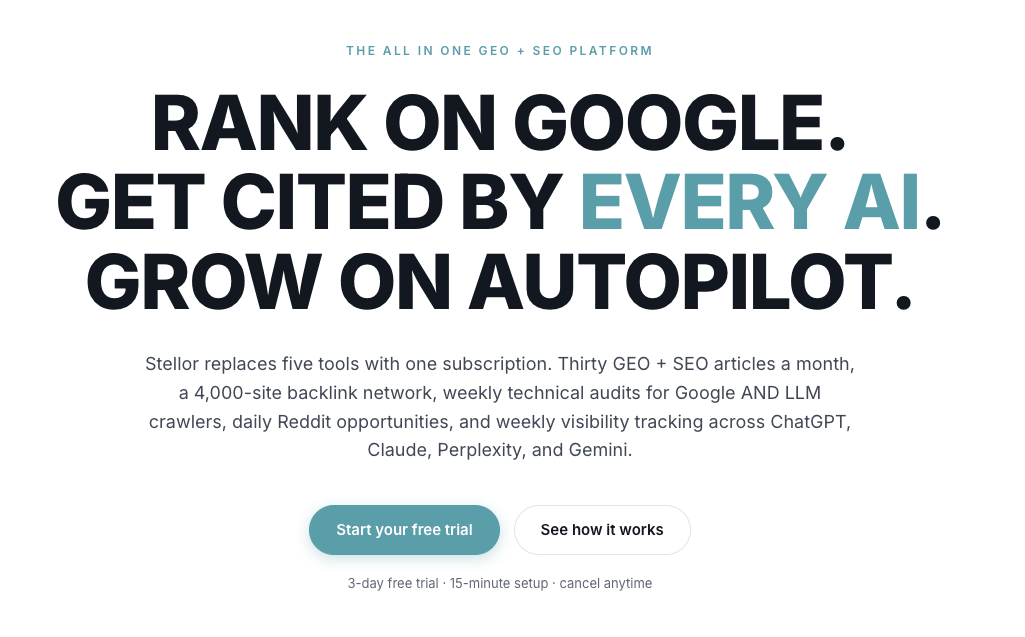
Trystellor replaces the agency retainer, the content tool, the backlink service, the technical auditor, and the AI visibility tracker with one subscription at $199 per month. You get 30 GEO and SEO-optimized articles published to your CMS monthly, a 4,000-site backlink network, weekly technical audits, daily Reddit opportunities, and LLM tracking across ChatGPT, Claude, Perplexity, and Gemini. Every component is built to work together, so nothing falls through the gaps between disconnected tools. Start with a 3-day free trial, no credit card required, and keep all published content even if you cancel.
FAQ
How much should a small business pay for SEO?
Small local businesses typically spend $500–$3,000 per month on SEO services. The right number depends on your market competitiveness, geographic scope, and whether content creation is included in the retainer.
What is the average monthly cost of SEO services?
The average monthly SEO project costs $3,199 based on 2026 Clutch marketplace data, with common pricing ranging from $500 to $10,000 or more depending on scope and agency.
Are there affordable SEO options for businesses on tight budgets?
Yes. Local SEO tools like BrightLocal start at $39 per month, and platforms like Trystellor bundle content, backlinks, and audits for $199 per month. Free tools like Google Search Console provide first-party performance data at no cost.
What is not typically included in an SEO retainer?
Most retainers exclude content writing, developer implementation, tool subscriptions, and paid search integration. Always request a line-item proposal to identify what costs extra before signing.
How long before SEO delivers a return on investment?
SEO typically delivers meaningful results in 6–12 months, with the median break-even point around seven months. Early keyword movement can appear in months 3–6, but significant traffic gains require sustained investment beyond that window.