

TL;DR:
- ChatGPT recommends businesses based on names that appear consistently across credible third-party sources, not just owned websites. Building third-party mentions, reviews, and editorial roundups significantly increases the chances of being cited in AI-generated answers. Improving crawlability, schema markup, and participation in community discussions can help businesses be better represented in retrieval-based AI responses.
ChatGPT selects business recommendations through retrieval-augmented generation: it queries live web sources, reads the pages it retrieves, and synthesizes names that appear consistently across independent, credible sites. The model favors businesses corroborated across multiple sources — directories, review platforms, editorial listicles, and forums — over businesses mentioned only on their own website. Most AI business citations originate on third-party domains, meaning your owned site alone will rarely get you cited.
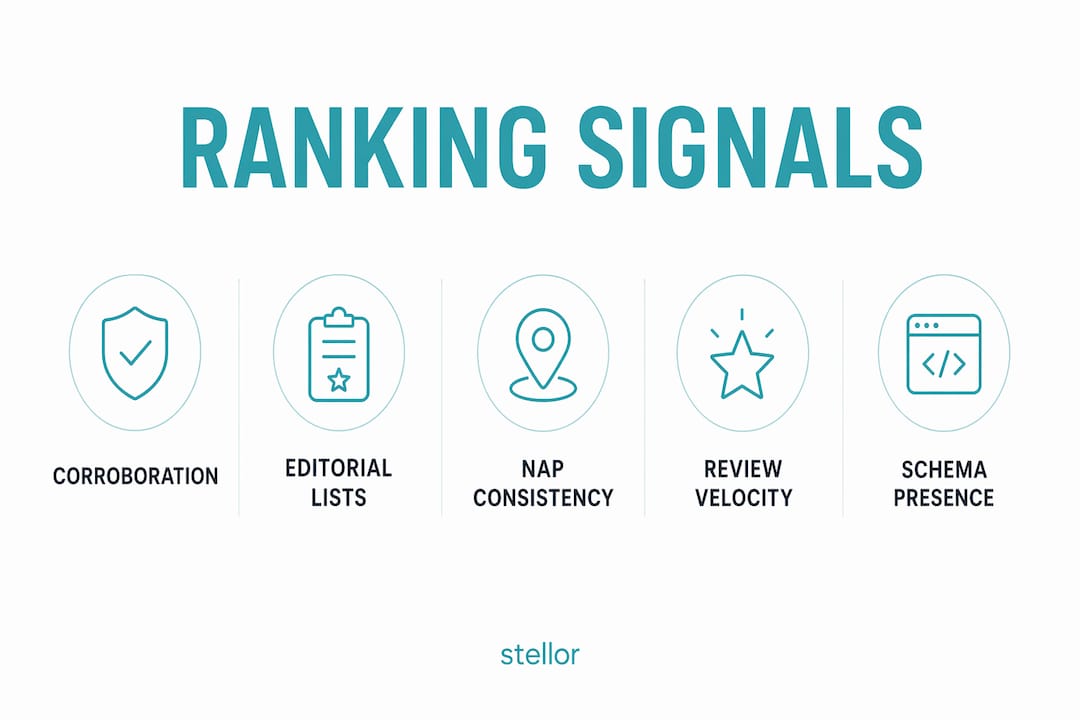
The top signals ChatGPT weighs when selecting a business:
- Corroboration — the same name appearing across independent sources (directories, reviews, editorial pages, Reddit)
- Editorial listicles and roundups — “best of” pages that aggregate options in a parsable format
- Review volume and specificity — star ratings with detailed text on Google, Yelp, and Trustpilot
- Structured data and schema — LocalBusiness JSON-LD that makes entity facts machine-readable
- NAP consistency — identical name, address, and phone number across every listing
- Reddit and forum mentions — authentic community discussion treated as human opinion
- Recency signals — timestamps and last-updated dates that confirm the business is still active
Paid ads play no role. The model builds its answers from organic citable pages, not ad slots. Understanding this changes where you invest your time.
Table of Contents
- How does ChatGPT actually find and retrieve business sources?
- What criteria does ChatGPT use to pick and rank businesses?
- How does ChatGPT handle conflicting data, and where does hallucination risk come from?
- Which signals can you actually change to get cited by ChatGPT?
- What can ChatGPT reliably not do, and how do you verify its recommendations?
- How do you test whether ChatGPT cites your business?
- How a structured weekly program turns signals into measurable citations
- Key Takeaways
- The gap between owning your site and owning your AI presence
- Trystellor gives you the third-party presence ChatGPT actually reads
- FAQ
How does ChatGPT actually find and retrieve business sources?
ChatGPT’s recommendation workflow runs on retrieval-augmented generation (RAG) with live web search, typically powered by Bing/Microsoft’s index. The process moves through four distinct stages, and your visibility depends on what happens at each one.
- Query understanding — The model interprets intent and constraints. “Best plumber in Austin” signals a local service recommendation with geographic scope. ChatGPT identifies the category, location, and implied quality threshold before it retrieves a single page.
- Retrieval — The model queries Bing (and, in some configurations, other indexes) and pulls roughly 5–15 web pages per answer. Pages that rank well in traditional search have a natural advantage here, but ranking alone is not enough — the page must also be parseable.
- Reading and parsing — Each retrieved page is read for extractable facts: business names, addresses, hours, review scores, and service descriptions. Pages built primarily in JavaScript that require client-side rendering are often skipped because the crawler cannot read them. Clean HTML with clear headings and short answer blocks gets parsed reliably.
- Synthesis — The model cross-references names across the retrieved pages. A business mentioned on three independent pages with consistent details is far more likely to appear in the final answer than one mentioned only once, even if that single mention is on a high-authority domain.
A quick example: A user asks, “Who are the best HVAC companies in Denver?” ChatGPT queries Bing, retrieves a mix of Yelp pages, Angi roundups, local news “best of” lists, and Reddit threads. It reads each page, extracts business names and supporting evidence, and synthesizes the names that appear across the most sources with the strongest corroborating detail.
Pro Tip: Make your service pages crawlable with static HTML. Avoid rendering critical business details — name, address, hours, services — exclusively through JavaScript. AI crawlers, like Googlebot, often cannot execute JS-heavy pages, which means your most important facts become invisible to the retrieval step.
The AI search impact on local discovery is real and accelerating. Businesses that treat crawlability as an afterthought are effectively invisible to this workflow.
What criteria does ChatGPT use to pick and rank businesses?
The highest-weight signals are corroboration across independent sources and presence in editorial listicles — everything else amplifies those two. Here is how each signal type works and what you can realistically control.

| Source type | Why AI uses it | What you control |
|---|---|---|
| Your own website | Baseline entity facts (name, address, services) | Schema markup, crawlable HTML, answer blocks |
| Business directories | NAP corroboration across independent domains | Claim and update every major listing |
| Editorial listicles / roundups | Aggregated options in parsable format; high citation rate | PR outreach, guest posts, getting included |
| Review platforms | Social proof with specificity; recency signals | Review velocity, response cadence |
| Reddit / forums | Authentic human opinion; high LLM trust weight | Genuine participation in relevant threads |
| News and trade media | Authority and editorial reputation | Press releases, expert commentary |
A few signals deserve extra attention:
- Corroboration is the single strongest trust signal. The same business name appearing in directories, reviews, editorial pages, and forums raises the model’s confidence enough to include it in an answer.
- Roundup articles are among the most frequently cited sources for AI recommendations. Getting listed in a “best of” article on a mid-authority site often outweighs having a technically perfect website.
- Schema markup functions as infrastructure. Structured data helps build a knowledge graph and improves extractability — even when LLMs do not read JSON-LD directly in every configuration, the downstream effect on entity recognition is durable.
- Reddit mentions carry disproportionate weight because LLMs treat forum discussion as authentic human opinion rather than marketing copy.
NAP consistency ties everything together. If your address appears differently across Google Business Profile, Yelp, and your website, the model’s confidence in your entity drops — and so does the likelihood of a citation.
How does ChatGPT handle conflicting data, and where does hallucination risk come from?
ChatGPT synthesizes retrieved passages and strongly prefers corroborated, quotable facts. When sources conflict or are sparse, the model fills gaps with its training data — and that is where hallucination risk enters.
The core risk: When ChatGPT cannot find consistent, citable facts across multiple sources, it may generate a plausible-sounding answer based on training data that is months or years out of date. A business with an inconsistent NAP, no third-party mentions, and a JavaScript-heavy site is essentially asking the model to guess.
RAG reduces but does not eliminate this risk. The model assigns higher confidence to facts that appear verbatim across multiple retrieved pages. A business address that appears identically on Google Business Profile, Yelp, and two editorial listicles will be cited with high confidence. An address that appears in three different formats across those same sources creates ambiguity the model may resolve incorrectly.
Common failure modes to watch for:
- Stale training data vs. browsing mode — Without web browsing enabled, ChatGPT draws on training data with a knowledge cutoff. Even with browsing enabled, pages that are not indexed or not crawlable will not be retrieved.
- JavaScript-blocked content — Critical business details hidden behind client-side rendering are invisible to the retrieval step.
- Inconsistent NAP — Conflicting name, address, or phone number across listings reduces corroboration confidence.
- Sparse third-party mentions — A business with only owned-domain content has almost no corroboration signal.
- Ambiguous business names — A name shared with another business in a different city creates entity confusion.
Pro Tip: Place at least one explicit, citable fact on every key page: your exact address, current hours, and a specific service with a price range. When the model retrieves your page, it needs a quotable anchor. Vague pages produce vague or incorrect citations.
Which signals can you actually change to get cited by ChatGPT?
The highest-leverage actions are fixing your Google Business Profile, building third-party review volume, and getting included in editorial roundups. Everything else compounds those three.
- Correct and complete your Google Business Profile — Verify your NAP, add service categories, upload photos, and respond to reviews. This is the fastest fix: days, not weeks.
- Build review velocity on multiple platforms — Aim for a steady cadence of new reviews on Google, Yelp, and industry-specific platforms. Specificity matters: reviews that mention your service type and location are more extractable than generic five-star ratings.
- Get listed in editorial roundups — Reach out to local news sites, industry blogs, and “best of” directories. A single inclusion in a well-indexed roundup can produce more AI citations than months of on-site optimization.
- Add LocalBusiness schema to every service page — A minimal JSON-LD block covers the essentials:
{
  "@context": "https://schema.org",
  "@type": "LocalBusiness",
  "name": "Your Business Name",
  "address": {
    "@type": "PostalAddress",
    "streetAddress": "123 Main St",
    "addressLocality": "Austin",
    "addressRegion": "TX",
    "postalCode": "78701"
  },
  "telephone": "+1-512-555-0100",
  "openingHours": "Mo-Fr 08:00-18:00",
  "url": "https://yourbusiness.com"
}
Place this in the <head> of your homepage and each service page. Schema.org’s LocalBusiness spec covers every available property.
- Write short answer blocks on service pages — Each page should answer at least one question in 2–3 sentences above the fold. “What does an HVAC tune-up cost in Denver? A standard tune-up runs $80–$150 and takes about an hour.” That format is directly extractable.
- Participate genuinely in Reddit threads — Find high-intent subreddits in your category and contribute helpful, specific answers. Why ChatGPT cites Reddit recommendations comes down to authenticity: the model treats community discussion as unbiased human opinion.
- Publish YouTube video descriptions with full transcripts — Video content with keyword-rich transcripts creates additional indexed text that retrieval systems can read.
Expected timelines: Google Business Profile fixes take effect in days. Review velocity builds over weeks. Roundup inclusions and schema effects compound over one to three months.

What can ChatGPT reliably not do, and how do you verify its recommendations?
ChatGPT cannot guarantee a ranked list of businesses, cannot access real-time data without browsing enabled, and cannot distinguish between a legitimate business and one with fabricated reviews. Its recommendations reflect what the open web says, not ground truth.
Core limitations:
- No guaranteed ranking order — the model synthesizes, it does not rank
- Training cutoff means businesses that opened recently may not appear without browsing mode
- Hallucination risk increases when third-party sources are sparse or contradictory
- Different models (ChatGPT, Perplexity, Claude, Gemini) weight sources differently and may return different businesses for the same query
- Paid ads do not influence which businesses appear in generated answers
Verification checklist for any AI business recommendation:
- Cross-check the recommended business on Google Business Profile for current hours and address
- Confirm reviews on Yelp, Google, and Trustpilot are recent and specific
- Re-prompt the same question across ChatGPT (browsing enabled), Perplexity, Claude, and Gemini — consistent mentions across all four are a stronger signal than a single-model citation
- Check whether the business appears in at least one editorial source independent of its own website
- Look for a last-updated timestamp on any page the AI cites
Pro Tip: Run the same query with slight variations: “best [service] in [city],” “top-rated [service] near [neighborhood],” and “recommended [service] [city] Reddit.” Inconsistencies across those three prompts reveal where the model is guessing versus where it has strong corroboration.
One practical note: AI-generated business recommendations are a starting point, not a verified directory. For business-critical decisions, confirm details directly with the business before acting.
How do you test whether ChatGPT cites your business?
Testing AI citation is repeatable and should be treated like search ranking monitoring: run the same prompts weekly, log the results, and track changes over time.
- Define your target prompts — Write 5–10 prompts your buyers would actually use: “best [service] in [city],” “top [service] companies near [neighborhood],” “who do people recommend for [service] in [city] Reddit.”
- Run prompts across four models — Test ChatGPT (with browsing enabled), Perplexity, Claude, and Gemini. Each model weights sources differently, so a citation on all four is a strong signal; a citation on only one suggests thin corroboration.
- Log every result — Record which businesses are cited, which sources are referenced, and whether your business appears.
- Run weekly — Citation landscapes shift as new content is indexed. Weekly testing catches changes within days of a new roundup or review batch going live.
- A/B test content edits — Publish a new answer block or schema update, then re-run your prompts two weeks later. If citation frequency increases, the edit worked.
| Metric | Definition | Why it matters |
|---|---|---|
| AI citation count | Number of prompts where your business is named | Baseline visibility across LLMs |
| Citation source count | Number of independent domains citing you | Corroboration strength |
| Time to first citation | Weeks from a content change to first new citation | Measures content velocity |
| Third-party vs. owned citation share | Ratio of external to own-domain citations | Flags over-reliance on owned content |
| Mention specificity | Whether the citation includes a service, location, or detail | Indicates extractability quality |
Appearing in three or more independent sources for the same query is a meaningful threshold. A single-source mention is fragile; the model may drop it on the next retrieval cycle. Three or more independent mentions signal the kind of corroboration that produces consistent citations.
How a structured weekly program turns signals into measurable citations
A consistent audit-and-content cadence produces measurable AI citation improvements within a single quarter. The key is treating AI visibility as a program, not a one-time fix.
Trystellor operationalizes this as a five-pillar workflow:
- Week 1 onboarding (15 minutes) — Input your services, locations, and brand voice. Trystellor indexes your existing site and delivers a free AI Visibility Audit within 48 hours, covering citation status across 25 buyer prompts, a competitor benchmark, and a 90-day content plan.
- 30 GEO/SEO articles per month — Each article targets a specific buyer query with schema markup, internal linking, and llms.txt configuration. Volume and consistency build topical authority fast enough to shift citation rates within a quarter.
- 4,000-site backlink network — Vetted publisher placements that build the corroboration signal across independent domains without manual outreach.
- Daily Reddit opportunity identification — High-intent threads surfaced in real time with reply suggestions your team reviews before posting. This builds the authentic community presence that LLMs treat as trusted opinion.
- Weekly LLM tracking — Trystellor queries ChatGPT, Claude, Perplexity, and Gemini using your actual buyer prompts and reports citation changes week over week.
Pro Tip: Use the weekly LLM tracking report as your primary KPI dashboard. Track citation count, citation source count, and third-party citation share. When a new article or backlink batch goes live, watch those three numbers over the following two weeks — that is your feedback loop.
KPIs Trystellor tracks and why they matter:
- Citation count per prompt — Direct measure of AI recommendation visibility
- Competitor citation share — Shows which businesses are winning the answers you should be earning
- Schema completeness score — Flags entity gaps before they suppress citations
- Backlink domain diversity — Corroboration requires independent domains, not volume from one source
For real estate businesses, the AI-driven visibility approach follows the same corroboration logic: third-party mentions on listing sites, editorial roundups, and community forums drive citations far more reliably than owned-domain content alone.
Key Takeaways
ChatGPT selects business recommendations by synthesizing names that appear consistently across independent third-party sources — your owned website alone is rarely enough to earn a citation.
| Point | Details |
|---|---|
| Third-party sources dominate | About 85% of AI business citations come from third-party domains, not your own website. |
| Corroboration is the top signal | A business named across directories, reviews, listicles, and Reddit earns far higher citation confidence than a single-source mention. |
| Paid ads have no effect | AI recommendations are built from organic citable pages; ad spend does not insert your name into generated answers. |
| Schema is durable infrastructure | LocalBusiness JSON-LD improves entity extractability and knowledge graph coverage for both Google and AI crawlers. |
| Trystellor tracks citations weekly | Trystellor queries ChatGPT, Claude, Perplexity, and Gemini with your buyer prompts and reports citation changes every week. |
The gap between owning your site and owning your AI presence
Most businesses spend the majority of their digital marketing budget on their own website — design, content, technical SEO — and almost nothing on the third-party ecosystem that AI actually reads. That imbalance made sense when Google’s algorithm weighted on-page signals heavily. It does not make sense now.
The businesses that get cited consistently by ChatGPT, Perplexity, and Gemini are not necessarily the ones with the best websites. They are the ones that show up in the most places with the most consistent information. A plumber with 200 Google reviews, three roundup inclusions, and a handful of genuine Reddit mentions will almost always outrank a plumber with a technically perfect website and almost no third-party presence.
The practical implication is a reallocation of effort. Getting into one well-indexed “best of” article in your city is worth more for AI citation than publishing ten blog posts on your own domain. Responding to a Reddit thread with a genuinely helpful answer is worth more than a perfectly optimized service page. That is not a reason to neglect your site — schema, crawlability, and answer blocks still matter. But the leverage is off-site, and most businesses have not caught up to that reality yet.
Trystellor gives you the third-party presence ChatGPT actually reads
Most businesses are invisible to AI recommendation engines not because their website is bad, but because they have almost no third-party footprint. Trystellor fixes that directly: 30 GEO/SEO-optimized articles per month, a 4,000-site backlink network, weekly technical audits, daily Reddit opportunities, and LLM tracking across ChatGPT, Claude, Perplexity, and Gemini — all for $199/month, replacing five separate tools.
The free AI Visibility Audit shows your current citation status across 25 buyer prompts, who the competitors winning your answers are, and a 90-day plan to change that. No credit card required for the three-day trial. See the full Trystellor product to start your audit today.
FAQ
How does ChatGPT decide which businesses to recommend?
ChatGPT retrieves 5–15 web pages per query and synthesizes business names that appear consistently across independent sources. Corroboration across directories, reviews, editorial listicles, and forums is the strongest selection signal.
Do paid ads help a business appear in ChatGPT’s recommendations?
No. AI recommendations are built from organic citable pages; paid ad spend has no direct effect on which businesses appear in a generated answer.
How long does it take to start appearing in ChatGPT recommendations?
Google Business Profile fixes take effect in days. Review velocity and schema improvements compound over weeks. Roundup inclusions and consistent third-party mentions typically produce measurable citation changes within one to three months.
Does ChatGPT behave the same as Perplexity, Claude, and Gemini for business recommendations?
No. Each model weights sources differently and may return different businesses for the same query. Testing across all four models weekly gives you a more accurate picture of your actual AI citation footprint.
What is the fastest single action to improve AI citation chances?
Fix your Google Business Profile first: verify your NAP, complete all service categories, and ensure your information is identical across every major directory. This is the fastest corroboration signal you can establish, often taking effect in days.