TL;DR:
- Guaranteed SEO ranking is an impossible promise because Google controls its algorithm and updates it constantly.
- Effective SEO in 2026 requires focusing both on traditional rankings and AI citation visibility across platforms like ChatGPT and Perplexity.
Guaranteed SEO ranking is defined as a promise made by an SEO provider to achieve a specific position in search engine results within a fixed timeframe. No legitimate SEO agency can deliver on that promise. Google controls its own algorithm, updates it hundreds of times per year, and shares none of its logic with outside vendors. Any agency offering a guaranteed first-page position is either targeting keywords so obscure they carry no commercial value, or using tactics that put your site at serious risk of a penalty.
Understanding this distinction is the first step toward making smarter decisions about your SEO investment. The industry term for what these providers are selling is “positional guarantee,” and it differs sharply from a legitimate performance-based SEO engagement tied to leads, revenue, and organic growth. In 2026, with AI answer engines like ChatGPT, Perplexity, and Gemini reshaping how buyers find businesses, the gap between a real SEO strategy and an empty ranking promise has never been wider. Platforms like Trystellor now track both traditional Google rankings and AI citation visibility, giving you a complete picture of search performance that no positional guarantee can replicate.
What is guaranteed SEO ranking, and why is it a red flag?
No SEO agency can guarantee a specific ranking because Google controls its own algorithm and updates it continuously with hundreds of unpredictable signals. That single fact makes any positional promise structurally impossible to honor. The agency does not control the output. They control only the inputs: content quality, technical health, and link acquisition.
When you see a guarantee of “page one in 30 days,” the agency is almost always doing one of three things:
- Targeting keywords with near-zero search volume, where ranking is easy but meaningless
- Using private blog networks (PBNs), bulk directory submissions, or keyword stuffing to manufacture short-term signals
- Writing contracts with loopholes that allow them to claim success while delivering no real business growth
Black-hat tactics like PBNs and keyword stuffing carry significant penalty risks and offer no durable value. Sites built on these methods require costly recovery after algorithm updates, and Google’s Helpful Content and spam updates have accelerated how quickly those penalties arrive.
Algorithm updates are the other variable no agency can control. A site ranking #3 in January can fall to page four after a core update in March. That is not a failure of execution. It is the normal behavior of a living algorithm. Any agency that promises to protect you from that reality is misrepresenting how search works.
“The right question to ask an SEO provider is not ‘Can you guarantee my ranking?’ It is ‘What inputs will you commit to, and how will you measure their impact on my business?’”
Pro Tip: Before signing any SEO contract, ask the agency to show you the specific keywords they are guaranteeing. Run those terms through Google Keyword Planner or Ahrefs. If the monthly search volume is under 100, the guarantee is worthless.
How SEO guarantees hide behind vanity metrics
Most guaranteed SEO services focus on rankings for irrelevant keywords, which rarely produce meaningful business ROI. This is the mechanism behind most guarantee scams, and it is worth understanding in detail.
Here is how the cycle typically works:
- An agency promises “first-page rankings” within 60 days.
- They select 10 keywords with low competition and minimal search volume, such as “affordable plumber in [small suburb]” with 20 monthly searches.
- They rank for those terms. The guarantee is technically met.
- You receive a report showing green checkmarks. Your phone does not ring.
- The contract renews, and the cycle repeats.
Ranking #1 in Google does not guarantee traffic or conversions if the keywords have low volume or low commercial intent. A position-one ranking for a term nobody searches is worth exactly nothing to your revenue.
The metrics that actually matter are qualified organic leads, organic revenue attribution, branded search growth, and conversion rate from organic traffic. These are harder to fake and harder to achieve, which is precisely why agencies offering guarantees avoid committing to them.
Contracts often contain loopholes that allow agencies to meet technical guarantees while providing minimal business growth. Watch for language like “targeted keywords at our discretion,” “ranking improvements measured from baseline,” or “traffic increases excluding branded terms.” Each of those phrases is a trapdoor.
A legitimate performance-based model ties the agency’s accountability to your business KPIs. For measurable SEO results, the contract should specify which keywords are in scope, what the monthly search volume floor is, how leads will be tracked, and what happens if targets are missed.
Pro Tip: Ask any prospective SEO provider to define “ranking improvement” in writing before you sign. If they cannot tie that definition to a keyword with verified search volume and a conversion goal, the guarantee has no commercial value.
Modern SEO: combining traditional ranking factors with AI visibility
SEO in 2026 requires two parallel strategies running simultaneously. The first addresses traditional Google ranking factors. The second addresses AI-generated answer visibility across ChatGPT, Perplexity, Claude, and Gemini. Treating these as separate problems is a mistake. They share inputs but reward different outputs.

Core Web Vitals remain confirmed ranking factors: LCP under 2.5 seconds, INP under 200 milliseconds, and CLS under 0.1. These are table stakes for Google. Pages that fail these thresholds lose ranking ground to technically healthier competitors, regardless of content quality.
On the AI visibility side, the signals are different. Structured content, schema markup, and brand citations across multiple platforms boost your presence in AI-generated answers. FAQ schema, HowTo schema, and clearly structured answer blocks make your content easier for large language models to extract and quote. Brand mentions across review sites, Reddit, YouTube, and comparison articles enhance AI citation rates more than raw backlink quantity in 2026.
The table below shows how the two strategies differ in focus and measurement:
| Strategy | Primary focus | Key tactics | KPIs |
|---|---|---|---|
| Traditional SEO | Google SERP rankings | Core Web Vitals, backlinks, on-page optimization | Organic traffic, keyword positions, CTR |
| AI visibility | LLM answer citations | Schema markup, brand mentions, structured FAQs | Citation frequency, prompt wins, AI referral traffic |
| Combined approach | Both search surfaces | Content depth, E-E-A-T signals, Reddit presence | Leads, revenue, AI + Google combined visibility |
The practical implication for your business: you need to optimize for both surfaces or you are leaving visibility on the table. A page that ranks #4 on Google but gets cited by ChatGPT for “best [service] in [city]” can still drive qualified leads. Tracking only one surface gives you an incomplete picture of your actual search performance.
Pro Tip: Add FAQ schema to every service page and location page on your site. It takes under an hour with a plugin like Yoast SEO or Rank Math, and it directly improves your eligibility for both Google’s AI Overviews and LLM-generated answers.
For local service businesses, combining these two approaches produces compounding results faster than either strategy alone.
How to evaluate legitimate SEO performance guarantees
A legitimate SEO guarantee is a performance-based commitment tied to qualified leads or organic revenue, with transparent contract details and a clear refund or remediation policy. That definition comes directly from how credible agencies structure accountability. It has nothing to do with a specific position in Google’s results.
When evaluating an SEO provider, look for these features in their proposal:
- Keyword scope defined upfront: Every keyword in scope should have verified monthly search volume and a stated commercial intent category.
- Geographic targeting specified: Local SEO guarantees should name the cities, zip codes, or service areas being targeted.
- Reporting cadence committed in writing: Weekly or monthly reports should include Google Search Console data, not just a third-party rank tracker screenshot.
- Technical audit included: A credible engagement starts with a full audit of your site’s technical health, including Core Web Vitals, schema completeness, and internal linking structure.
- Link building methodology disclosed: Ask specifically whether they use PBNs or guest posts on unrelated sites. A credible provider uses vetted publisher networks and editorial placements.
Effective SEO guarantees tie agency accountability to transparent, measurable business outcomes like organic lead volume and revenue, not just rankings or traffic. That accountability requires clear contracts detailing targets, reporting cadence, and quality of work.
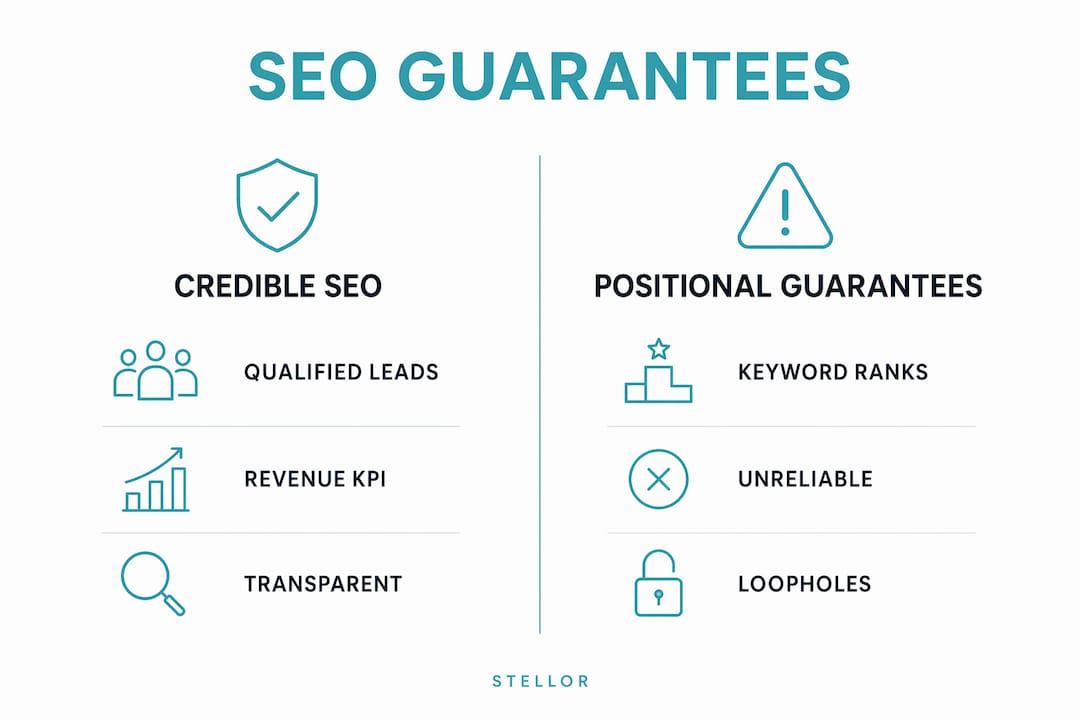
The comparison below shows what separates a credible SEO engagement from a positional guarantee scheme:
| Feature | Credible SEO engagement | Positional guarantee scheme |
|---|---|---|
| Keyword selection | High-volume, commercial intent terms | Low-volume, easy-to-rank terms |
| Success metric | Leads, revenue, organic conversions | Position in SERP |
| Contract transparency | Full keyword list, volume, and targets | Vague “page one” language |
| Reporting | Google Search Console + analytics | Third-party rank tracker only |
| Risk disclosure | Algorithm update impact acknowledged | Guarantees maintained regardless |
SEO success in 2026 hinges on demonstrating E-E-A-T (Experience, Expertise, Authoritativeness, and Trustworthiness) with proof-based content and technical health. Any provider who dismisses E-E-A-T or cannot explain how their work builds it is not operating a credible practice.
For a deeper look at local SEO strategies that prioritize business outcomes over positional promises, the framework applies directly to competitive service markets.
Pro Tip: Request a sample monthly report from any SEO agency before signing. If it shows only keyword positions and no conversion data, organic revenue attribution, or Search Console metrics, the agency is optimizing for the appearance of results, not the results themselves.
Key takeaways
Guaranteed SEO ranking is a positional promise no agency can legitimately honor because Google controls its algorithm, and the only real SEO guarantee is a performance-based commitment tied to qualified leads, organic revenue, and transparent reporting.
| Point | Details |
|---|---|
| Positional guarantees are unreliable | Google’s algorithm is controlled externally; no agency can promise a specific rank. |
| Vanity metrics mask poor ROI | Rankings for low-volume keywords meet technical guarantees but produce no business growth. |
| AI visibility is now required | Optimizing for ChatGPT, Perplexity, and Gemini citations is as important as Google rankings in 2026. |
| Legitimate guarantees tie to business KPIs | Credible SEO commitments specify leads, revenue, and conversion targets, not positions. |
| Contract clarity protects you | Demand keyword lists with verified search volume, reporting cadence, and methodology disclosure before signing. |
Why I stopped trusting ranking guarantees years before everyone else did
I have reviewed hundreds of SEO proposals over the years, and the pattern is always the same. The agencies with the boldest guarantees are the ones with the thinnest methodologies. They lead with the promise because they cannot lead with the process.
The uncomfortable truth is that most business owners want the guarantee because SEO feels opaque. When someone says “page one in 60 days,” it sounds like certainty in a space that feels uncertain. That psychological appeal is exactly what makes the pitch so effective and so dangerous.
What I have found actually works is the opposite of a guarantee. It is a detailed process commitment: here are the 30 pieces of content we will publish, here is the backlink methodology, here is how we will track your AI citation rate across ChatGPT and Perplexity, and here is what the data will look like in 90 days. That kind of transparency is harder to sell but far easier to deliver on.
The other thing I have learned: rankings are a lagging indicator. They tell you what happened, not what is happening. Businesses that obsess over their position in Google are watching the scoreboard instead of playing the game. The teams that win are tracking organic lead volume, branded search growth, and AI citation frequency. Those metrics move before rankings do, and they connect directly to revenue.
If an agency cannot show you their process in detail, cannot name the tools they use to track AI visibility, and cannot define success in terms of your business outcomes, walk away. The guarantee they are selling is not protection. It is a distraction.
— Cole
How Trystellor tracks real SEO performance without empty promises
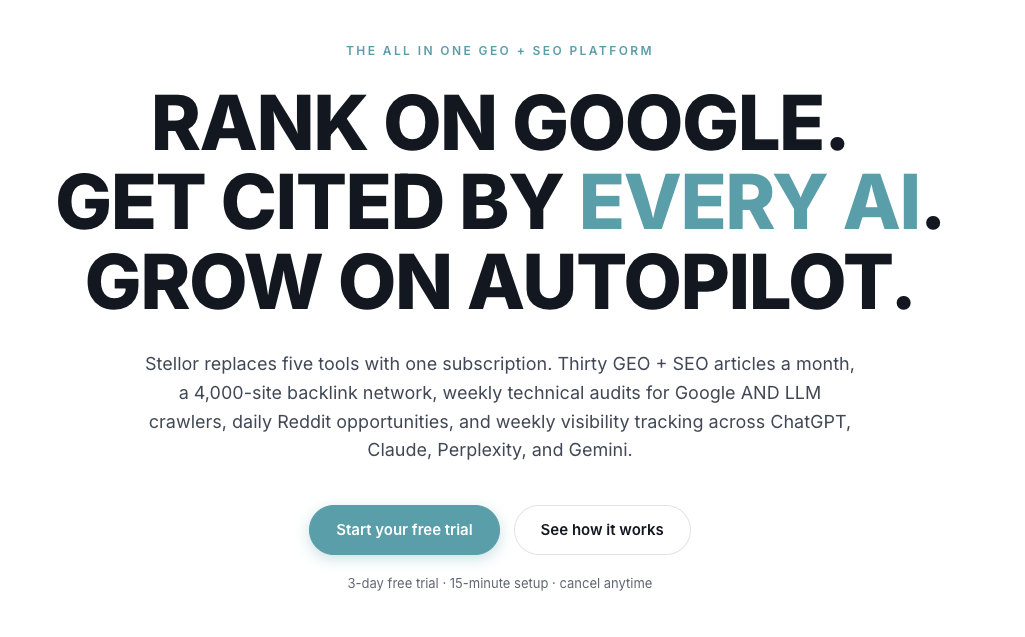
Trystellor is a GEO + SEO platform built for businesses that need measurable results across both Google and AI answer engines. For $199 per month, it replaces five separate tools: a content production service, a backlink network, a technical SEO auditor, a Reddit engagement workflow, and an LLM visibility tracker covering ChatGPT, Claude, Perplexity, and Gemini.
Every week, Trystellor queries AI engines using the exact prompts your buyers use and reports back which businesses are being cited and where you stand. That is the kind of performance data that connects SEO effort to business outcomes. No positional guarantees. No vanity metrics. Just transparent, weekly reporting on what is actually working. Start with a three-day free trial and get your AI Visibility Audit within 48 hours, no credit card required.
FAQ
Can any SEO agency guarantee a first-page Google ranking?
No. Google controls its ranking algorithm and updates it continuously, making specific positional guarantees impossible to honor legitimately. Agencies that offer them typically target low-volume keywords or use risky tactics.
What should a legitimate SEO guarantee include?
A legitimate SEO guarantee is tied to qualified leads, organic revenue, or conversion-based KPIs, with a clear contract specifying keyword scope, search volume minimums, and reporting cadence.
How does AI visibility affect SEO strategy in 2026?
AI visibility now requires optimizing for LLM-generated answers alongside traditional Google rankings. Schema markup, structured content, and brand citations across Reddit, review sites, and comparison articles directly influence whether ChatGPT or Perplexity cites your business.
What are the risks of black-hat SEO tactics used in ranking guarantees?
Private blog networks and keyword stuffing carry significant Google penalty risks. Sites built on these methods often lose rankings after algorithm updates and require costly recovery work to restore organic visibility.
How do I verify whether an SEO agency is delivering real results?
Cross-reference the agency’s rank tracker reports with your own Google Search Console data. Track organic lead volume and revenue attribution separately. If rankings are improving but leads are flat, the agency is optimizing for the wrong keywords.