

The fastest path to getting a page indexed starts with the URL Inspection tool in Search Console. Check the verdict, fix any blockers like robots.txt rules, noindex tags, or canonical conflicts, then submit your sitemap or request indexing directly. Give it at least a few days, then confirm with a site search.
TL;DR:
- Confirm your page is crawlable and correctly canonicalized, as canonical mismatches are a common cause of indexing issues despite proper crawling.
- Ensure your sitemap lists only canonical URLs, includes accurate last modified dates, and is submitted whenever you make bulk updates.
- Fix technical blockers such as noindex tags, robots.txt disallow rules, server errors, and duplicate content to improve indexing chances.
- Improve discovery by internal linking from main pages and external signals like backlinks, rather than relying solely on sitemaps.
- After fixing issues, request indexing through URL Inspection and wait at least one week before reassessing search visibility.
Table of Contents
- Verify index status: URL Inspection, site: operator, and the Page Indexing report
- Fix the common technical blockers that prevent indexing
- Help Google discover your pages: sitemaps, internal links, and external signals
- Request indexing and automated options: URL Inspection, the Indexing API, and third-party tools
- Timing, monitoring, and verification: what to expect and how to track changes
- How Stellor keeps pages discoverable and indexable
- Prioritized checklist for fastest indexing wins
- How Stellor can speed indexing and AI visibility
- Sources
- FAQ
Verify index status: URL Inspection, site: operator, and the Page Indexing report
Before you fix anything, you need to know what Google actually sees. That means checking, not guessing.
Open the URL Inspection tool in Search Console and paste in the exact URL. Google returns one of two verdicts: “URL is on Google” or “URL is not on Google.” That single line tells you whether you’re dealing with a discovery problem or a ranking problem, and those require completely different fixes.
The report gives you more than a yes or no. It shows the last crawl date, any fetch errors, and which URL Google chose as the canonical, which sometimes differs from the one you specified. If Google picked a different canonical than you intended, that’s often the real reason a page you care about isn’t showing up.
For quick spot checks, two shortcuts save time:
- Search
site:example.com/your-page-urlto see if Google has the exact page in its index. - Search a distinctive phrase from the page in quotes to check if Google is showing a different version of the content.
If you manage a larger site, checking pages one by one stops being practical. That’s when the Page Indexing report earns its keep. It’s built for sites with hundreds of pages or more, and it groups every URL Google has found into indexed and not indexed, with a “Why pages aren’t indexed” table that names the specific reason for each group, whether that’s “Crawled, currently not indexed,” “Discovered, currently not indexed,” or a technical block. For a smaller site, a site: search and occasional spot checks with URL Inspection will get you the same answer faster.
Fix the common technical blockers that prevent indexing
Most indexing problems come down to a handful of repeat offenders. Work through them in order.
- Check robots.txt. Use the robots.txt tester in Search Console to confirm you haven’t accidentally disallowed the page or an entire folder. A single misplaced rule can silently block a whole section of your site.
- Remove unintended noindex tags. Look for a
noindexmeta tag in the page’s HTML and check the HTTP response headers for anX-Robots-Tagset to noindex. Either one will keep a page out of the index even if it crawls fine. - Confirm your canonical tags point the right way. A page you want indexed should have a self-referential canonical tag. If Google’s chosen canonical in URL Inspection doesn’t match your tag, that mismatch is usually the actual cause.
- Resolve server errors and access gates. A 500 error, a broken redirect chain, or a login wall will all stop Google from fetching the page at all, no matter how good the content is.
- Clean up duplicate and parameterized URLs. Faceted navigation, tracking parameters, and paginated series create near-duplicate content that dilutes indexing signals. Use canonical tags to point variants at the main version, or apply noindex to pages that shouldn’t compete for the same query.
Robots.txt deserves a specific warning here. Blocking a URL in robots.txt stops Google from crawling it, but it does not guarantee the page won’t be indexed if Google already knows about it from links elsewhere, as the Page Indexing report documentation notes. If your real goal is keeping a page out of the index entirely, use a noindex tag instead, and make sure robots.txt isn’t blocking access to a page you’re also trying to noindex, since Google can’t read a directive on a page it can’t crawl.
Pro Tip: Run the live test inside URL Inspection after any fix. It shows you exactly how Google renders the current version of the page before you spend a request-indexing credit on it.
Help Google discover your pages: sitemaps, internal links, and external signals
Fixing blockers only matters if Google can find the page in the first place. Discovery and indexing are two separate jobs, and skipping the first one is a common reason pages sit in limbo.

Start with your XML sitemap. It should list canonical URLs only, include accurate lastmod dates, and get submitted through Search Console whenever you add or update pages in bulk. According to Google’s overview of how Search works, Google finds most new pages through links, and a sitemap acts as a helpful map rather than a guarantee.
That’s exactly why internal linking matters as much as the sitemap itself:
- Link to new pages from your homepage or main navigation, since pages several clicks deep get crawled less often.
- Add contextual links from related, already-indexed pages, similar to how an essential SEO audit checklist can flag orphaned pages with no internal links pointing to them.
- Share new pages through channels that generate real external links over time, whether that’s a newsletter, social post, or a mention on a partner site like this guide to structuring service area pages for discovery.
- Check your CMS-generated sitemap for junk. Many platforms auto-include parameterized URLs, tag archives, or duplicate content that muddies your indexing signals instead of clarifying them.
External links still carry weight for discovery, not just authority. A page with zero internal links and zero external mentions is one Google has to stumble across on its own, which can take considerably longer than a page that’s woven into your existing site structure.
Request indexing and automated options: URL Inspection, the Indexing API, and third-party tools
Once you’ve fixed the blocker and confirmed discoverability, it’s time to ask directly. Open URL Inspection, run “Test live URL,” and if that comes back clean, click “Request indexing.” This tells Google to prioritize a crawl of that specific page rather than waiting for its next scheduled pass.
A few things to keep in mind:
- Request indexing is meant for individual URL updates, not bulk submissions. Hammering the same page repeatedly won’t speed things up and can look like a signal problem rather than a fix.
- The Indexing API exists, but it’s limited by Google to specific content types, primarily job postings and livestream video pages, and it requires API setup that most sites don’t need.
- If you manage a high volume of URL changes, look for monitoring tools that track your request results and index status over time rather than submitting requests manually one by one.
Pro Tip: If a page still won’t index a week after your request, don’t submit it again. Go back to URL Inspection and check whether the “Discovered, currently not indexed” or “Crawled, currently not indexed” reason has changed, since that tells you whether the problem is technical or a quality signal Google isn’t ready to trust yet.
Timing, monitoring, and verification: what to expect and how to track changes
Patience is part of the process, and it’s the step most people skip. According to Google’s guidance on missing pages, you should allow at least a week after submitting a sitemap or requesting indexing before concluding that something is wrong. That single week of waiting solves more “my page won’t index” panic than any technical fix.
Once that week has passed, confirm status with the same tools you used to diagnose the problem in the first place:
- Run a
site:search for the exact URL to see if it’s showing up in results. - Check URL Inspection for the “URL is on Google” verdict and note the new last-crawl date.
- Review the Page Indexing report for a shift in your not-indexed counts if you’re tracking multiple pages at once.
- Set a recurring reminder to check Search Console’s coverage data monthly, since a sudden drop in indexed pages usually signals a site-wide issue, not an isolated one.
It’s worth remembering that being indexed and appearing in search results aren’t the same thing. Google’s own indexing overview makes clear that “URL is on Google” confirms inclusion in the index, not a guarantee of ranking or visibility, since that depends on relevance and quality signals separate from indexing itself. If a page is indexed but never seen, the fix shifts from technical troubleshooting to content and relevance work.
How Stellor keeps pages discoverable and indexable
Every step above takes time to execute well and time to repeat across a growing site. Stellor is built around that exact workload. The platform publishes thirty GEO and SEO-optimized articles a month per customer, each one structured with the internal linking and schema markup that make discovery straightforward rather than accidental.
Weekly technical audits check eleven factors that overlap directly with the fixes covered in this guide, including schema completeness, page speed, mobile responsiveness, and internal linking depth, surfacing problems before they turn into indexing gaps. A 4,000-site backlink network adds the external discovery signals that help new pages get found faster, and weekly LLM visibility tracking across ChatGPT, Claude, Perplexity, and Gemini extends that same discoverability question into AI answer engines.
Onboarding takes about fifteen minutes, and new customers get a free AI Visibility Audit within 48 hours that flags indexing and visibility blockers across the existing site before any new content goes live.
Prioritized checklist for fastest indexing wins
If you only do one thing today, inspect the URL and fix whatever blocker it reveals. Then submit your sitemap or request indexing, and give it a full week before you touch it again.
If a page still won’t index after that, check for canonical mismatches, near-duplicate content competing for the same query, and anything unusual in your server logs. A managed service starts making sense once you’re publishing at real volume and need ongoing content and backlink work handled without babysitting every URL yourself.
— Cole
How Stellor can speed indexing and AI visibility
Fixing indexing issues one page at a time works, but it doesn’t scale once you’re publishing regularly. Stellor handles the recurring parts of that workload automatically instead of leaving them for you to repeat every month.
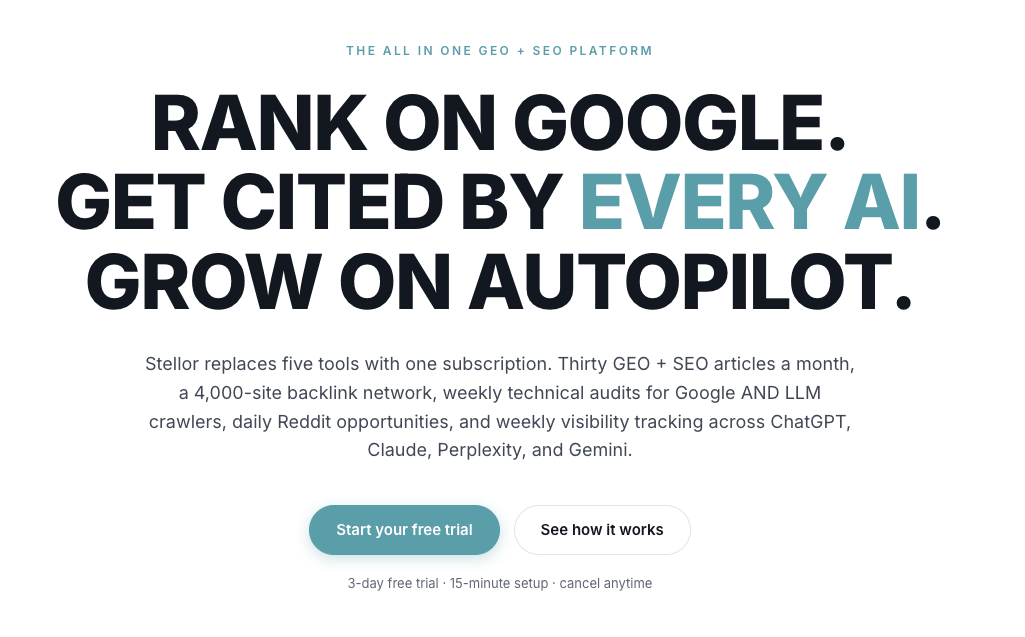
The platform covers:
- Thirty GEO and SEO-optimized articles published to your site every month, each built with the internal linking and structure that support discovery.
- Weekly technical audits that catch indexing blockers, schema gaps, and site speed issues before they cost you visibility.
- A 4,000-site backlink network that builds the external signals search engines and AI crawlers use to find and trust new pages.
- Weekly LLM visibility tracking across ChatGPT, Claude, Perplexity, and Gemini, so you know where you’re being cited and where competitors are showing up instead.
Setup takes about fifteen minutes, and every new account gets a free AI Visibility Audit within 48 hours. Pricing starts at $199 per month with a 3-day free trial and no credit card required. Check out the Stellor product page if you’re ready to see what it finds on your own site.
Sources
FAQ
How long does it take for a page to get indexed?
Google recommends waiting at least a week after submitting a sitemap or requesting indexing before assuming there’s a problem, according to Google’s guidance on missing pages. Simple, well-linked pages on established sites often index faster, while new or low-authority sites can take longer.
How do you get pages indexed by Google?
Start by running the page through URL Inspection to see its current status, then fix any blockers like a noindex tag or robots.txt rule. Once the page passes a live test, submit your sitemap or click “Request indexing” directly from the tool.
Why are pages not indexed by Google?
The most common causes are a noindex tag, a robots.txt block, a canonical tag pointing to a different URL, or the page simply not being linked from anywhere else on the site. The Page Indexing report lists the specific reason for each unindexed URL, such as “Crawled, currently not indexed” or “Discovered, currently not indexed.”
How do I stop Google from indexing certain pages?
Add a noindex meta tag or an X-Robots-Tag header to the pages you want excluded, since this is the reliable way to keep a page out of the index. Blocking the page in robots.txt only stops crawling, and Google can still index a blocked URL if it’s already been discovered through links elsewhere, per the Page Indexing report documentation.