

TL;DR:
- Choosing the right GEO platform depends on whether you want to monitor AI mentions or actually fix citation gaps through content, backlinks, and technical fixes. An effective platform automates content publishing, builds vetted backlinks, conducts regular audits, and tracks multiple AI engines, reducing manual workload and costs. Small businesses should prioritize platforms that offer rapid onboarding, integrated features, and transparent results, such as Stellor, which consolidates these services into one affordable subscription.
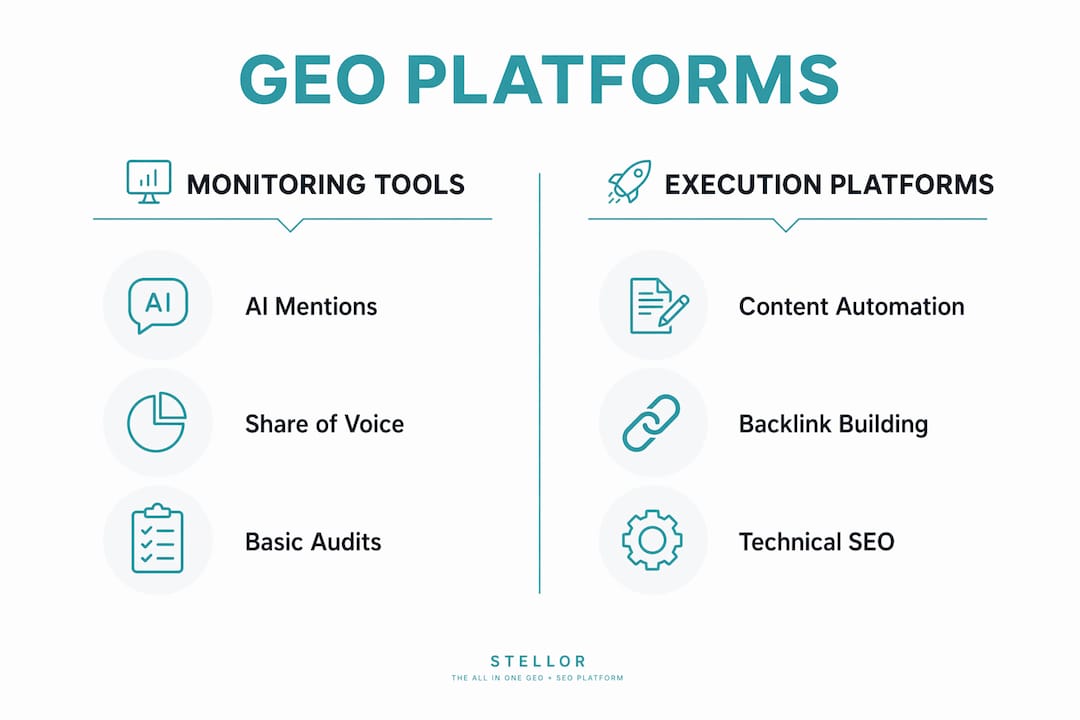
The right GEO platform depends on whether you need to monitor your AI visibility or actually fix it. Monitoring tools tell you where ChatGPT, Gemini, Perplexity, and Claude are ignoring your brand. Execution platforms go further and produce the content, backlinks, and technical fixes that change the answer. Most businesses shopping for the best GEO platforms conflate the two categories and end up paying for a dashboard while still needing to do the execution work themselves.
When comparing GEO services, evaluate eight dimensions: platform focus (GEO-only vs. hybrid SEO/AI), content automation depth, backlink network quality, technical audit coverage, community engagement features, AI visibility tracking scope, ease of onboarding, and pricing structure. Execution platforms that combine all of these under one subscription consistently outperform stacked point solutions on both speed and cost.
What to look for in a GEO platform comparison
Every platform in this category claims to improve your AI visibility. The real question is how much of the work it actually does for you.
Platform focus: GEO-only, SEO suite, or hybrid
Pure monitoring platforms track whether AI engines mention your brand and report your share of voice. They are useful for diagnosis but leave execution entirely to your team. SEO suites with AI add-ons give you one dashboard for traditional rankings and AI mentions, though the AI tracking is often a secondary feature rather than the core product. Hybrid platforms built for both GEO and SEO from the ground up treat the two disciplines as one pipeline, which is where the most durable visibility gains tend to come from.
Content automation capabilities
The gap between platforms is widest here. Some tools surface content gaps and hand you a list of recommendations. Others draft articles for your review. A small number publish directly to your CMS at scale, fully formatted with schema markup, internal linking, and llms.txt configuration. Volume matters because topical authority compounds over time. A platform that publishes thirty optimized articles per month builds citation momentum far faster than one that produces a monthly report.
Backlink network quality
AI engines and Google both use inbound authority signals to gauge trust. Platforms that include a vetted backlink network remove the need for manual outreach or the reputational risk of private blog networks. For most small and mid-market businesses, this single capability replaces thousands of dollars per month in agency fees.
Technical SEO audit depth
AI crawlers look for specific signals: schema completeness, llms.txt readiness, structured data integrity, page speed, and mobile responsiveness. A platform that audits these weekly and surfaces one-click fixes keeps your site technically competitive without requiring a developer on retainer.
Community engagement and social signals
ChatGPT draws heavily on Reddit discussions when generating recommendations for service businesses. Platforms with a Reddit module that identifies high-intent threads and drafts reply suggestions give you a presence in the exact communities the LLMs are quoting. This is one of the most underused GEO platform features in the market right now.
AI visibility tracking scope
The minimum credible standard in 2026 is coverage across ChatGPT, Gemini, Perplexity, and Claude. Platforms that track only one or two engines give you an incomplete picture. Prompt-level tracking, which shows the specific buyer questions that trigger or miss your brand, is more useful than a simple mention count.
Ease of onboarding and setup
Many buyers underestimate the time required to make a GEO platform operational. A tool that takes weeks to configure and requires dedicated analyst hours is a liability for resource-constrained teams. Onboarding that captures your services, locations, and brand voice in fifteen minutes and delivers a baseline audit within forty-eight hours is a meaningful differentiator.
Pricing structure
GEO services vary widely in pricing depending on the level of service and features offered. Enterprise platforms are custom-priced. The critical question is not the list rate but what you actually get for it: a monitoring dashboard, or a platform that reduces your manual workload.
| Criterion | Monitoring-only platforms | Execution platforms |
|---|---|---|
| Platform focus | AI mention tracking | GEO + SEO + AI visibility combined |
| Content automation | Recommendations only | Auto-publishes optimized articles |
| Backlink network | Not included | Vetted publisher network included |
| Technical audits | Basic or none | Weekly, multi-signal, with fixes |
| Community engagement | Not included | Reddit module with draft replies |
| AI tracking scope | 1–4 engines | ChatGPT, Claude, Gemini, Perplexity |
| Onboarding time | Hours to weeks | 15 minutes to first audit |
| Pricing | $89–$500+/mo | From $199/mo flat |
Common mistakes that derail platform selection
The single most expensive mistake is mistaking a monitoring tool for an execution platform. A dashboard that tells you ChatGPT is not citing your business is only useful if someone on your team then writes the content, builds the links, and fixes the technical issues. For most small and mid-market businesses, that someone does not exist.
- Choosing by feature count. A platform with twenty dashboard widgets is not more effective than one with five if those five actually reduce your workload. Prioritize operational output over interface complexity.
- Ignoring integration capabilities. A GEO platform that does not connect to your CMS, Google Analytics, or CRM creates a reporting gap that costs hours every month. Ask specifically how data flows in and out before signing.
- Skipping the onboarding evaluation. Platforms that require weeks of setup and analyst training are routinely underused. Poor adoption is the leading cause of wasted GEO budgets.
- Evaluating list price instead of total cost. A $300/month monitoring tool plus a content agency plus a link-building service plus a technical SEO retainer adds up fast. Compare the all-in cost of a stacked solution against a unified platform.
- Overlooking multi-location needs. If you operate more than one location, you need a platform that can generate location-specific content and track AI citations at the location level, not just the brand level.
Pro Tip: Before committing to any platform, run a two-week pilot with a defined set of buyer prompts. Require exportable evidence of citation changes, not just dashboard screenshots. A platform that cannot show you what changed and why is not ready for your business.
How Stellor solves the problems most GEO platforms leave behind
Trystellor is built for the business owner or marketer who needs the visibility problem fixed, not just reported. It consolidates content production, backlink building, technical audits, community engagement, and AI citation tracking into one subscription at $199 per month, replacing what would otherwise require five separate vendors.

The content engine publishes a substantial number of GEO and SEO-optimized articles to your CMS every month. These are not generic posts. Each one targets a specific buyer query, complete with schema markup, internal linking, and llms.txt configuration that makes the page readable by both Googlebot and the crawlers used by ChatGPT, Claude, Perplexity, and Gemini. Thirty articles per month builds topical authority fast enough to shift rankings and AI citation rates within a single quarter.
The 4,000-site backlink network channels authority signals through vetted publishers, so your inbound profile grows naturally without manual outreach or the risks of private blog networks. Weekly technical audits run eleven checks covering schema completeness, page speed, mobile responsiveness, and AI crawler signals, with one-click fixes surfaced directly in the dashboard.
The Reddit module identifies high-intent threads in real time and drafts reply suggestions for your review. Because AI engines weight community consensus heavily when generating recommendations, this creates a compounding citation advantage that pure monitoring tools cannot replicate. Stellor’s LLM tracking queries ChatGPT, Claude, Perplexity, and Gemini weekly using the actual prompts your buyers type, then reports exactly where your business appears, which competitors are winning the answers you should be earning, and how the citation landscape shifts week over week.
Onboarding is designed to be completed rapidly. Within a short period, Stellor delivers a free AI Visibility Audit covering your citation status across multiple buyer prompts, a competitor benchmark, a full technical site report, a backlink profile review, a Reddit opportunity map, and a custom action plan. You keep the audit even if you cancel. The three-day free trial requires no credit card.
Stellor serves solo operators, multi-location franchises, regulated professional services firms, e-commerce brands, B2B SaaS companies, and marketing agencies. Review workflows are available for healthcare, legal, and financial services, where every published asset requires approval before going live.
Ready to see where your business stands? Start your free AI Visibility Audit and get a ninety-day action plan in forty-eight hours, no credit card required.
Key Takeaways
The most effective GEO platform for US businesses combines content automation, backlink building, technical audits, and AI citation tracking in one subscription rather than spreading those functions across multiple tools.
| Point | Details |
|---|---|
| Monitoring vs. execution | Monitoring tools report gaps; execution platforms fix them with automated content and links. |
| Content volume matters | Thirty optimized articles per month builds topical authority fast enough to shift AI citations within a quarter. |
| Backlinks still count | A vetted 4,000-site network replaces costly agency outreach for most small and mid-market businesses. |
| Onboarding predicts adoption | A fifteen-minute setup and forty-eight-hour audit delivery reduces the risk of tool underuse. |
| Total cost beats list price | A unified platform at $199/month typically costs less than stacking five separate point solutions. |
FAQ
What is a GEO platform and how does it differ from an SEO tool?
A GEO platform tracks and improves how AI engines like ChatGPT, Perplexity, Gemini, and Google AI Overviews mention and cite your brand. Traditional SEO tools optimize for blue-link rankings; GEO platforms optimize for AI-generated answers and share of voice.
How do I choose between a monitoring tool and an execution platform?
If your team has the capacity to write content, build links, and fix technical issues based on data, a monitoring tool may suffice. If those tasks fell to the same person running the platform, an execution platform like Stellor reduces workload and accelerates results.
What AI engines should a GEO platform cover?
The minimum credible standard is ChatGPT, Gemini, Perplexity, and Claude. Platforms that track only one or two engines leave significant blind spots in your citation picture.
How much do GEO platforms cost for US businesses?
Self-serve platforms run from roughly $89 per month at entry level. Managed agency retainers typically start at a high monthly cost. Unified execution platforms like Stellor start at $199 per month and replace multiple vendor subscriptions.
What should I ask before committing to a GEO platform?
Ask whether the platform publishes content or only recommends it, how it handles multi-location businesses, what integrations it supports, and whether you can export prompt-level evidence of citation changes. A 30-day GEO playbook can also help you structure your evaluation criteria before you start a trial.