

Generative engine optimization (GEO) is the practice of structuring content so AI systems like ChatGPT, Perplexity, Claude, and Gemini can extract it, trust it, and cite it in generated answers. The single highest priority right now is rewriting your key pages into self-contained, front-loaded paragraphs backed by sourced facts. Tools like Stellor build this into weekly LLM visibility tracking so you can see the citation impact instead of guessing at it.
TL;DR:
- Citation and source presence, including figures and quotes, significantly increase AI-generated visibility by roughly 30 to 40 percent.
- Structuring key pages with front-loaded, self-contained answers that include sourced facts is essential for being quoted in AI responses.
- Consistent, high-volume publication of optimized content and third-party references are necessary to influence citation share across prompts and categories.
- Technical health, crawlability, and external presence remain foundational, with GEO adding a parallel focus on extractability and citation-worthiness.
- Weekly tracking of AI citations and prompt behavior helps measure and improve your brand’s share of voice within generative answer engines.
Table of Contents
- What Is Generative Engine Optimization?
- How Is GEO Different From Traditional SEO?
- Does GEO Actually Move Visibility?
- Generative Engine Optimization Strategies That Work
- How Do You Measure GEO Performance?
- What Does a Managed GEO Program Actually Deliver?
- The Gap Between GEO Theory and GEO Practice
- Get GEO and SEO Running on One Platform
- Sources
- FAQ
What Is Generative Engine Optimization?
GEO is the discipline of making content easy for AI systems to retrieve, understand, and quote. Most generative engines, whether ChatGPT with browsing enabled or Perplexity’s default mode, run on a retrieval-augmented generation pattern: the system pulls a handful of passages from across the web, then synthesizes them into a single answer. Your content isn’t competing for a ranking position anymore. It’s competing to be one of the three or four passages the model decides to paraphrase or quote.
Academic work on GEO-bench formalized this as a black-box optimization problem: given the same query, some content structures get pulled into answers far more often than others. The winning traits aren’t mysterious. They’re extractability, entity clarity, and citation density.
A few structural habits separate content that gets quoted from content that gets ignored:
- Passages that answer a question in the first two sentences, without requiring the reader to scroll for context
- Clear entity names (brands, tools, people, places) instead of vague pronouns like “this solution” or “the company”
- Statistics and quotes with a visible source, which the ACM SIGKDD research treats as a core lever in its benchmark methods
- Single-topic sections rather than sprawling posts that bury the answer under five unrelated subtopics
Closed LLM responses, the kind generated without live web retrieval, rely on training data instead of your current site. That’s a separate battle, largely won through sustained, widespread citation over time. Retrieval-augmented systems are the one you can influence week to week, and that’s where GEO work pays off fastest.
How Is GEO Different From Traditional SEO?
SEO optimizes for a click. GEO optimizes for a citation. That distinction reshapes almost every editorial decision you make, from how you open a paragraph to how you title a page.
Traditional SEO metrics track rank position, impressions, and click-through rate. GEO metrics track citation frequency, share of voice inside AI answers, and whether your brand shows up when a prompt names your category instead of your name. Rankings and citations correlate loosely at best. A page can rank on page one and still never get quoted, if the actual answer is buried under three paragraphs of preamble.
Some SEO fundamentals carry over without changes:
- Technical health and crawlability still matter, since a model’s retrieval layer can’t cite a page it can’t fetch
- Original research and genuinely useful content still outperform thin, templated pages
- Fast load times and mobile usability remain baseline requirements, not GEO-specific ones
What changes is the editorial rulebook. Keyword density stops mattering; extractable, quotable phrasing takes its place. Meta descriptions written to earn a click matter less than opening sentences written to survive being lifted out of context. If your SEO and AI visibility strategies aren’t aligned around this shift, you’re optimizing for a search era that’s already half over.
Does GEO Actually Move Visibility?
Yes, and the numbers are specific enough to act on. Benchmark testing on GEO-bench found that adding citations, quotations, and statistics to existing content boosted visibility in generative engine responses by roughly 30 to 40 percent. That’s not a marginal edit. It’s the difference between a page that never gets mentioned and one that becomes a recurring source.
The mechanism behind that lift matters more than the number itself. AI answer engines are built to sound authoritative, and models weight passages that already read as authoritative, meaning they carry a named source, a specific figure, or a direct quote. A separate benchmarking study on generative engine optimization confirms the uplift varies by domain, but the direction holds consistently across tested categories.
The business upside shows up even when click-through rate drops. A user who gets a complete, cited answer inside ChatGPT may never visit your site, but if your brand is the one named in that answer, you’ve fulfilled the same intent a click used to represent, brand recall and trust, without the traffic. The risk sits on the other side of that coin: pages that bury their answer in throat-clearing paragraphs, or that never appear on any third-party site an LLM might reference, simply don’t get pulled into the conversation at all.
Generative Engine Optimization Strategies That Work
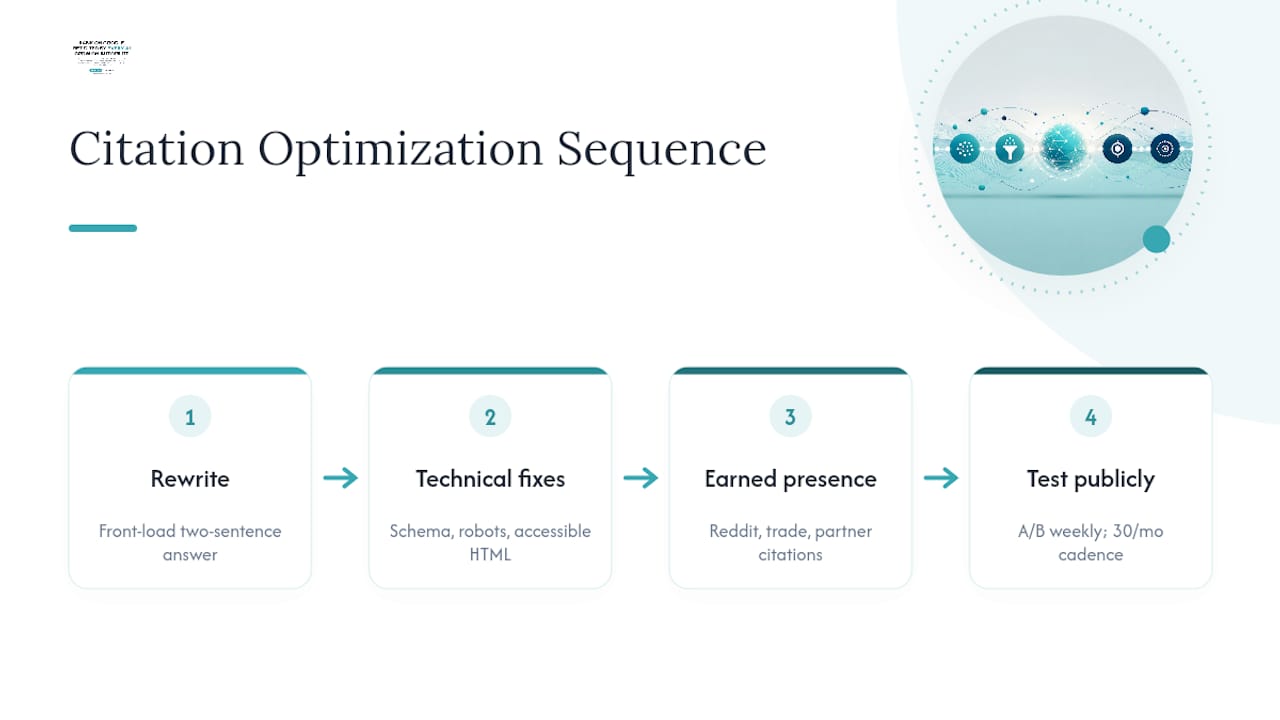
Three categories of work drive most of the citation gains: editorial rewrites, technical readiness, and earned presence off your own site. Treat them as a sequence, not a menu.
1. Rewrite for extraction, not persuasion. Open every important section with a two-sentence answer that would make sense if someone copied it out of context and dropped it into a chat window. Follow it with a specific statistic and, where you have one, a short quote from a named source. Practitioner guidance from Search Engine Land points to this front-loaded, self-contained structure as the single most consistent trait among frequently cited pages. Build dedicated single-topic explainers and FAQ blocks instead of one sprawling page trying to answer six questions at once.
2. Fix the technical layer models actually read. Schema markup that tags facts, prices, and entities gives retrieval systems structured data instead of forcing them to guess. An llms.txt file, still new but increasingly checked by AI crawlers, signals which parts of your site are safe and useful to reference. Clean canonical tags and accessible HTML (no critical content locked behind JavaScript rendering) keep your pages inside the retrieval pool at all. Google Search Central still treats core SEO health, indexability, mobile usability, page speed, as a prerequisite for any AI feature eligibility.
3. Build presence outside your own domain. LLMs frequently pull from third-party platforms, review sites, and forums rather than brand pages alone. A steady stream of Reddit mentions, trade publication citations, and partner site references does more for AI visibility than another blog post nobody else links to. Industry platforms like The Build are the kind of trusted third-party presence models tend to lean on when a query touches a specific trade or vertical.
4. Test in public, fast. Run A/B versions of the same page, one with front-loaded facts, one without, and check citation behavior across your target LLMs weekly. A 30-article-a-month cadence gives you enough surface area to run these tests across dozens of topics simultaneously instead of waiting months for a single page to prove itself.
Pro Tip: Before rewriting an entire page, test the fix on just the opening paragraph of your highest-traffic post. If citation frequency shifts within two or three weeks, you’ve found your template for the other 29 pages that month.
How Do You Measure GEO Performance?
Rankings and organic sessions don’t tell you whether an AI engine ever mentioned your brand. You need a parallel set of KPIs built specifically for citation behavior.
The primary metrics worth tracking:
- AI citation frequency: how often your brand or domain appears in generated answers across ChatGPT, Claude, Perplexity, and Gemini for a defined prompt set
- Share of voice: your citation rate relative to competitors answering the same category of question
- Context triggers: which specific prompts or phrasings pull your content into an answer, and which ones return competitors instead
- Sentiment: whether the AI’s summary of your brand is accurate and favorable, not just present
- Downstream clicks and conversions: the smaller but still measurable traffic segment that does click through from an AI answer
Run experiments the same way you’d run any conversion test. Change one paragraph’s opening sentence, wait two weeks, then re-run the same prompt set and compare. Add a citation to a previously uncited claim and check whether that page starts showing up. Search Engine Land’s practitioner research recommends exactly this kind of narrow, single-variable testing over broad site-wide rewrites, since it isolates which change actually moved the needle.
For tooling, weekly automated LLM visibility checks beat manual spot-checking, since prompt behavior in these models shifts often enough that a monthly check misses real movement.
What Does a Managed GEO Program Actually Deliver?
Most marketing teams don’t have the bandwidth to manually query four AI engines every week, track citation drift, and rewrite pages fast enough to matter. That’s the operational gap a managed platform is built to close.
A program built around GEO at scale typically combines:
- A consistent content cadence, 30 articles a month is enough volume to test structural changes across dozens of topics in a single quarter
- A backlink network spanning thousands of sites to build the third-party presence that AI engines already lean on
- Weekly technical audits checking schema completeness, llms.txt readiness, and crawlability, the same technical layer covered above
- Daily Reddit opportunity surfacing, since community threads are a recurring source LLMs draw from when generating recommendations
- Weekly LLM visibility tracking across ChatGPT, Claude, Perplexity, and Gemini, reporting exactly which prompts cite you and which cite a competitor instead
Stellor’s free AI Visibility Audit, delivered within 48 hours of signup, reports current citation status across 25 buyer prompts, a competitor benchmark, a technical site report, and a 90-day action plan specifying what publishes in the first 30, 60, and 90 days.
The uplift math: GEO-bench testing found that adding citations, quotations, and statistics to existing content increased visibility in generative engine answers by 30 to 40 percent. A monthly publishing cadence compounds that lift across a growing set of pages instead of betting it all on one rewrite.
The Gap Between GEO Theory and GEO Practice
Most GEO advice online stops at “add citations and structure your content better,” treating it like a one-time formatting fix. That’s incomplete. The GEO-bench research is genuinely rigorous, but a single optimized page tells you almost nothing about whether your brand is winning citations across the dozens of prompt variations real buyers actually type into ChatGPT or Perplexity.
The overlooked piece is volume and cadence. One well-structured article might get cited once. Thirty structured articles a month, tested against real prompt data, start shifting share of voice across an entire category. That’s a publishing and measurement problem, not a writing problem, and most marketers treat it as the latter.
Where conventional advice actually falls short is the assumption that GEO replaces SEO. It doesn’t. Crawlability, technical health, and content quality remain the floor. GEO adds a second, parallel layer of extractability and citation-worthiness on top of that floor. Prioritize the front-loaded rewrite first, since it’s the fastest lever. Build the measurement habit second. Everything else follows from having accurate data on what’s actually getting cited.
— Cole
Get GEO and SEO Running on One Platform
Most teams trying to do this manually end up paying for a content agency, a backlink vendor, a technical SEO tool, a Reddit monitoring workflow, and a separate AI tracking tool, five subscriptions to cover one job. Stellor replaces that stack for $199 a month, combining everything in this guide into a single managed system.
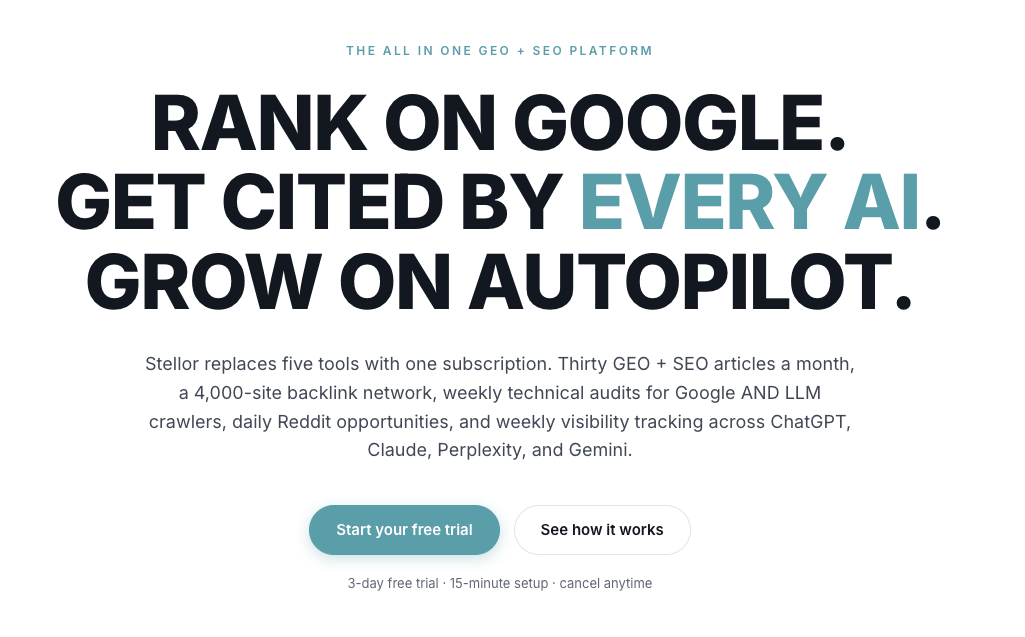
The platform publishes 30 GEO and SEO-optimized articles a month, built around the front-loaded, cited structure covered above. It runs on a 4,000-site backlink network for the third-party presence AI engines pull from, plus weekly technical audits and daily Reddit opportunity surfacing. Weekly LLM visibility tracking across ChatGPT, Claude, Perplexity, and Gemini shows exactly when your brand gets cited and when a competitor takes the spot instead.
Start with the free 3-day trial, no credit card required, and claim the free 48-hour AI Visibility Audit to see your current citation status before committing to anything.
Sources
- GEO: Generative Engine Optimization | ACM SIGKDD proceedings
- Generative engine optimization (GEO): How to win AI mentions — Search Engine Land
FAQ
What Is Generative Engine Optimization in Simple Terms?
GEO is the practice of structuring web content so AI answer engines like ChatGPT and Perplexity can extract and cite it in generated responses, rather than optimizing purely for search-engine rankings.
How Is GEO Different From SEO?
SEO targets ranking position and clicks, while GEO targets citation frequency and share of voice inside AI-generated answers; both still depend on crawlable, technically healthy pages.
Does Adding Citations Really Improve AI Visibility?
Yes. GEO-bench testing found that adding citations, quotations, and statistics to content increased its visibility in generative engine answers by roughly 30 to 40 percent.
What Should Marketers Change First for GEO?
Rewrite your highest-traffic pages so the first two sentences of each section fully answer the question, then back that answer with a sourced statistic or quote.
Can a Platform Like Stellor Track AI Citations Automatically?
Yes. Stellor runs weekly visibility checks across ChatGPT, Claude, Perplexity, and Gemini, reporting which prompts cite your brand and which cite a competitor instead.
Is Reddit Really Relevant to AI Search Visibility?
Yes. AI answer engines frequently pull from community discussions when generating recommendations, which is why steady, authentic Reddit presence has become a measurable part of GEO work.