

Fix your Google Business Profile and launch a review request flow first. That single move captures the most Map Pack visibility fastest, since A large majority of “garage door repair near me” searches trigger the Map Pack and review velocity drives who show up in it. From there, pick one provider path: a local agency, a freelancer, in-house staff, or an automated GEO+SEO platform.
TL;DR:
- Prioritize fixing your Google Business Profile and establishing a review flow to quickly gain Map Pack visibility, as most local searches trigger this feature.
- Use dedicated service and city pages with local content, real photos, and structured data to attract research-stage traffic and improve local rankings.
- Build review velocity by aiming for 8 to 15 new reviews per month and responding promptly to increase recent review influence on rankings.
- Select a provider based on proven local SEO work, specific deliverables, and transparent processes, avoiding promises of guaranteed quick Map Pack wins.
- Expect initial SEO results within 30 to 90 days, with full lead volume growth typically materializing after 12 months of consistent effort.
Table of Contents
- Garage Door Company SEO: Who Should Do the Work?
- How Do You Improve Garage Door Company SEO?
- What Content Actually Wins Garage Door Searches?
- How Do You Choose a Garage Door SEO Provider?
- How Long Does Garage Door SEO Take?
- How Stellor Handles Garage Door Company SEO
- What I’d Actually Prioritize First
- Try the Stellor Alternative to a Traditional SEO Retainer
- Sources
- FAQ
Garage Door Company SEO: Who Should Do the Work?
Search engine optimization for garage doors isn’t one job. It’s four or five overlapping ones: Google Business Profile management, service page writing, review generation, citation cleanup, and technical maintenance. Before you hire anyone or assign it internally, figure out which class of provider actually matches your budget and your timeline.
Local SEO agencies specialize in service-area businesses and usually bring templated playbooks for GBP, citations, and service pages. They tend to show first movement in Google Business Profile visibility within 30 to 60 days, since that work doesn’t require new content or backlinks to take effect. Retainers commonly run from a few hundred to a few thousand dollars a month depending on how many locations you operate and how competitive your city is. This path fits multi-location operators who want hands-off execution and don’t mind a monthly invoice with variable transparency into what’s actually being done.
Freelancers offer the lowest overhead and the most direct communication, but capacity is the tradeoff. One person can’t run 30 pages of content, a citation cleanup, and a review campaign simultaneously without stretching timelines. Freelancers work well for a single-location owner who needs a GBP fix and three or four service pages done right, not a full-scale content operation.
In-house marketing gives you control and institutional knowledge of your service area, but most garage door companies don’t have a full-time SEO specialist on staff, and part-time attention to SEO tends to produce part-time results. This route makes sense only if you already have marketing headcount and can dedicate real hours weekly, not an afternoon a month.
GEO+SEO platforms automate the repetitive parts (content publishing, technical audits, backlink placement) so a small team can operate at agency scale without agency headcount. This suits owners who want SEO strategies for local services that don’t hinge on one freelancer’s calendar or a slow agency onboarding process.
- Local agency: best for franchises or multi-city operators wanting done-for-you execution
- Freelancer: best for single-location shops with a tight, specific ask
- In-house: best for companies with dedicated marketing staff and time
- GEO+SEO platform: best for owners who want consistent volume without managing vendors
How Do You Improve Garage Door Company SEO?
Once you’ve picked a provider path, the actual work follows a predictable order. Here’s the sequence that produces calls fastest, based on how local search actually ranks emergency service businesses.
-
Optimize your Google Business Profile completely. Set your primary category to “Garage Door Supplier” or “Garage Door Repair Service” depending on your core business, then add every applicable service under Services (spring repair, opener installation, panel replacement, emergency repair). Upload real job-site photos weekly, post updates twice a month, answer the Q&A section proactively before customers ask, and turn on messaging. List emergency hours explicitly if you offer 24/7 service. This is the highest-leverage step in garage door repair SEO because Map Pack visibility depends heavily on profile completeness and activity.
-
Build dedicated service and city pages. Don’t run one generic “services” page. Build individual pages for spring repair, opener repair, panel replacement, and installation, then cross them with your service cities if you cover more than one. Use clean URL structures like
/garage-door-spring-repair-denver, put the primary service in the H1, and structure H2s around the questions people actually ask (cost, timeline, warning signs). Add LocalBusiness and Service schema markup so Google and AI crawlers can parse exactly what you do and where. Include real photos and honest pricing ranges. Vague “call for quote” language converts worse than a stated range, even a wide one. -
Build review velocity, not just review count. Aim for 8 to 15 new reviews a month in your first few months, a target that reflects how much review recency and volume influence Map Pack placement more than raw lifetime count. Ask for reviews at the moment of job completion, not days later by email, when the customer’s satisfaction is freshest. Reply to every review, good or bad, within 48 hours. Pull recurring phrases from your best reviews (“fixed my spring same day,” “showed up in an hour”) and echo that language on your service pages.
-
Lock down citation consistency. Your business name, address, and phone number need to match exactly across Google, Bing, Yelp, Angi, and any garage door manufacturer directories you qualify for (Clopay, Amarr, and similar brands often list certified dealers). Add your Chamber of Commerce and BBB listings too. Inconsistent NAP data is one of the quieter reasons a well-built site still underperforms in the Map Pack.
-
Fix the technical basics. Pages need to load in under three seconds, particularly on mobile, since page speed directly affects conversions for urgent, phone-first searches. Confirm mobile usability, implement structured data correctly, set canonical tags so duplicate location pages don’t cannibalize each other, and check crawl health monthly using Google Search Console. A technical SEO audit that flags these issues before a customer bounces is worth more than another blog post.
Pro Tip: Put your phone number in a click-to-call button at the top of every mobile page, above the fold. Garage door emergencies are decided in seconds, and a customer who has to scroll to find your number will call the next result instead.
What Content Actually Wins Garage Door Searches?
Content for a garage door company splits into two intents that behave nothing alike. Emergency searchers (“garage door won’t open,” “spring snapped”) want a fast answer and a phone number. Replacement searchers (“garage door installation cost,” “best garage door styles”) want photos, pricing context, and comparisons before they call anyone.
Emergency pages should open with a short diagnosis of the problem, a click-to-call button, and a compact checklist of what your technician will check on arrival. Skip long backstory. A customer with a door stuck open at 11pm doesn’t want your company history; they want confirmation you can show up tonight.

Replacement and installation pages carry the opposite structure: photo galleries of completed jobs, pricing ranges by door type and material, long-form FAQs covering warranty and maintenance questions, and comparison content (steel versus wood, insulated versus non-insulated). These pages do more work over time because they capture research-stage traffic weeks before the purchase decision.
City pages need a genuinely local angle; a page that just swaps the city name into a templated paragraph reads as thin to both readers and Google. Include neighborhood-specific service notes, local project photos, and testimonials from customers in that actual city. A generic aggregated list of “cities we serve” with no unique content per city rarely ranks and does nothing for AI visibility either.
Speaking of AI visibility: ChatGPT, Perplexity, and Gemini favor pages that open with a direct, BLUF-style answer to the query rather than a slow narrative windup. Structure your FAQs as literal question headings with concise answers, use schema markup consistently, and don’t neglect Reddit threads and Q&A forums where AI tools pull real-world recommendations.
Publishing cadence matters more than any single page. A trickle of one post a month rarely builds topical authority fast enough to matter. Sites that maintain consistent output, something closer to 30 pieces a month covering every service, city, and question combination, compound their authority far quicker than sporadic publishing ever does.
How Do You Choose a Garage Door SEO Provider?
Vetting an SEO vendor for a garage door company comes down to proof, not promises. Any agency or freelancer worth hiring should be able to show you real, specific work, not a generic capabilities deck.
Look for these capabilities before signing anything:
- A documented Google Business Profile program with before/after examples from other local service clients
- Live examples of service-area pages they’ve built, not just a description of the process
- Evidence of local link-building or citation work specific to home services
- Call tracking or lead attribution tied to actual revenue, not just traffic and ranking screenshots
When you’re on a sales call, ask these questions directly:
- “Can you show me a Google Business Profile you’ve optimized in the last 30 days, including before-and-after screenshots?”
- “Can you build me one sample city or service page as a trial deliverable before I commit to a retainer?”
- “What’s your exact process for generating review requests, and how many reviews per month should I expect?”
- “How do you report results, specifically calls and leads tied to organic traffic, not just keyword rankings?”
Watch for these red flags. A vendor promising guaranteed Map Pack placement within days is either inexperienced or dishonest, since Google’s algorithm doesn’t work on fixed timelines. Vague deliverables like “monthly SEO work” with no itemized list of pages or tasks usually mean you’re paying for very little. And any provider who can’t produce a single local example in your industry or an adjacent home-services vertical hasn’t done this work before.
How Long Does Garage Door SEO Take?
Set your expectations by milestone, not by wishful thinking. Google Business Profile improvements and review flow can show early signs of traction within 30 to 90 days, since that work doesn’t depend on new content indexing. Map Pack position shifts typically become visible in the 60 to 90 day range, and broader organic traffic gains tend to show up between months 3 and 6. Full maturity, where lead volume is steady and less dependent on any single ranking, usually arrives at 12 months or beyond.
| Approach | Speed to first wins | Typical monthly cost shape | Hands-on effort required |
|---|---|---|---|
| DIY / tools only | Slow, 3+ months | Low, mostly time cost | Very high |
| Freelancer retainer | Moderate, 60 to 90 days | Low to mid, few hundred dollars | Moderate |
| Local agency retainer | Moderate, 60 to 90 days | Mid to high, four figures monthly | Low to moderate |
| GEO+SEO platform | Moderate, 60 to 90 days | Flat subscription | Low |
How Stellor Handles Garage Door Company SEO
Stellor runs the same playbook above on autopilot instead of leaving it to a single freelancer’s bandwidth or a slow agency queue. It publishes 30 GEO-optimized service, city, comparison, and FAQ pages a month, backed by a 4,000-site backlink network for the off-page authority signals that protect rankings against copycat competitors. Weekly technical audits catch page speed and schema problems before they cost you a call. A Reddit engagement module and weekly LLM visibility tracking across ChatGPT, Claude, Perplexity, and Gemini show exactly when your business gets cited, or when a competitor does instead.
This fits multi-location operators and busy owners who want the volume and consistency of an agency without managing five separate vendors or waiting on a single writer’s calendar.
What I’d Actually Prioritize First
If I were running a garage door company today, I’d ignore most of the advice telling you to “build a content strategy” before your Google Business Profile is even complete. Sequence matters. Fix GBP and get review requests flowing first, because that’s the fastest lever with the shortest feedback loop. Service pages come second. Broader content and backlinks come third, because they compound slower and reward patience more than urgency.
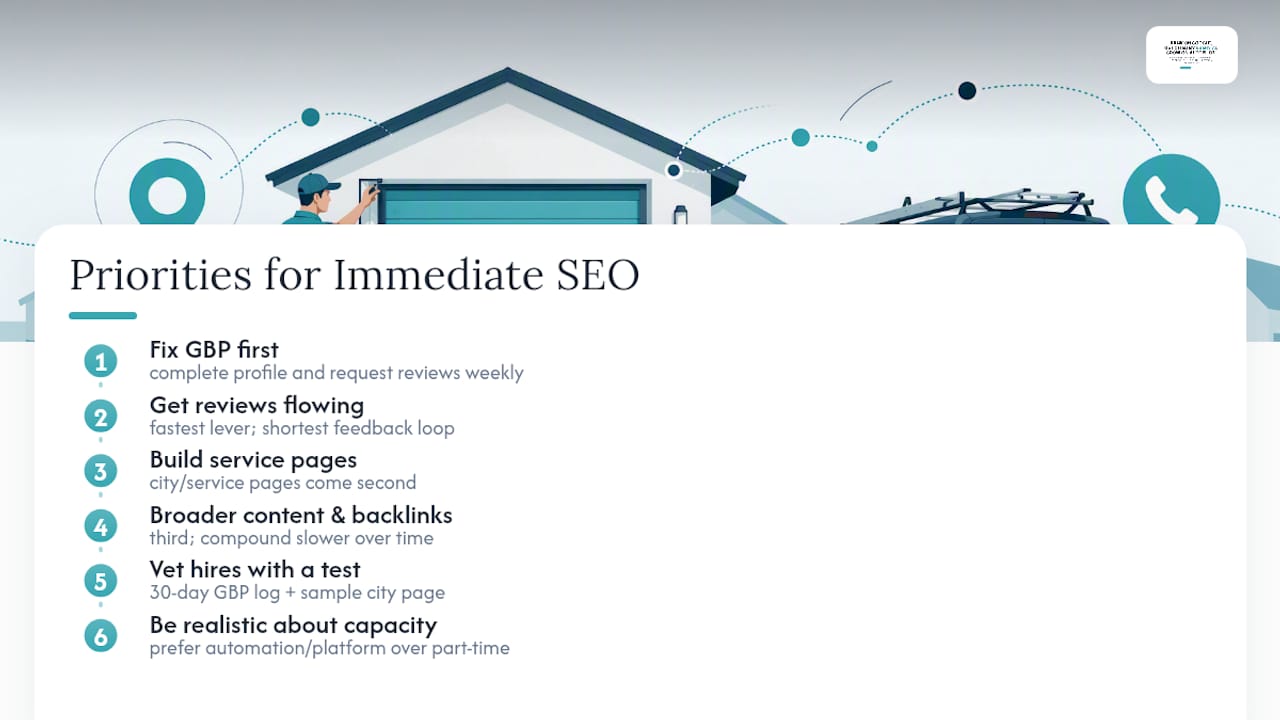
Before hiring anyone, run a small test: ask for a 30-day GBP activity log and one sample city service page. That single deliverable tells you more about a vendor’s actual competence than any pitch deck. If they can’t produce it or hedge on timelines, walk away.
And be honest about your own capacity. If you don’t have someone who can commit real weekly hours to this, automation usually beats a part-time in-house effort, and a platform beats an agency you can’t audit month to month.
— Cole
Try the Stellor Alternative to a Traditional SEO Retainer
Stellor is the alternative to hiring a local SEO agency for garage door SEO, and the concrete difference is what you get for one flat subscription: 30 GEO and SEO-optimized articles a month, a 4,000-site backlink network, weekly technical audits, and weekly AI visibility tracking across ChatGPT, Claude, Perplexity, and Gemini, all replacing what would otherwise take five separate vendors to assemble.
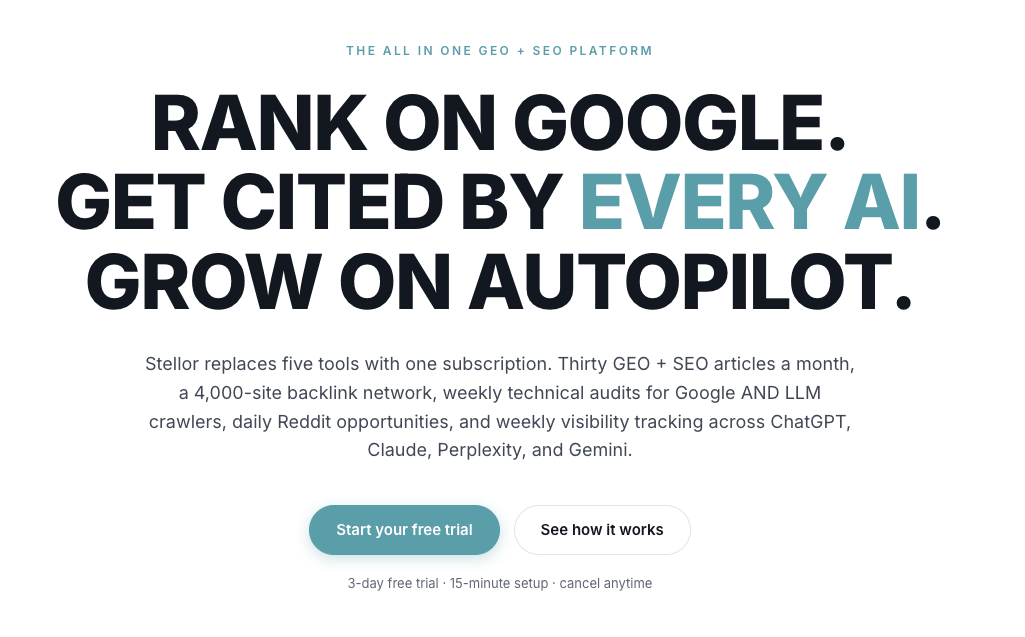
Instead of vetting a freelancer’s availability or waiting on an agency’s onboarding queue, you get a free AI Visibility Audit within 48 hours of setup, covering your current AI citation status, a competitor benchmark, a technical site report, and a 90-day action plan. Onboarding takes about 15 minutes, and the 3-day free trial requires no credit card. If your GBP and review flow are already handled, this is the next lever: content volume and AI citation tracking running on autopilot instead of on your calendar. Visit the Stellor product page to start the trial.
Sources
For deeper technical grounding beyond this guide, check Google Search Central for official crawling and indexing documentation, and Schema for the structured data vocabulary behind LocalBusiness and Service markup. Backlinko’s on-page SEO guide and SEMrush’s technical SEO guide cover the mechanics referenced throughout this article in more depth.
FAQ
How Much Should I Pay for Garage Door SEO Services?
Costs vary by provider type: freelancers often run a few hundred dollars monthly, local agencies commonly charge four figures monthly depending on city competitiveness and location count, and platform subscriptions run on a flat monthly rate. Stellor’s platform starts at a flat monthly subscription covering content, backlinks, audits, and AI tracking in one plan.
How Do I Advertise a Garage Door Company Online?
Combine organic local SEO (Google Business Profile, service pages, reviews) with paid search ads targeting your top money terms like “garage door repair near me” and “spring repair,” since paid ads capture immediate visibility while organic rankings build over months. Running both together also gives you keyword and conversion data that improves your organic content strategy.
Is SEO Still Worth It for Garage Door Companies in 2026?
Yes. Local searches for garage door repair and installation continue to trigger the Google Map Pack at a very high rate, and AI answer engines are now pulling from the same well-structured, review-backed local pages that rank organically. Ignoring SEO means ceding both channels to competitors who’ve built the profile, reviews, and content you haven’t.
What Should I Look for in the Top Garage Door SEO Companies?
Look for documented Google Business Profile results, live service and city page examples, a clear review generation process, and reporting that ties leads back to actual calls and revenue rather than just rankings. Firms like Blue Corona are commonly cited in this space for home-services digital marketing, though you should still request the same proof points from any provider regardless of name recognition.
What Are the Highest-Priority “Money Terms” for Garage Door SEO?
Focus on a short list of 4 to 6 high-intent phrases such as “garage door repair near me,” “spring repair,” and “opener repair” rather than a long, unfocused keyword list, since these terms carry the highest call-conversion rates for emergency and near-term replacement searches.