

TL;DR:
- A fully managed SEO content service provides end-to-end content creation, technical SEO, backlink building, and performance reporting. It includes ownership of all content, transparent analytics, and a concrete 90-day plan before ongoing commitment. Trystellor offers these services for $199 monthly, with a free trial and comprehensive AI visibility tracking.
A fully managed SEO content service setup is a done-for-you subscription that handles content production, technical SEO, backlink delivery, and performance reporting so your site earns organic traffic without an in-house team. For most small and medium-sized businesses, the right starting move is a fixed-cadence subscription that includes an onboarding audit and a concrete 90-day action plan before you commit to month two. Trystellor delivers exactly that: 30 GEO and SEO-optimized articles per month, a 4,000-site backlink network, weekly technical audits, and LLM visibility tracking across ChatGPT, Claude, Perplexity, and Gemini, all for $199/month with a 3-day free trial and no credit card required.
Before you sign anything, confirm your vendor will:
- Publish directly to your CMS (WordPress, Webflow, Ghost, or custom) with schema.org structured data on every article
- Connect to your GA4 and Google Search Console accounts while leaving you as admin
- Deliver a free AI Visibility Audit within 48 hours and a written 90-day action plan
- Hand over full content ownership if you cancel
- Report weekly on indexed pages, keyword movements, and backlink velocity
For a deeper look at how local SEO content strategies translate into measurable rankings, Trystellor’s resource library is a practical starting point.
Table of Contents
- What does a fully managed SEO content service actually include?
- How to set up your fully managed SEO content service: the onboarding checklist
- What should you expect to pay, and what are the red flags?
- What results can you realistically expect and when?
- How do you choose the right provider?
- What proof should you request before committing?
- How Trystellor’s fully managed setup works in practice
- Data privacy and security during onboarding
- Key Takeaways
- The one thing most SMBs negotiate wrong
- Trystellor replaces five vendors at a fixed monthly price
- Useful sources for onboarding verification
- FAQ
What does a fully managed SEO content service actually include?
The scope varies by vendor, but a genuine full-service offering covers five core pillars. Understanding each one helps you spot gaps in a vendor’s proposal before you sign.
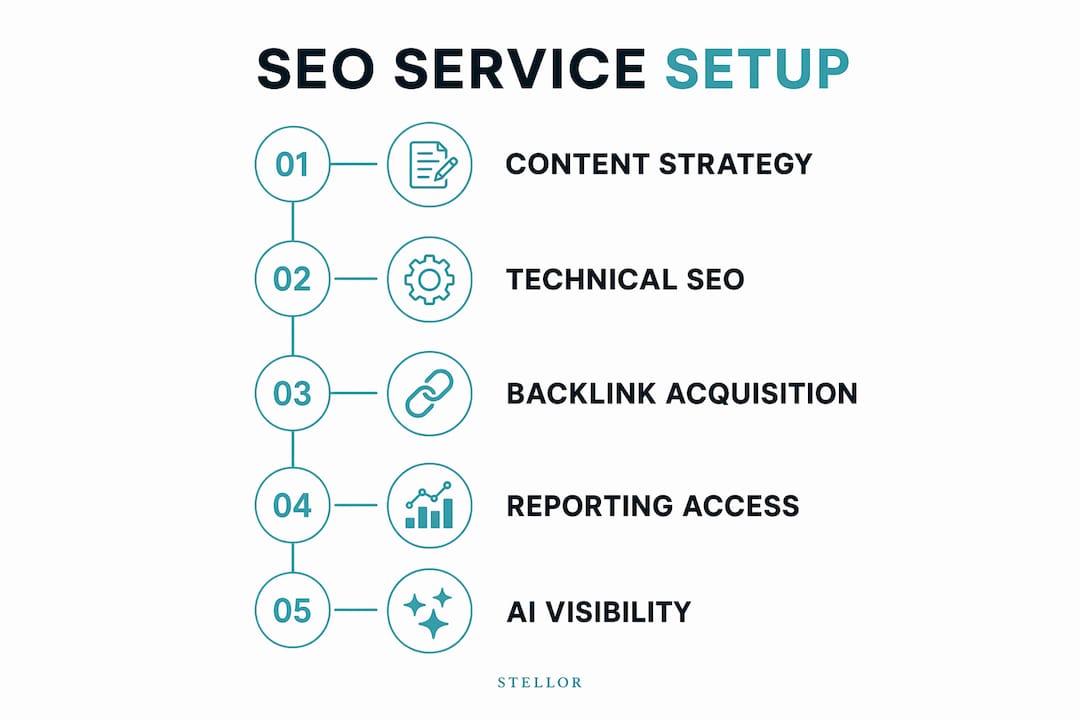
Content strategy and production. A managed service should own your keyword research, content calendar, and article production end to end. That means researched, on-page-optimized articles with proper heading hierarchy, internal linking, and schema markup baked in at publish time, not added as an afterthought. Platforms that integrate optimization into the writing process, scoring content across dimensions like keyword usage, heading structure, and NLP term coverage, produce more consistent output than those that rely on a single editor’s judgment.
Technical SEO audits and fixes. Weekly crawls should surface broken links, redirect chains, Core Web Vitals failures, sitemap errors, and indexation gaps. The best vendors remediate issues directly rather than handing you a spreadsheet and wishing you luck. An SEO-aware CMS can automate canonical tags, sitemaps, and server-rendered HTML, which cuts the developer handoffs that slow most publishing pipelines.

Backlink acquisition. A managed backlink program should place links on relevant, vetted publishers, not private blog networks. Ask for domain rating ranges, link acquisition methods, and a sample list of referring domains. This is where most cheap services cut corners.
Reporting and account access. You should receive weekly or monthly reports tied to GA4 and Google Search Console data, with keyword movement, organic sessions, and conversion signals clearly labeled. You retain admin access to every account, always.

AI and LLM visibility tracking. This is the newest pillar and the one most vendors skip. AI answer engines like ChatGPT and Perplexity now draw on Reddit threads, structured data, and llms.txt configurations when generating recommendations. A managed service that monitors your citation status across those platforms gives you a measurable edge most competitors do not yet have. Trystellor’s AI visibility approach tracks exactly which buyer prompts your business is winning and losing each week.
Common add-ons worth asking about: image creation, social distribution, editorial approval workflows for regulated industries (healthcare, legal, financial services), and white-label reporting for agencies.
How to set up your fully managed SEO content service: the onboarding checklist
Most onboarding delays come from two places: missing access credentials and undefined approval workflows. Work through these steps in order.
- Discovery call. Share your services, target locations, brand voice guidelines, and any content you have already published. The vendor uses this to train their content engine and avoid duplicating existing work.
- Baseline audit. Request a technical audit (crawlability, Core Web Vitals, sitemap, schema), a content audit (thin pages, keyword gaps, duplicate content), and an AI Visibility Audit covering your current citation status across buyer prompts. A solid SEO audit checklist maps technical, on-page, and backlink priorities in one pass.
- CMS access. Grant a publisher role or short-lived write credentials, not admin. Most managed services need only the ability to create and publish posts.
- GA4 and Google Search Console verification. Add the vendor as a Viewer or Analyst in GA4 and as a Full User in Search Console. You keep Owner-level access. Confirm they connect both tools to their reporting dashboard before month one begins.
- Crawl budget and sitemap check. Verify your XML sitemap is submitted in Search Console and that your robots.txt is not accidentally blocking key directories.
- Schema and structured data plan. Agree on which schema types apply to your content: Article, LocalBusiness, FAQ, HowTo, Service. This matters for both Google rich results and AI crawler legibility.
- llms.txt configuration. If your vendor tracks AI visibility, confirm they will configure or audit your llms.txt file so AI crawlers can correctly index and cite your pages.
- Editorial workflow and approval settings. Decide whether content publishes automatically or routes to you for review first. For regulated industries, a staging-and-approval step is non-negotiable.
- Keyword map and content calendar sign-off. Review the first 30-day content plan before a single article is written. Confirm topic clusters, target URLs, and internal linking logic.
- Backlink strategy and safety checklist. Ask for the vendor’s link acquisition method, domain rating minimums, and a sample list of publisher sites. Confirm no private blog networks are involved.
Pro Tip: Ask for your AI Visibility Audit and written 90-day action plan within 48–72 hours of signing up. A vendor who cannot produce both quickly is telling you something important about their operational readiness.
What should you expect to pay, and what are the red flags?
Managed SEO content services in the U.S. market generally fall into three pricing shapes.
- Monthly retainer by scope. A dedicated manager handles a defined set of deliverables each month. Setup fees of $250–$500 are common and cover the baseline audit, GA4/Search Console configuration, and the initial 90-day strategy document.
- Per-article pricing. You pay per published piece, typically with schema, images, and CMS publishing included. This model works for businesses that want predictable per-unit costs but can result in inconsistent publishing cadence.
- Tiered subscription (content + links + technical). A fixed monthly fee covers a set article volume, backlink quota, audit cadence, and reporting. This is the model Trystellor uses: one price, all five pillars, no add-on surprises.
What inclusions look like at each price band: Entry-level plans ($199–$500/month) typically cover 4–10 articles, basic technical audits, and monthly reporting. Mid-tier plans ($500–$1,500/month) add backlink programs, more content volume, and dedicated account management. Enterprise plans above $1,500/month usually include daily content delivery, full content strategy, topic cluster architecture, and bi-weekly strategy calls.
Red flags to watch for:
- Vague deliverables (“we’ll publish content regularly”) with no defined volume or cadence
- Content ownership clauses that revert rights to the vendor on cancellation
- Backlink methods described only as “outreach” with no domain list available
- No direct access to your GA4 or Search Console data
- Automatic annual renewals with 60-day cancellation notice requirements
- Ranking guarantees (no ethical SEO vendor can guarantee a specific position)
Negotiation baseline: insist on client ownership of all content and accounts from day one, a trial period or audit before the first full month, and a written 90-day action plan with measurable milestones. For local service businesses, the content ownership clause is especially important because your service-area pages and location content are long-term assets.
What results can you realistically expect and when?
SEO compounds. The first 30 days rarely produce ranking jumps, but they set the foundation that makes months 4–12 pay off.
| Timeline | Primary Activities | KPI to Watch |
|---|---|---|
| Days 1–30 | Baseline audit, GA4/GSC setup, schema fixes, first content batch published | Indexed pages, Core Web Vitals baseline, crawl errors resolved |
| — | Content cadence ramp, technical fixes deployed, backlink program starts | Keyword impressions in Search Console, referral domain count |
| — | Content clustering, internal linking depth, backlink velocity building | Targeted keyword position movements, organic session growth |
| Months 4–6 | Topical authority building, AI citation appearances, conversion tracking | Organic sessions, AI citation mentions, leads from organic |
| Months 7–12 | Compounding traffic, featured snippet capture, steady conversion lift | Revenue from organic, keyword portfolio breadth, AI citation rate |
For SMBs, realistic half-year expectations include meaningful movement on multiple target keywords, a measurable increase in organic sessions, and initial AI citation appearances for branded and category queries. Over time, a well-executed managed program typically produces a content library deep enough to establish topical authority in your service category.
KPIs to track weekly: indexed pages, Core Web Vitals scores, crawl errors, backlink velocity.
KPIs to track monthly: organic sessions, targeted keyword positions, conversion rate from organic, AI citation mentions across ChatGPT/Perplexity/Claude/Gemini. For a practical framework on measurable SEO results, Trystellor’s guide maps each metric to the business outcomes SMBs actually care about.
How do you choose the right provider?
The vendor call is your best due diligence tool. Go in with specific questions and listen for specificity in return.
Evaluation checklist:
- Scope: does the service cover content, technical SEO, backlinks, and reporting, or just one or two pillars?
- Content quality process: is there human editorial review, real-time SEO scoring, or both?
- Backlink safety: can they show you a sample domain list with DR/TF ranges and acquisition methods?
- Reporting transparency: do you get direct GA4 and Search Console access, or only a vendor-branded dashboard?
- Onboarding speed: can they deliver an audit and 90-day plan within 48–72 hours?
- Ownership: do you own all content and accounts from day one?
- Pricing predictability: is the monthly fee fixed, or does it grow with add-ons?
- AI visibility: do they track your citation status in ChatGPT, Perplexity, Claude, and Gemini?
Questions to ask on the vendor call:
- “Can you show me a sample 90-day action plan from a current client in my industry?”
- “What CMS platforms do you publish to directly, and how do you handle approval workflows?”
- “What is your backlink acquisition method, and can I see a sample referring domain list?”
- “What does your monthly report look like? Can I see a redacted example?”
- “What happens to my content and accounts if I cancel?”
- “Do you offer a trial period or a free onboarding audit before I commit?”
A vendor who hedges on content ownership or cannot show a sample report is a vendor to skip. Good answers are specific: a named CMS list, a real domain rating range, a redacted report PDF, and a clear cancellation policy in writing.
What proof should you request before committing?
Vendor claims are easy to make. These artifacts are harder to fake.
- Onboarding audit sample. Ask for a recent audit from a client in a comparable industry. It should include technical findings, keyword gap analysis, backlink profile baseline, and a prioritized fix list.
- Anonymized case studies with metrics. Look for organic session growth, keyword position improvements, and timeline. Vague “we grew traffic significantly” claims without numbers are not case studies.
- Sample monthly report. A real report pulls from GA4 and Search Console and shows keyword movements, content published, links acquired, and technical fixes completed. If the vendor cannot show you one, they probably do not produce one.
- Client references. Ask for two contacts you can email directly. A vendor confident in their work will provide them without hesitation.
- Backlink domain list. Request domain names, DR/TF scores, and acquisition methods for a sample link batch. Cross-check a few domains in Ahrefs or Semrush to confirm they are real, relevant publishers.
On guarantees: any vendor promising a specific ranking position is either uninformed or misleading you. What a legitimate guarantee looks like is a refund policy tied to deliverable completion (articles published, audits run, links placed), not a ranking outcome. Trystellor’s free AI Visibility Audit is a concrete example of a trust signal that costs the vendor real effort and signals genuine confidence in their product.
For local SEO link building, the domain relevance of backlinks matters as much as their authority score. A link from a local business directory or a niche trade publication carries more weight for a service-area business than a generic DR-40 blog.
How Trystellor’s fully managed setup works in practice
Trystellor consolidates what most SMBs would otherwise piece together from five separate vendors: a content production tool, a backlink service, a technical SEO auditor, a community engagement workflow, and an AI visibility tracker. The platform publishes 30 GEO and SEO-optimized articles per month directly to your CMS, each with schema markup, internal linking, and llms.txt configuration so pages are legible to both Googlebot and AI crawlers. The 4,000-site backlink network places links through vetted publishers, not private blog networks. Weekly audits run eleven checks covering schema completeness, page speed, mobile responsiveness, and structured data integrity, with one-click fixes surfaced in the dashboard.
Sample onboarding timeline:
- Hours 0–48: 15-minute setup call captures services, locations, and brand voice. Free AI Visibility Audit delivered, covering citation status across 25 buyer prompts, a competitor benchmark, technical site report, backlink profile review, and Reddit opportunity map.
- Days 7–14: Technical fixes prioritized and deployed. GA4 and Search Console connected. Schema and llms.txt configuration confirmed.
- Days 14–21: First content batch published. Keyword map and content calendar signed off. Backlink program begins.
| Dimension | Trystellor’s Approach |
|---|---|
| Content volume | Regular GEO and SEO-optimized articles published monthly to your CMS |
| Backlink approach | Vetted backlink network covering thousands of sites, avoiding private blog networks |
| Technical audit frequency | Weekly technical checks with streamlined fixes |
| AI/LLM tracking | Ongoing queries across leading AI platforms for visibility tracking |
| Reporting cadence | Regular AI visibility reports with monthly performance summaries |
| Pricing model | Affordable monthly pricing with a brief free trial period |
The free trial includes a comprehensive AI Visibility Audit. You retain the audit results even if you cancel.
Data privacy and security during onboarding
Handing a vendor access to your CMS, analytics, and hosting is a real security decision. Treat it like one.
Grant the minimum access each role actually needs. For CMS publishing, a contributor or editor role is sufficient; admin access is rarely justified. In GA4, Analyst-level access lets a vendor read data and create reports without touching account settings. In Google Search Console, Full User access covers all reporting and verification tasks while Owner access stays with you. For any hosting or SFTP access needed for technical audits, create a read-only user and revoke it once the audit is complete.
Document every access grant in a shared log with the date granted, the role assigned, and the purpose. This makes offboarding clean: when you cancel or switch vendors, you revoke each credential from the log rather than hunting through account settings.
Ask your vendor directly: where is your data stored, who on their team has access to your credentials, and what is their process for revoking access on cancellation? A vendor with no clear answer to those three questions is a vendor worth reconsidering. For regulated industries, confirm the vendor’s data handling practices align with any applicable compliance requirements before granting CMS or database access.
Key Takeaways
A fully managed SEO content service setup works when you demand ownership, transparent reporting, and a written 90-day plan before committing to month two.
| Point | Details |
|---|---|
| Demand a 90-day action plan | Require a written plan with content topics, KPIs, and milestones before signing month one. |
| Verify GA4 and Search Console access | Confirm you retain admin/owner access to both accounts at all times. |
| Require content ownership | All articles, audits, and strategy documents must be yours to keep on cancellation. |
| Track 30/60/90 KPIs | Monitor indexed pages and crawl errors at 30 days, keyword impressions at 60, and organic sessions at 90. |
| Trystellor as a starting point | Trystellor delivers 30 articles/month, a 4,000-site backlink network, weekly audits, and LLM tracking for $199/month with a 3-day free trial. |
The one thing most SMBs negotiate wrong
The conventional wisdom says to negotiate on price. That is almost always the wrong lever. A vendor who drops their monthly fee by $50 but keeps a vague deliverables clause and a locked content ownership policy has just sold you a liability, not a service.
The negotiation that actually protects you is about ownership and early milestones. Insist that every article, audit report, keyword map, and strategy document is yours from the moment it is delivered, with no proprietary claims and no ongoing fees tied to content access. Then insist on a written 90-day plan with specific, measurable milestones: how many articles published, which keywords targeted, how many backlinks placed, and what technical fixes completed. Those milestones become your exit criteria if the vendor underdelivers.
Transparent reporting matters just as much. A vendor who gives you direct GA4 and Search Console access, plus a monthly report you can verify independently, has no reason to hide underperformance. A vendor who only shares a branded dashboard they control has every incentive to cherry-pick the numbers. Short trials and free audits are not just marketing tactics; they are the fastest way to see whether a vendor’s reporting matches reality before you are locked into a retainer.
Trystellor replaces five vendors at a fixed monthly price
Most SMBs building a managed SEO program end up paying for a content agency, a link-building service, a technical audit tool, a community monitoring platform, and an AI visibility tracker separately. That stack costs more, creates reporting gaps, and requires someone on your team to coordinate five different vendors.
Trystellor consolidates all five into one subscription at $199/month. You get 30 GEO and SEO-optimized articles published directly to your CMS each month, backlinks placed through a 4,000-site vetted network, weekly technical audits with one-click fixes, daily Reddit opportunity discovery, and weekly LLM tracking across ChatGPT, Claude, Perplexity, and Gemini. The free AI Visibility Audit, delivered within 48 hours of signup, shows exactly where you stand across 25 buyer prompts and which competitors are winning the answers you should be earning. Start the 3-day free trial at trystellor.com with no credit card required, and keep the audit regardless.
Useful sources for onboarding verification
- Google Search Central documentation — the authoritative reference for crawlability, indexing, Core Web Vitals, and structured data requirements. Use it to verify any technical claim a vendor makes during onboarding.
- Schema.org structured data reference — the canonical source for schema types (Article, LocalBusiness, FAQ, HowTo). Confirm your vendor is implementing the correct types for your content.
- Trystellor AI Visibility Audit — request the free 48-hour audit to get your current citation status, competitor benchmark, and 90-day action plan before committing.
- Essential SEO audit checklist for local service businesses — a practical checklist covering technical, on-page, and backlink priorities; use it to cross-check what your vendor’s baseline audit covers.
- Local SEO link building strategies — covers backlink safety, domain relevance, and local link tactics; useful for evaluating a vendor’s backlink acquisition claims.
- Measurable SEO results for local service businesses — maps KPIs to business outcomes so you can set realistic expectations and hold vendors accountable at each milestone.
FAQ
What does a fully managed SEO content service setup include?
A complete setup covers content production, on-page SEO and schema, technical audits, backlink acquisition, GA4/Search Console integration, and monthly reporting. The best services also include AI visibility tracking across ChatGPT, Perplexity, Claude, and Gemini.
How long does onboarding take before content goes live?
Most managed services complete technical setup and publish the first content batch within 14–21 days of signup. Trystellor delivers a free AI Visibility Audit within 48 hours and typically publishes the first articles in the 14–21 day window.
What is a realistic timeline for seeing organic traffic growth?
Meaningful keyword movement typically appears in the 60–90 day window. Steady organic session growth and AI citation appearances usually build between months 4 and 6, with compounding results through month 12.
What red flags should I watch for in a managed SEO contract?
Avoid contracts with vague deliverable language, content ownership clauses that revert rights to the vendor, ranking guarantees, and automatic annual renewals with long cancellation notice requirements.
Does Trystellor include backlinks and AI visibility tracking?
Yes. Trystellor’s subscription includes a 4,000-site vetted backlink network and weekly LLM tracking across ChatGPT, Claude, Perplexity, and Gemini, alongside 30 articles per month and weekly technical audits, all at $199/month.