

Entity SEO for local businesses means helping Google and AI answer engines understand exactly who you are, what you do, and where you operate, as a verified, connected entity rather than a page full of keywords. The single highest-impact move is claiming and verifying your Google Business Profile and publishing LocalBusiness or Organization JSON-LD on your site. That one combination strengthens both your Maps ranking and your odds of being cited by AI tools.
TL;DR:
- Claim and verify your Google Business Profile and publish detailed LocalBusiness JSON-LD to improve Maps ranking and AI citation chances.
- Build an accurate entity map by inventorying all your brand, locations, and services, then create content that reflects these relationships clearly.
- Focus on consistent NAP data, accurate mentions, and ongoing review collection to strengthen your entity signals and local prominence.
- Use structured data properties like name, address, sameAs, openingHours, and geo coordinates to optimize for voice search and AI-driven answers.
- Prioritize correctness and completeness over volume in off-page citations and regularly update schema and contact info to sustain your entity authority.
Table of Contents
- What is entity SEO and how does it differ from local SEO?
- Technical foundation: structured data, JSON-LD, and claiming your presence
- Build an entity map and content architecture
- Off-page entity signals: mentions, citations, and context
- Measuring entity authority and AI citation progress
- Your 30/60/90-day entity SEO checklist
- How Stellor fits the entity SEO checklist
- Integrating entity SEO with citations, NAP, and reviews
- How voice search and virtual assistants change entity strategy
- Local influencers and partnerships as entity signals
- Common pitfalls when implementing entity SEO locally
- What to prioritize as entity SEO keeps evolving
- Try Stellor without reworking your whole stack
- FAQ
- Sources
What is entity SEO and how does it differ from local SEO?
An entity, in search terms, is a distinct, identifiable thing: your business, a location, a service, a person on your team. Google and large language models do not just match keywords anymore. They build a web of entities and the relationships between them, often called a knowledge graph, to answer questions with confidence.
Traditional local SEO focuses on keywords, citations, and backlinks. Entity SEO adds a layer on top: it asks whether search engines can confidently identify your business as a unique, verifiable entity distinct from every other business with a similar name. This distinction matters because Search Engine Journal’s entity SEO overview frames the discipline around three core practices: entity identification, relationship mapping, and measurable association-building, not just ranking for phrases.
For a local business, this plays out across three connected entity types:
- Brand entity: your business name, logo, and official site, disambiguated from competitors with similar names.
- Location entity: each physical address or service area, tied to a Business Profile and consistent contact details.
- Service entity: the specific services you offer, described consistently across your site and listings so Google can match you to the right queries.
Keywords still matter. But entities are what let an AI assistant say “this plumber serves downtown and has strong reviews” instead of guessing from scattered mentions.
Technical foundation: structured data, JSON-LD, and claiming your presence
Google’s structured-data documentation for local businesses recommends JSON-LD as the preferred format and instructs site owners to use the most specific LocalBusiness subtype available, such as Plumber, Electrician, or Dentist, rather than the generic LocalBusiness type. This is not a ranking trick. It is machine-readable documentation that explicitly declares relationships, your service area, your departments, your multi-location structure, so Google does not have to infer them from unstructured text.
The properties that carry the most weight:
- name, address, and telephone, matched exactly to your Business Profile and every directory listing.
- sameAs, linking to your verified social profiles and other official pages so Google can connect them to one entity.
- openingHours and geo coordinates, which support both Maps display and AI assistants answering “is this place open now.”
- logo and image, required for Knowledge Panel eligibility under Google’s Organization schema guidance.
Verified Business Profile listings see measurably better engagement. Google states that local ranking depends on relevance, distance, and prominence, and prominence is shaped partly by how complete and consistent your information is across the web, including reviews and links.
Verification also plays a role in what Google calls “establishing official information.” Per Google’s guidance on adding business details, a verified Business Profile combined with consistent, publicly available information gives Google more confidence in assigning Knowledge Panel ownership to your business rather than leaving it ambiguous or crediting a competitor. For hands-on examples of the actual markup, our guide on LocalBusiness schema examples walks through working snippets you or a developer can adapt directly. If you want a developer-facing reference with more implementation detail, Wexla’s guide to local business schema covers common edge cases for service businesses.
Build an entity map and content architecture
Before you can signal entity relationships, you need to know what your entities actually are. Start with an inventory: list your brand, every location, every service line, key team members, and any products you sell. A roofing company with three locations and five service types has at minimum nine distinct entities that need consistent representation across the web.

Once you have the inventory, sketch the relationships. Your brand entity sits at the center. Each location connects to it. Each service connects to both the brand and the relevant locations. This is your entity map, and it should drive your site structure, not the other way around.
Content patterns that reinforce the map:
- A canonical hub page for the brand itself, usually your homepage or about page, carrying Organization schema.
- A dedicated landing page for each location, with LocalBusiness schema and location-specific content, not a copy-pasted template.
- Service pages that reference the locations where that service is available, creating internal links that mirror the real relationships.
- FAQ sections with structured Q&A markup that answer the specific questions buyers ask about each service and location combination.
This architecture does double duty. It helps human visitors find what they need, and it gives Google and AI crawlers an unambiguous map of how your entities relate. Search Engine Land’s guide to entity-based competitor analysis covers practical techniques for identifying gaps in this kind of mapping, which is useful once your own structure is in place and you want to see where competitors are being cited instead of you.
Off-page entity signals: mentions, citations, and context
Raw backlink counts matter less for entity prominence than whether the mentions you get are accurate and contextual. A directory listing with the wrong phone number actively hurts you. A niche industry mention that correctly names your business, service, and city reinforces the entity relationships you have already built on-site.
Where reliable entity mentions come from:
- Local directories and chambers of commerce, as long as your NAP details match your Business Profile exactly.
- Niche industry sites and associations relevant to your trade, which carry more contextual weight than generic directories.
- Community forums, particularly Reddit, where AI answer engines increasingly pull real recommendations when generating responses to buyer questions.
- Local press and sponsorships that mention your business by name alongside your city or service area.
Monitoring matters as much as outreach. Set a recurring search for your business name and city to catch inconsistent listings before they spread. When you find an inaccurate mention, a quick correction request is usually enough, most directory and press sites will fix it on request.
Pro Tip: Audit your top 20 citations quarterly for NAP consistency; one wrong digit in a phone number can quietly undercut months of entity-building work.
Measuring entity authority and AI citation progress
Entity SEO is only useful if you can see it moving. Track a mix of traditional local metrics and newer AI-visibility signals.
Core local KPIs:
- Business Profile views, calls, and direction requests from Business Profile Insights.
- Maps pack ranking for your priority service and location terms.
- Organic clicks to location and service pages, tracked in Search Console.
- Review volume and velocity, since Google names review signals as part of prominence.
Entity and AI signals to watch:
- Whether a Knowledge Panel appears for your brand name search.
- How many of your sameAs links are live and correctly resolving.
- How often your business is cited when you query ChatGPT, Claude, Perplexity, and Gemini with the prompts your buyers actually use.
A weekly cadence works best for the AI checks specifically, since citation patterns shift faster than Google’s organic index. Our breakdown of how to track and win AI citations goes deeper on setting this up without manually running the same five prompts across four different tools every week.
Your 30/60/90-day entity SEO checklist
Turning this into a work plan is simpler than it looks once you sequence it correctly.
- Days 1 to 7: verify your Business Profile, publish LocalBusiness or Organization JSON-LD on your homepage and about page, and fix any NAP mismatches you find in a quick directory sweep.
- Days 8 to 30: build your entity map, publish location hub pages and structured FAQs, and add sameAs links to every verified social and review profile.
- Days 31 to 90: pursue contextual mentions on niche sites and forums, start weekly AI-visibility checks, and refine schema and content based on what you find.
| Phase | Primary focus | Key output |
|---|---|---|
| Days 1 to 7 | Verification and base schema | Verified profile, live JSON-LD |
| Days 8 to 30 | Entity mapping and content | Location hubs, sameAs links |
| Days 31 to 90 | Off-page signals and measurement | Contextual mentions, AI tracking |
For a broader audit framework that covers technical issues beyond entities, our SEO audit checklist for local service businesses is worth running alongside this plan.
How Stellor fits the entity SEO checklist
We built Stellor to automate most of the checklist above rather than leave it as a quarterly scramble. Our platform publishes 30 GEO and SEO-optimized articles a month, including the location hub pages and structured FAQs this kind of entity mapping depends on, each one built with the schema and internal linking the plan calls for.
What we automate directly:
- Content cadence: 30 articles monthly, aligned to your services and locations, with JSON-LD and internal links built in.
- Authority signals: a 4,000-site backlink network that builds the contextual mentions off-page entity signals require.
- Technical health: weekly audits covering schema completeness and the other factors that affect entity recognition.
- AI visibility: weekly tracking across ChatGPT, Claude, Perplexity, and Gemini, showing exactly when and where you get cited.
Onboarding takes about 15 minutes to capture your services, locations, and voice. Within 48 hours, we deliver a free AI Visibility Audit showing your current citation status, a competitor benchmark, and a custom 90-day action plan you keep regardless of what you decide next.
Integrating entity SEO with citations, NAP, and reviews
Entity SEO does not replace the fundamentals of local SEO, it depends on them. Citation consistency is the raw material entities are built from: if your business name, address, and phone number vary across ten directories, Google has ten slightly different signals to reconcile instead of one confident entity profile.
Reviews work the same way. Google explicitly includes review signals in its prominence factor, and review text itself often contains the service and location keywords that reinforce your entity’s scope. A plumbing company with consistent reviews mentioning “water heater repair” across multiple locations is building entity evidence every time a customer leaves feedback.
The practical order of operations is: fix NAP consistency first, because inconsistent data undermines every other effort. Layer schema and entity mapping on top of a clean citation base. Keep collecting reviews throughout, since they are an ongoing entity signal rather than a one-time task. Treat all three as one system instead of three separate projects, and the compounding effect shows up faster in both Maps rankings and AI citations.
How voice search and virtual assistants change entity strategy
Voice queries tend to be longer, more conversational, and more likely to expect a single direct answer rather than a list of ten links. A voice assistant answering “who’s the closest electrician that does emergency calls” has to pick one business, not rank ten.
This raises the bar for entity clarity. An assistant pulling from a knowledge graph needs unambiguous data: a verified address, accurate hours, and services described in plain, consistent language rather than vague marketing copy. Structured data makes this retrieval easier, since openingHours and geo properties answer exactly the kind of question a voice query asks.
The practical implication is to write service descriptions the way a customer would actually ask about them. “Emergency water heater repair available 24 hours” is more useful to a voice assistant than “comprehensive plumbing solutions.” The same clarity that helps a human skim your site helps an assistant extract a confident answer.
Local influencers and partnerships as entity signals
A mention from a recognized local figure, a neighborhood blogger, a community radio host, a well-followed local Instagram account, carries entity weight because it ties your business name to a specific place in a context readers trust. This is different from a paid directory listing: it is a contextual association that search engines and AI tools can read as independent validation.
Partnerships work similarly. Sponsoring a local event, co-hosting a workshop with another small business, or appearing in a roundup of trusted local vendors all create the kind of mention that reinforces your location and service entities without looking like self-promotion. The key is accuracy: every mention should use your correct business name and location so it strengthens the same entity rather than creating a slightly different, competing signal.
These relationships take longer to build than a directory submission, but they tend to be harder for competitors to replicate, which is part of why they carry disproportionate weight for entity prominence over time.
Common pitfalls when implementing entity SEO locally
The most common mistake is publishing structured data that is sparse or inconsistent with what appears on the page itself. Schema that claims one phone number while the visible page shows another does more harm than no schema at all, since it introduces contradiction instead of clarity.
A second pitfall is treating entity SEO as a one-time project. Business hours change, service areas expand, and team members come and go. Stale schema and outdated sameAs links erode the confidence Google and AI tools place in your entity over time.
A third pitfall is chasing volume over accuracy in off-page mentions. A hundred low-quality directory listings with inconsistent NAP data do less for entity prominence than twenty accurate, contextual ones. Prioritize correctness over count at every stage, from your first JSON-LD implementation to your last outreach email.
What to prioritize as entity SEO keeps evolving
The businesses that win here are not the ones with the most schema markup, they are the ones with the most accurate and complete information consistently represented everywhere it appears. Gimmicks like stuffing sameAs with irrelevant profiles or publishing thin location pages just to hit a page count tend to backfire as AI tools get better at detecting inconsistency.
The sustainable approach is simpler than it sounds: keep your core facts correct, keep your schema current, and keep building legitimate contextual associations. As AI citation becomes a bigger share of how customers find local businesses, the entities with the cleanest, most consistent footprint will keep compounding their advantage.
— Cole
Try Stellor without reworking your whole stack
We designed Stellor to cover this entire checklist from one subscription instead of five separate tools. Our platform handles the content cadence, the backlink network, the technical audits, and the weekly AI visibility tracking across ChatGPT, Claude, Perplexity, and Gemini, so the entity work above happens on a schedule instead of whenever you find time for it.
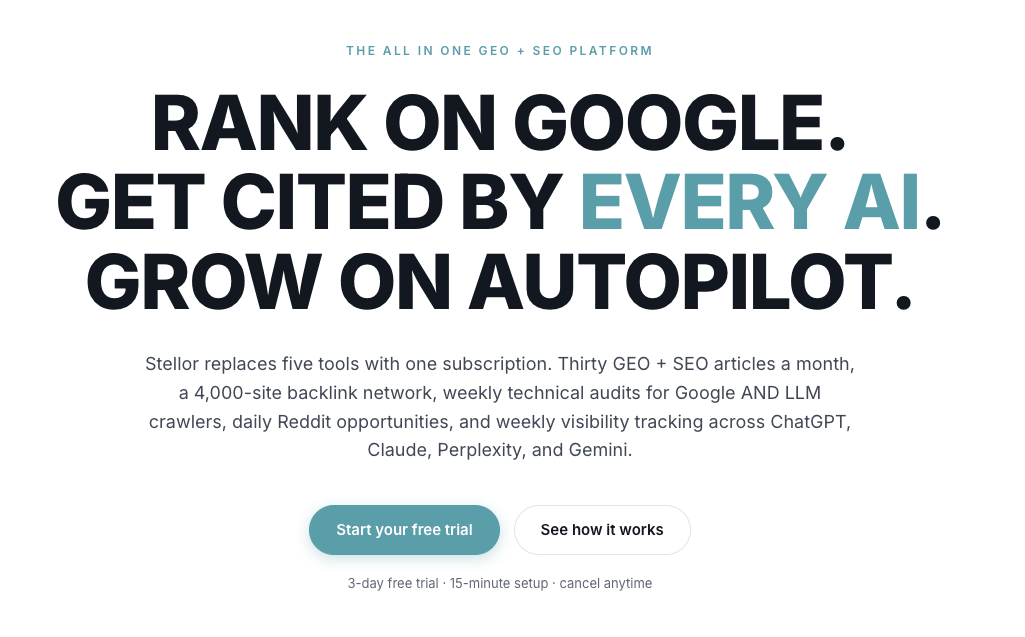
Our 3-day free trial requires no credit card, and every new account gets a free AI Visibility Audit within 48 hours showing your current citation status and a 90-day plan you keep either way.
Before choosing any vendor for this work, ask:
- Do they publish schema that matches what is actually on the page?
- Can they show you weekly AI citation tracking, not just traditional rankings?
- Do you keep the content and reports if you cancel?
If you want to see where you stand first, our blog covers more of the tactics above in depth.
FAQ
How much should I pay for local SEO?
Costs vary widely depending on scope, from a few hundred dollars a month for basic citation cleanup to several thousand for full-service agencies. Platforms that bundle content, backlinks, audits, and AI tracking into one subscription, like Stellor starting at $199 a month, typically cost less than hiring separate vendors for each piece.
Is local SEO a thing?
Yes, local SEO is a well-established discipline covering Business Profile optimization, citations, and map pack rankings, and Google publishes official guidance on local ranking factors. It remains distinct from entity SEO, though the two now overlap heavily as AI tools draw on the same structured data and profile signals.
What is entity-based SEO?
Entity-based SEO focuses on helping search engines and AI tools identify your business as a distinct, verifiable entity with clear relationships to your services and locations, rather than optimizing for keywords alone. Search Engine Journal’s overview frames it around entity identification, relationship mapping, and measurable association-building.
Is SEO dead now with AI?
No, traditional SEO still matters since Google’s organic and Maps results drive significant traffic, but AI answer engines have added a second visibility channel businesses need to track. The practical shift is toward entity clarity and structured data that serve both Google’s ranking systems and AI citation at once.