

The fastest path to more profitable electrician leads starts with finishing your Google Business Profile and turning on Local Services Ads this week, not next quarter. Layer in three tightly built service pages for EV chargers, panel upgrades, and emergency calls, and you’ll capture the searches that already convert. If you’d rather hand off the content, technical audits, backlinks, and AI visibility tracking, Stellor runs all of it as one managed system.
TL;DR:
- Completing your Google Business Profile thoroughly and applying for Local Services Ads early is essential, as verification takes one to two weeks and can delay other efforts.
- Prioritizing high-ticket, high-urgency services like EV charger installations and panel upgrades on dedicated pages boosts conversion rates and local search rankings.
- Fixing technical issues such as site speed, mobile responsiveness, and schema markup often has a bigger impact on rankings than content improvements alone.
- Running both Local Service Ads and search ads with tailored landing pages reduces overlap and maximizes cost efficiency based on the type of search intent.
- Using a managed platform like Stellor consolidates SEO, backlinks, and AI citation tracking, saving time and maintaining consistent progress for busy electrical contractors.
Table of Contents
- Electrician SEO Checklist: Seven Moves for the First 30 Days
- Why Do GBP Completeness and Reviews Determine Local Pack Rankings?
- How Do You Build Service Pages That Rank and Convert?
- What Technical Fixes Actually Unlock Rankings?
- How Should You Split Ad Spend Between LSA and Search Ads?
- How Long Until Electrician SEO Actually Pays Off?
- How Does Stellor Handle Electrician SEO for You?
- A Trades-First Take on What Actually Moves the Needle
- Get More Electrician Leads Without Managing Five Vendors
- Sources
- FAQ
Electrician SEO Checklist: Seven Moves for the First 30 Days
Electrician SEO isn’t a mystery. It’s a short list of overdue tasks most contractors have been putting off for a year. Here’s the order that gets you booked calls the fastest, based on what actually moves the needle for electrical contracting businesses competing in crowded local markets.
- Finish your Google Business Profile completely. Add your license number, full service list, real job photos, and a messaging option that actually gets answered. Post once a week, even if it’s just a finished panel upgrade photo with a caption.
- Apply for Local Services Ads and gather your verification documents now. Background checks and license verification can take one to two weeks, so this is the item most likely to bottleneck everything else.
- Publish three service pages before you touch anything else. EV charger installation, panel upgrades, and emergency electrician service cover your highest-margin and highest-urgency work.
- Automate review requests with a same-day text or email after every job, paired with response templates so nothing sits unanswered for a week.
- Add LocalBusiness and Service schema, plus FAQPage schema on your three priority pages. This is what helps Google and AI engines actually understand what you do and where.
- Confirm your site loads fast on mobile and that click-to-call buttons work without a second tap. Most electrical leads happen on a phone, often during an actual emergency.
- Set up a tracking phone number tied to a simple funnel so you know which channel, GBP, LSA, or organic, actually produced the booked job.
Pro Tip: Do the LSA application and the GBP completion in the same week. LSA approval is the slowest-moving piece, so start the clock on it while you’re still uploading photos and writing service copy.
None of these seven items require a developer or a marketing degree. They require about six focused hours and a willingness to stop treating your website as a digital business card.
Why Do GBP Completeness and Reviews Determine Local Pack Rankings?
Google Business Profile completeness and review velocity are the two biggest levers behind whether you show up in the Local Pack, the three-listing map block that appears above organic results for searches like “electrician near me.” A profile with gaps in its service list or category structure has almost no shot at that box, regardless of how good your website is.
Consumer behavior research shows review volume and recency heavily influence local click-through and booking decisions, meaning a profile with 12 reviews from two years ago loses to a competitor with 60 reviews added steadily over the past six months. Recency carries almost as much weight as total count.
What fields actually move the needle on your profile
Fill in every one of these, not just the obvious ones:
- Primary and secondary categories. “Electrician” as primary, then add specific categories like “Electrical Installation Service” if available.
- Service list with real descriptions, not just a category tag. List panel upgrades, EV charger installation, and emergency service individually.
- Business hours, including a 24/7 flag if you do emergency work. Leaving this blank costs you the after-hours search traffic entirely.
- At least 15 to 20 photos, mixing job-site work, your van, your team, and completed panels. Real contributor examples on Google Maps show how consistently updated photos keep a profile looking active rather than abandoned.
- Products or service attributes where Google allows them, like “licensed and insured” or “financing available.”
- Q&A section seeded by you with the three questions customers actually ask, before a competitor or a confused customer fills it in for you.
For a deeper walkthrough of every field and how Google weighs them, our guide on what is Google Business Profile covers the setup end to end.
By the Numbers: Industry data suggests aiming for a steady review accumulation within your first year, adding new ones regularly to keep your profile active without triggering spam filters. That cadence keeps your profile looking active without triggering suspicion from Google’s spam filters, which flag sudden review spikes.
Citation cleanup and where to check first
Inconsistent business listings across the web quietly undercut your local rankings. Check your name, address, and phone number match exactly across Yelp, Angi, Nextdoor, Better Business Bureau, HomeAdvisor, and your state electrical licensing board’s public directory if it publishes one. A mismatched suite number or an old phone line still floating on one of these sites is enough to confuse Google’s confidence in your business identity.
Local Services Ads versus search ads: when each one wins
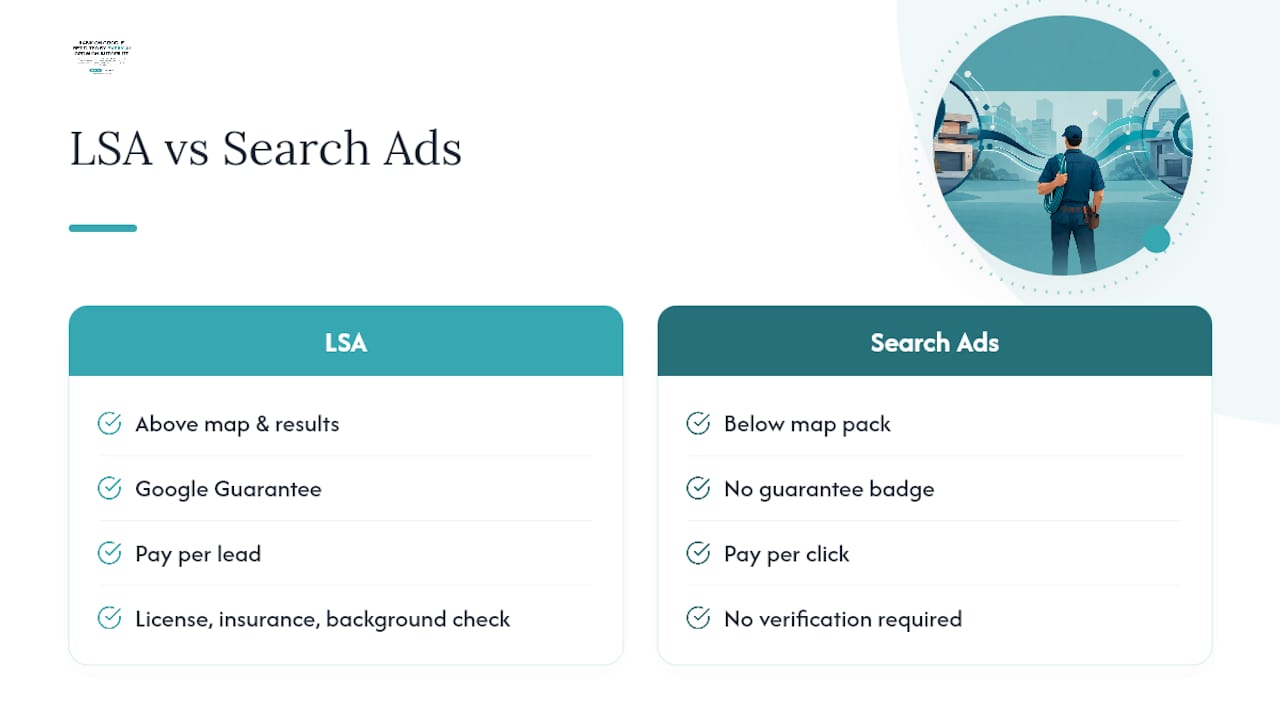
Local Services Ads sit above the map pack and standard search results, and they carry a Google Guarantee badge that standard search ads don’t get. That badge matters more for electrical work than almost any other trade, because homeowners calling about a sparking outlet want reassurance fast, not five tabs of comparison shopping.
LSA leads for electrical work generally average a moderate cost per lead in current industry benchmarks in current industry benchmarks, and that cost typically beats standard search ads for emergency and residential service categories. Verification takes one to two weeks and includes a license check, insurance proof, and a background check on the business owner. Once approved, you pay only for leads, not clicks, which makes LSA a stronger fit for reactive, urgent-need searches while search ads still win for project-intent terms where buyers are comparing quotes.
How Do You Build Service Pages That Rank and Convert?
Build your service-and-location matrix around ticket size and urgency, not around every service you technically offer. A 15-page site covering EV chargers, panel upgrades, and emergency service across your top three cities will outperform a 40-page site that spreads thin across generator installs, ceiling fan wiring, and smart-home setups nobody in your market is searching for.
The highest-ROI electricians tend to focus on three channels first, GBP, LSA, and a handful of high-value service pages, then scale outward once those are producing calls consistently, according to industry analysis of electrical contractor marketing. That’s a sharper strategy than trying to rank for 30 keywords on day one.
Which service and city combinations come first
| Priority | Service | Why it’s first |
|---|---|---|
| 1 | EV charger installation | High ticket, growing demand, buyers already own the EV so intent is strong |
| 2 | Panel upgrade | High ticket, often triggered by home sale or insurance requirement |
| 3 | Emergency electrician | High urgency, low price sensitivity, fast decision cycle |
| 4 | Additional cities in your service radius | Repeat the top three services per city once page one is proven |
EV charger installation and panel upgrades convert at higher rates than general electrical work because both are considered purchases, not emergencies, which means buyers spend more time researching and are further along when they call. That’s exactly the traffic worth building a dedicated page for.
What goes on a service page that actually converts
Structure each page the same way, even if the service changes:
- H1 with the service and your service area (“EV Charger Installation in [City]”), not a vague tagline.
- A lead paragraph answering the obvious question first: what it costs, how long it takes, whether permits are required.
- License number and insurance status stated plainly, not buried in a footer.
- Scope of work in plain language: what’s included, what’s typically extra, common complications.
- A realistic price range or starting estimate. Vague “call for pricing” pages lose to competitors willing to state a range.
- Before-and-after job photos specific to that service, not generic stock imagery.
- A single, obvious call to action: a click-to-call button and a short quote-request form, not both competing for attention.
Content that pulls its weight beyond service pages
Question-led posts are where you start winning citations from AI answer engines, not just Google’s organic results. Structured data and short, question-focused posts increase the chance of being quoted by AI systems like ChatGPT and Perplexity when someone asks “how much does a panel upgrade cost” or “do I need a permit for an EV charger.” Pair each question post with FAQ schema so the answer is machine-readable, not just human-readable.
Aim for 800 to 1,200 words on core service pages, competitive markets often need 1,500 or more to outrank established competitors, and keep FAQ posts tighter, 400 to 700 words is plenty. Link every FAQ post back to its relevant service page, and link every service page to your GBP listing and your reviews. Our guide on SEO for plumbers walks through a nearly identical page structure if you want a second reference point from an adjacent trade.
What Technical Fixes Actually Unlock Rankings?
Most electrician websites lose rankings to problems that have nothing to do with content: slow load times, broken mobile layouts, and missing structured data. Fix the technical layer first, because no amount of good copy overcomes a page that takes six seconds to load on a customer’s phone standing in a dark garage.
Prioritize these, in order:
- Mobile-first design confirmed on an actual phone, not just a browser resize. Test your click-to-call button with your thumb.
- Fast first contentful paint. Compress images, especially job-site photos, which are usually the biggest offenders on trade sites.
- HTTPS across every page, no exceptions, including old blog posts you forgot existed.
- Canonical tags set correctly so Google doesn’t index duplicate versions of your city or service pages.
- LocalBusiness and Service schema on every service page, with your license number and service area included in the markup.
- FAQPage schema on every question-led post, structured according to Schema so search engines and AI crawlers parse it correctly.
- Review snippet markup where your platform supports it, so star ratings can appear directly in search results.
- An llms.txt file signaling to AI crawlers which parts of your site are safe and useful to reference.
Pro Tip: Run a technical audit weekly, not quarterly. A broken form or a stalled sitemap can sit unnoticed for months on a site nobody checks, quietly costing you calls the entire time.
Sort every issue you find into three priority tiers. P1 covers anything blocking indexing or breaking the phone number, fix same day. P2 covers speed and schema gaps, fix within the week. P3 covers minor accessibility or formatting issues, batch these monthly. Patch small technical debt as you find it; only consider a rebuild if your site is running on a platform that can’t support schema markup or mobile responsiveness at all. Google’s own developer documentation is the most reliable reference for confirming a fix actually worked before you move to the next item.
How Should You Split Ad Spend Between LSA and Search Ads?
Local Services Ads should absorb most of your budget for emergency and residential repair calls, while standard search ads handle project-intent searches where buyers are actively comparing quotes, like “panel upgrade cost” or “EV charger installer near me.” Running both without a clear split wastes money on overlapping intent.
| Channel | Best for | Typical CPL/CPC | Notes |
|---|---|---|---|
| Local Services Ads | Emergency calls, urgent repairs | ~$39 per lead for electrical | Pay per lead, Google Guarantee badge builds trust fast |
| Search ads (project intent) | EV chargers, panel upgrades, planned work | Varies by market and competition | Pay per click, requires a strong landing page to convert |
To calculate whether a channel is worth the spend, work backward from your average ticket and close rate. If your average panel upgrade job nets $2,800 and you close one in three qualified leads, you can afford a cost per lead well above what a $39 LSA lead costs and still turn a healthy margin. Run that math before you assume a channel is too expensive.
Match every ad to a landing page built for that exact search, not your homepage. A search ad for “EV charger installation” should point to your EV charger service page, complete with pricing range and the same call-to-action button, not a generic contact page that makes the visitor hunt for relevant information.
Build a negative keyword list before you launch anything:
- “DIY” and “how to install” to filter out people who aren’t hiring anyone.
- “Jobs” and “hiring” to filter out job seekers, not customers.
- “Cheap” and “free” if your business doesn’t compete on rock-bottom pricing.
- Brand names of tools or parts suppliers unrelated to installation services.
How Long Until Electrician SEO Actually Pays Off?
Set expectations by channel, because conflating them is how business owners give up on SEO too early. Local Services Ads can start generating calls within days of approval. Search ads produce clicks immediately, though conversion quality takes a few weeks to stabilize as you refine targeting. Organic SEO, service pages, FAQ content, and technical fixes typically need four to twelve weeks before you see consistent local traction, and competitive metro markets can run longer.
Track these KPIs weekly, not just monthly:
- Calls received and what percentage came from GBP, LSA, or organic search.
- Booked jobs versus calls received, your actual close rate.
- Average ticket size by service category.
- Cost per lead by channel, recalculated monthly as ad platforms shift pricing.
- Customer lifetime value, especially for maintenance contracts or repeat-service customers.
By the Numbers: The U.S. Bureau of Labor Statistics projects continued growth in electrician employment over the coming decade, which means the pool of competitors chasing the same searches keeps expanding too. Waiting on visibility work only gives that competition more runway.
Report on a simple weekly dashboard: calls, bookings, close rate, cost per lead. Roll it into a monthly summary that adds revenue by channel. Run small experiments, a new ad headline, a revised service page CTA, for two to four weeks before judging results, then scale whatever channel is producing the lowest cost per booked job, not just the lowest cost per lead.
How Does Stellor Handle Electrician SEO for You?
If the checklist above sounds like a lot to run alongside actual electrical work, that’s the entire reason a managed platform exists. Stellor publishes thirty GEO and SEO-optimized articles every month for each customer, including service pages, location pages, and FAQ posts, and runs weekly technical audits so the P1 fixes above never sit ignored for months.
Beyond content, Stellor operates a vetted 4,000-site backlink network to build the authority signals search engines still weigh heavily, alongside LLM visibility tracking that checks weekly whether ChatGPT, Claude, Perplexity, and Gemini are actually citing your business when someone asks for an electrician recommendation. A Reddit module surfaces relevant local threads daily, since more AI answer engines pull recommendations from real community discussions than most contractors realize, a shift backed by rising generative AI usage for online search.
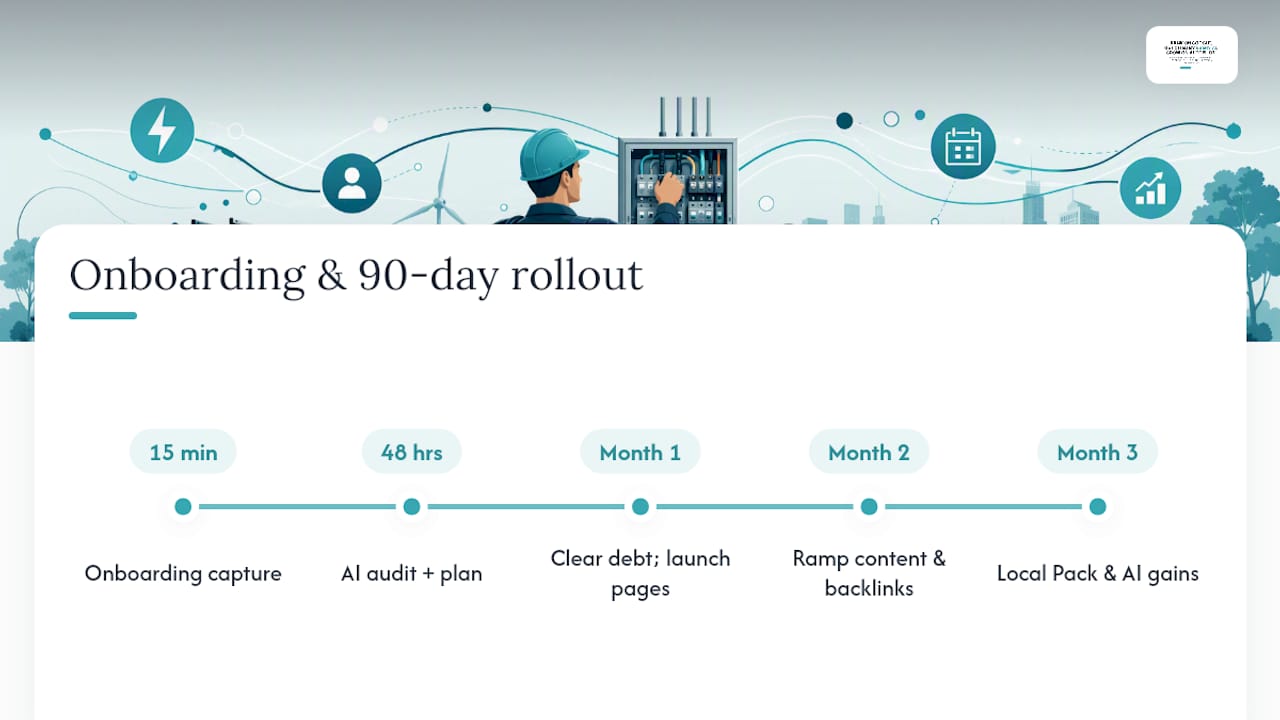
Onboarding takes about 15 minutes to capture your services, cities, and brand voice. Within 48 hours, you get a free AI Visibility Audit covering your current citation status across 25 buyer prompts, a competitor benchmark, a technical site report, and a 90-day action plan.
Pro Tip: Keep the 90-day action plan even if you decide to run parts of this in-house. It lays out exactly which pages and prompts to prioritize first, whether Stellor builds them or your own team does.
Expect months one through three to look like this: month one clears technical debt and launches priority service pages, month two ramps content volume and backlink acquisition, month three shows the first measurable shifts in Local Pack position and AI citation frequency. If you cancel at any point, you keep every article the platform has produced.
A Trades-First Take on What Actually Moves the Needle
Most electrician SEO advice treats every service like it deserves equal attention. It doesn’t. The research is consistent on this point: EV chargers and panel upgrades convert at higher rates and carry bigger tickets than routine repair work, so they deserve dedicated pages and dedicated ad budget before anything else gets built.
The conventional wisdom oversells volume, more pages, more posts, more keywords, when the real lever is precision. Three well-built service pages backed by a completed GBP and an active LSA account will outperform a bloated site chasing 40 loosely related terms. That’s not a shortcut. It’s just where the ROI actually lives.
Where most contractors go wrong is treating SEO and paid ads as separate decisions instead of one funnel. Your search ad’s landing page, your LSA verification, and your organic service page should all point at the same three or four priority services, reinforcing each other instead of competing for the same limited attention span you have to run a business.
Start with GBP and LSA this week. Everything else compounds from there.
— Cole
Get More Electrician Leads Without Managing Five Vendors
Stellor replaces the content writer, the link-building service, the technical SEO auditor, and the AI visibility tracker most electrical contractors would otherwise juggle separately, for a monthly subscription fee. That’s the concrete trade-off: instead of coordinating five subscriptions and hoping they talk to each other, one platform handles the service pages, the backlinks, the weekly audits, and the ChatGPT and Perplexity citation tracking together.
That matters most for electrical contracting businesses because the work above, GBP optimization, LSA verification, service page builds, schema markup, review automation, takes real hours every week to maintain properly. Stellor runs the technical audits automatically, publishes the service and FAQ pages your priority list calls for, and tracks whether AI answer engines are actually recommending your business over competitors.
Start with the Stellor product page and claim the 3-day free trial, no card required, to see your free AI Visibility Audit within 48 hours.
Sources
- Occupational Outlook Handbook: Electricians — Bureau of Labor Statistics
- Electrical contractor marketing in 2026: The tactics that actually work — TOFU
- Top Electrician Marketing Strategies for 2026 — PipelineOn
- Electrician SEO: Boost Traffic and Get More Leads — ServiceTitan
FAQ
Can electricians make $200,000 a year?
Solo electricians and small crews can reach that income level with a strong mix of high-ticket work like panel upgrades and EV charger installs, though it depends heavily on local labor rates, crew size, and how consistently the business fills its schedule with profitable jobs rather than low-margin service calls.
How much does it cost to pay someone for SEO?
Costs vary widely by scope and market, from a few hundred dollars a month for basic local optimization to several thousand for full-service content, backlinks, and technical work; managed platforms like Stellor consolidate that work into a single subscription.
What are the best keywords for electricians?
High-intent terms tied to EV charger installation, panel upgrades, and emergency electrician service tend to convert best, since they combine strong buyer intent with the higher ticket sizes that make ad spend and content investment worthwhile.
How long does electrician SEO take to show results?
Local Services Ads can produce calls within days of approval, search ads convert within weeks once targeting stabilizes, and organic SEO typically needs four to twelve weeks of consistent work before rankings and traffic become reliable.
Should I use Local Services Ads or Google search ads?
Use Local Services Ads for emergency and residential repair calls, since the Google Guarantee badge builds trust fast and the average cost per lead runs lower for electrical categories, and reserve search ads for project-intent searches like panel upgrades where buyers are comparing quotes.
Is a managed SEO platform worth it for a small electrical business?
If you don’t have the hours to run weekly technical audits, publish service pages, and track AI citation trends yourself, a managed option like Stellor covers that work for a flat monthly fee instead of piecing together separate tools and freelancers.