

Yes, small businesses can earn editorial backlinks, and the fastest path is narrow, not wide. Focus on one citable asset, reclaim mentions you already have, and run targeted journalist and broken-link outreach instead of mass pitching. A focused 90-day effort produces the best return, with first placements typically landing between month two and month six. Pair that outreach with basic site fixes and simple tracking, and the results compound from there.
TL;DR:
- Small businesses can earn editorial backlinks by creating a single, highly relevant asset and running focused outreach for 90 days, with results typically appearing between months two and six.
- Editorial links are genuine publisher-initiated mentions added without payment, differentiating them from guest posts or paid placements, and remain valuable even if tagged nofollow.
- Relevance to your target audience is more important than domain authority, so focus on publications your potential customers read rather than high-authority sites that don’t reach your audience.
- Strategies like responding to journalist queries, fixing broken links, building citable assets, and recovering unlinked mentions are effective and don’t require large budgets.
- Using managed services like Stellor can accelerate results by providing content, outreach, technical audits, and AI citation tracking, freeing up small business owners’ limited time.
Table of Contents
- What Are Editorial Backlinks for SMB, and How Do They Differ From Guest Posts?
- Why Do Editorial Backlinks Matter for SEO and AI Visibility?
- How Can SMBs Earn Editorial Backlinks Without a Big Budget?
- How Do You Prioritize and Schedule Editorial Outreach Over 90 Days?
- What Audit and Reclaim Tasks Should You Do Before Outreach?
- How Do You Measure the Results of Editorial Backlinks for SMBs?
- How Does Managed Support Speed Up Editorial Link Results?
- DIY, Freelancer, or Managed Platform: Which Fits Your Business?
- Stellor: A Faster Path to Real Editorial Backlinks
- Trusted Resources for Editorial Link Building
- Sources
- FAQ
What Are Editorial Backlinks for SMB, and How Do They Differ From Guest Posts?
An editorial backlink is a link a publisher adds on its own, without payment, because your content genuinely helps their readers. That is the entire definition, and it is also the reason editorial links carry more weight than nearly any other link type you can acquire.
Guest posts, niche edits, and paid placements all involve you initiating the transaction. A guest post exists because you pitched an article and the outlet agreed to run it, usually with a bio link attached. A niche edit means someone inserted your link into an existing article, often for a fee. An editorial link is different: the publisher found your content, decided it added value, and linked to it without being asked. According to OutreachDesk’s breakdown of editorial links, that independence is what separates a true editorial mention from every other link type on the market.
Use this three-question test whenever you evaluate a link, whether it is one your team is chasing or one an agency is reporting as a win:
- Who initiated the link? If you or your outreach team asked for it directly, it leans toward guest post or niche edit territory, not pure editorial.
- Was payment involved? Money changing hands, even indirectly through a “content partnership” fee, disqualifies a link from editorial status.
- Would the piece exist without your outreach? If the article was already written and your link slots into existing context, that is closer to editorial than a piece commissioned around your brand.
Nofollow tags do not disqualify a link from being valuable. A nofollow editorial mention still sends referral traffic, still builds brand recognition, and still feeds the pool of content that AI answer engines draw from when generating recommendations, according to the same OutreachDesk analysis.
Why Do Editorial Backlinks Matter for SEO and AI Visibility?
Editorial links function as trust signals, not just ranking fuel. Google’s own link spam guidance treats manipulated links as a policy violation precisely because organic, publisher-chosen links are supposed to represent genuine endorsement. When a local news outlet or trade publication links to your business unprompted, that endorsement is difficult to fake and easy for search engines to weigh differently than a purchased link.
The AI layer raises the stakes further. Large language models like ChatGPT, Claude, Perplexity, and Gemini summarize and cite the open web when answering buyer questions, and they tend to pull from sources that already carry independent editorial validation. A mention in a regional business journal or an industry association newsletter is exactly the kind of content those systems treat as credible.
For most small businesses, referral traffic and qualified leads matter more than abstract link equity. A single well-placed mention on a niche trade site can send more converting visitors in a week than a generic high-authority link sends in a year, because the audience already matches your customer profile.
Relevance beats raw domain authority almost every time. A specialist publication with a tightly matched audience can outperform a general high-authority site for the specific keywords an SMB actually needs to rank for. That single insight should reshape how you prioritize every outreach list you build going forward.
Pro Tip: Before chasing any backlink opportunity, ask whether the site’s readers would ever plausibly become your customers. If the answer is no, skip it, regardless of the domain’s authority score.

How Can SMBs Earn Editorial Backlinks Without a Big Budget?
Six tactics account for most of the editorial links small businesses actually earn. None require a large budget, but each demands a specific, repeatable process.
- Answer journalist queries with tight, specific responses. Journalist-query platforms and HARO-style alternatives connect reporters with sources daily. According to SEOptimer’s roundup of backlink services, effective responses run 50 to 100 words, answer the exact question asked, and include a credential or data point the reporter can quote directly. Expect a hit rate around 1 in 10 to 1 in 20 queries, which means a daily habit of scanning and answering three to five relevant queries is more productive than sporadic bursts.
- Replace broken links on resource pages. Use a crawler like Ahrefs or Screaming Frog to find dead links on pages that already list businesses in your category. Send a short note flagging the broken link, then suggest your page as a working replacement. Follow up once after five business days; anything beyond that reads as pressure rather than helpfulness.
- Build one genuinely citable asset. This is the highest-leverage move in the entire list. Original local data, a free calculator, a downloadable template, or a detailed case study gives publishers a reason to link without you asking twice. FloxoLab’s guide to white-hat link building frames this as starting with a fit statement: name the exact publisher who would cite this resource before you build it, not after.
- Write guest contributions with an audience-first angle. A guest post only earns editorial-adjacent trust when it is written for the outlet’s readers, not for your backlink. Pitch a specific insight the publication’s audience needs, keep self-promotion to a single contextual mention, and budget three to five hours per placement including drafting and revisions.
- Work partnerships, suppliers, and trade associations. Supplier directories, local chamber pages, and trade association member lists are durable sources of editorial mentions because the relationship already exists. Trade-focused hubs like The Build’s distributor directory show how supplier-side pages naturally link out to the businesses they work with, which is a pattern worth replicating in your own industry.
- Recover unlinked mentions. Search your business name in Google News and site search operators to find articles that mention you without linking. Reach out with a short, non-transactional note: thank the writer, note the mention, and ask if they would consider linking the business name to your site for reader convenience. Conversion rates on these requests tend to run higher than cold outreach because a relationship already exists in the form of the mention itself.
Each tactic maps to a different time commitment and a different type of relationship, which is exactly why a portfolio approach beats betting everything on one channel. A practical small-business link-building plan treats these as complementary, not competing, and that framing holds up well once you start tracking results.
How Do You Prioritize and Schedule Editorial Outreach Over 90 Days?
A 90-day plan breaks cleanly into three phases, and trying to run all of them at once is the most common reason SMB link campaigns stall.
Days 1 to 30: audit and asset creation. Spend this phase auditing your existing backlink profile, fixing technical issues, and building your one citable asset. Budget two to three hours per week if you are doing this yourself, more if the asset involves original data collection.
Days 31 to 60: focused outreach. This is where journalist queries, broken-link replacement, and unlinked-mention recovery run in parallel. Realistic weekly targets:
- About a dozen to twenty journalist queries answered per week
- Around ten broken-link or resource-page pitches sent per week
- Several unlinked mentions searched and contacted per week
Days 61 to 90: scale and refine. Double down on whichever channel produced replies, and drop the ones that did not. This is also when guest contributions and partnership outreach tend to pay off, since relationships built in the first two months start converting.
Whether a paid placement or PR help is worth the cost depends on your time constraints more than your budget. Digital PR costs vary widely, and reactive, journalist-query-style services tend to sit at the lower end compared to hero content campaigns or long-running retainers. If your team has two to five hours a week and local relationships already in place, DIY outreach usually wins on cost. If time is the actual bottleneck, a managed service or a broader local SEO link-building approach closes that gap faster than hiring and training in-house.
Track everything in a single sheet with columns for outlet name, contact, pitch date, follow-up date, response, and outcome. That single habit separates campaigns that improve month over month from campaigns that repeat the same mistakes indefinitely.
What Audit and Reclaim Tasks Should You Do Before Outreach?
Outreach only works if your site can actually receive and keep the links you earn. Run these checks before or alongside any pitching:
- Audit your backlink and unlinked-mention profile. Tools like Ahrefs, Semrush, or Google Search Console show which sites already link to you and which pages get the most external attention. Search your brand name in quotes to surface unlinked mentions worth reclaiming.
- Fix broken redirects and restore missing pages. Any link pointing to a 404 is wasted equity. Set up 301 redirects for moved pages and restore deleted content that still attracts inbound links.
- Request credit for unlinked mentions professionally. Frame the ask around reader convenience, not your SEO goals, and keep it to two or three sentences.
- Confirm indexability and schema before you pitch. A publisher who checks your site and finds it slow, unindexed, or missing basic structured data is far less likely to follow through. Review common DIY local SEO mistakes to catch the issues that quietly kill outreach conversion rates.
How Do You Measure the Results of Editorial Backlinks for SMBs?
Track four numbers: referral traffic from new domains, count of new referring domains overall, movement on your target keywords, and whether AI tools now cite your business when asked relevant prompts. Ranking effects usually lag behind the links themselves by weeks or months, so patience matters more than most SMB owners expect.
Small businesses often see measurable ranking lifts after accumulating 12 to 30 quality referring domains, though the exact threshold depends on your starting position and how competitive your market is. First placements typically appear between month two and month six of consistent outreach.
| Approach | Typical Time or Cost | Best Fit |
|---|---|---|
| DIY outreach (journalist queries, broken links) | 2 to 5 hours per week | Owners with local relationships and some spare time |
| Freelance link builder or PR contractor | Varies by scope and engagement length | Businesses with budget but no internal bandwidth |
| Reactive PR / journalist-response services | Lower cost entry point relative to hero content campaigns | SMBs testing editorial outreach before committing further |
| Managed SEO and content platform | Monthly subscription, ongoing | Owners who want outreach, content, and audits handled together |
Report business value in terms leadership actually cares about: leads generated from referral traffic, conversion rate on that traffic compared to other channels, and any PR pickup that extended past the original placement.
How Does Managed Support Speed Up Editorial Link Results?
Author note: this section was prepared by Cole. Read more from Cole on the Stellor author page.
The constraint most SMBs actually face is not knowing what to do. It is finding the hours to do it consistently. A citable asset takes real time to research and build. Journalist queries need daily attention. Broken-link outreach needs a tracking sheet somebody actually updates.
Stellor addresses that gap directly through a few connected pieces:
- 30 GEO and SEO-optimized articles published monthly, including the location and comparison pages that often become the citable assets journalists and publishers link to.
- A 4,000-site backlink network that replaces manual outreach for a meaningful share of link-building volume.
- Weekly technical audits covering schema, indexability, and the readiness checks that determine whether a publisher’s link actually holds value once granted.
- Daily Reddit engagement tracking, since AI answer engines draw heavily on Reddit threads when generating business recommendations.
- Weekly LLM visibility tracking across ChatGPT, Claude, Perplexity, and Gemini, showing exactly when your business gets cited and when a competitor gets cited instead.
Case study and proprietary benchmark details will populate here as reporting data becomes available.
DIY, Freelancer, or Managed Platform: Which Fits Your Business?
DIY outreach makes sense when you have real time and existing local relationships; a chamber connection or a supplier tie already does half the work a cold pitch would need to do. Managed support makes more sense when time, not knowledge, is the actual bottleneck.
Watch for three red flags in any provider you consider. Guaranteed editorial links is the first, since no legitimate service controls a third-party publisher’s editorial decisions. Opaque reporting is the second: if you cannot see which specific pages link to you and why, you cannot verify the work. Exact ranking guarantees is the third, since ranking depends on far more than any single vendor controls.
Before signing anything, ask direct questions: How do you disclose paid versus earned placements? What does a sample report actually look like? Can I see three real, verifiable placements from the last quarter?
— Cole
Stellor: A Faster Path to Real Editorial Backlinks
Stellor is an alternative to managing multiple vendors for content, links, audits, and AI tracking by bundling these services into a single subscription. Pricing details are available on the Stellor website.
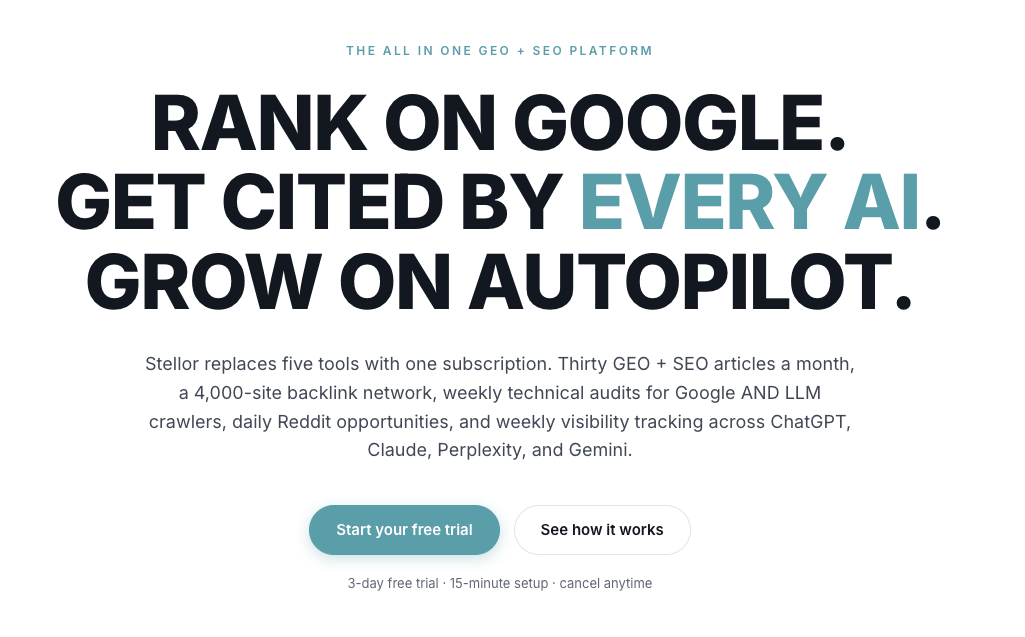
That matters most for SMBs stuck exactly where this article started: knowing the tactics but lacking the hours to run journalist queries, build a citable asset, and audit your site every week without dropping something else. Stellor publishes the location and comparison pages that become link-worthy assets, runs backlink outreach through its 4,000-site network, catches technical issues before they block outreach, and reports weekly on whether ChatGPT, Claude, Perplexity, and Gemini are actually citing your business.
It fits best for owners and marketers who have validated that editorial links matter but do not have two to five hours a week to spend chasing them manually, and agencies managing multiple client sites who need the workflow standardized. Start with the Stellor product page to see the full feature breakdown, or begin the 3-day free trial with no card required to get a baseline AI visibility audit within 48 hours of onboarding.
Trusted Resources for Editorial Link Building
Bookmark Google Search Central’s link spam policies for the authoritative word on what counts as manipulative versus earned. For journalist-query workflows, SEOptimer’s list of backlink sites covers HARO alternatives worth testing. For a structured 90-day framework, revisit the small-business link-building strategy guide referenced throughout this piece. If you run a home-service business, local SEO link building strategies that actually work offers sector-specific detail worth pairing with everything above.
Sources
- What Counts as an Editorial Link (And What Doesn’t) in 2026
- Small-Business Link Building Strategy: A Practical 90-Day Plan
- White-Hat Link Building for Small Businesses | FloxoLab
FAQ
What Is an Editorial Backlink Exactly?
An editorial backlink is a link a publisher adds on its own, without payment, because your content or business adds genuine value to their article. It differs from guest posts and niche edits because the publisher initiates it rather than you pitching for placement, according to OutreachDesk’s editorial-link definition.
How Many Editorial Backlinks Does an SMB Actually Need?
Small businesses often see measurable ranking movement after earning 12 to 30 quality referring domains, though the exact number depends on your starting position and competition level. Quality and relevance matter more than hitting a specific count.
How Long Does It Take to Get Editorial Backlinks?
Most SMBs see first editorial placements between month two and month six of consistent outreach. Ranking movement usually lags behind the links themselves, so treat the first 90 days as foundation building rather than a results window.
Is HARO Still a Good Way to Get Editorial Backlinks?
Journalist-query platforms remain one of the most accessible channels for SMBs, with concise, specific responses producing a hit rate around 1 in 10 to 1 in 20 queries. Daily attention matters more than occasional bursts of activity.
Can Stellor Help With Editorial Backlinks Specifically?
Stellor supports editorial link outcomes through its 4,000-site backlink network, weekly technical audits, and monthly content output that gives publishers something citable to link to. Pricing and full feature details are listed on the Stellor product page.
Are Nofollow Editorial Mentions Worth Pursuing?
Yes. A nofollow editorial mention still drives referral traffic, builds brand recognition, and feeds the content pool that AI answer engines cite from, even without passing direct ranking equity.