

TL;DR:
- Optimizing individual project pages with detailed content, schema, and images produces faster SEO results than homepage focus.
- Regularly publishing and updating project case studies strengthens authority, improves rankings, and attracts targeted buyer traffic.
The fastest SEO wins for a design firm come from project-level pages, not your homepage. Prioritize each project page with a descriptive title, 400–600+ words of case-study content, CreativeWork schema, and optimized images — that combination moves the needle faster than any other tactic. Portfolio optimizations typically show ranking changes within 4–8 weeks, while thought leadership compounds over several months.
The priority order is clear: portfolio project pages first, vertical landing pages second, thought leadership third. Start there and you will see results before broader site work pays off.
Table of Contents
- Design firm portfolio SEO best practices: why project pages are your highest-leverage asset
- How to structure your site so search engines understand which projects matter
- What to publish on each project page
- Technical SEO essentials for portfolio pages
- Image SEO for design portfolios
- How to scale portfolio publishing and build topical authority
- How to measure search and AI visibility for portfolio pages
- Quick checklist: wins you can do in a day, a week, and a month
- Keyword research tailored to design firm portfolios
- Optimizing portfolio content for voice search and AI-driven queries
- Strategies for acquiring high-quality backlinks to portfolio pages
- Multimedia SEO beyond images: video and interactive elements
- Local SEO for design firms targeting geographic clients
- How often should you update portfolio pages to sustain rankings?
- Key Takeaways
- A practitioner’s perspective on portfolio-first SEO
- Trystellor makes portfolio SEO scale without adding headcount
- Useful sources and validation tools
- FAQ
Design firm portfolio SEO best practices: why project pages are your highest-leverage asset
Portfolio pages map directly to buyer intent. A prospect searching “mobile app redesign for fintech startup” is not browsing — they are evaluating vendors. A well-optimized project page intercepts that search at exactly the right moment.
The metrics that tell you whether your portfolio SEO is working:
- Traffic to individual project pages (not just the portfolio index)
- Conversion rate from project page to inquiry or contact form
- Average time on page and session depth
- Number of images indexed in Google Images
- Frequency of AI citations when prompts match your specialty
- Referral backlinks pointing to specific project pages
When an AI engine cites your project summary in response to a buyer query, that citation often drives more qualified inbound traffic than a mid-page organic ranking. Speed matters too: portfolio tweaks and schema can influence rankings in 4–8 weeks, but redirect mistakes after a redesign can add several months to recovery.
How to structure your site so search engines understand which projects matter
A shallow, descriptive hierarchy is the baseline. The path Home > Portfolio > Project with breadcrumb navigation and keyword-rich URLs tells both Google and AI crawlers exactly what each page represents. Site architecture and internal linking are among the strongest signals search engines use to gauge page importance.
Clean URL patterns pair capability with industry: /portfolio/mobile-app-redesign-fintech or /portfolio/brand-identity-healthcare-startup. Avoid ID-based URLs like ?project=2039 — they carry no keyword signal and confuse crawlers.
Internal linking follows a hub-and-spoke model. A vertical landing page for “fintech UX design” links out to three or four individual project pages, and those project pages link back to the hub and cross-link to related work. Use descriptive anchor text: “view our fintech dashboard redesigns” beats “see related work” for both SEO and usability. The 2026 internal linking guide covers the mechanics in detail.
Pro Tip: Before any site redesign or platform migration, build a full redirect map. Missing redirects on portfolio pages destroy accumulated link equity and can delay recovery by months — treat redirect planning as architecture, not an afterthought. The SEO platform switching checklist walks through exactly what to audit before you go live.
What to publish on each project page
Every project page should read like a case study. Search engines cannot index a visual layout — they read your text. Here is the template:
- SEO title (50–60 chars): “Mobile App Redesign for Fintech Startup | FirmName”
- Meta description (150–160 chars): “We redesigned a fintech mobile app’s onboarding flow, cutting drop-off by 34% and improving activation for 50K+ users. See the full case study.”
- H1: State the capability, industry, and outcome. H2s: Challenge, Approach, Deliverables, Results.
- Body (400–600+ words): Challenge (2–3 sentences) → Approach (methodology, tools, constraints) → Deliverables (what shipped) → Results (measurable outcomes) → Testimonial or CTA.
Two sample title patterns that work: “Brand Identity Design for Healthcare SaaS — FirmName” and “E-Commerce UX Redesign That Increased Checkout Conversion.” Both pair capability with industry and hint at outcome — exactly what long-tail searchers type.
NDA projects are not a dead end. Publish process-oriented, anonymized case studies that describe methodology and outcomes without exposing confidential assets. A keyword-rich description of your design thinking ranks just as well as a named client story.
Technical SEO essentials for portfolio pages
Fix three things first: redirects before launch, Core Web Vitals, and CreativeWork schema on every project page.
| Metric | Target | Why It Matters |
|---|---|---|
| LCP (Largest Contentful Paint) | fast | Direct Google ranking signal; hero images are the usual culprit |
| INP (Interaction to Next Paint) | very low | Replaces FID; measures responsiveness under real user interaction |
| CLS (Cumulative Layout Shift) | minimal | Prevents layout jumps from unspecified image dimensions |
JavaScript-heavy platforms like Webflow and Framer can work for SEO, but they risk rendering delays and LCP problems on image-heavy pages. Audit Core Web Vitals in Google Search Console and PageSpeed Insights before and after launch.
For CreativeWork schema, the minimum viable markup names the creator, describes the work, and identifies the client industry. Validate every implementation with Google’s Rich Results Test before publishing. The full schema reference lives at schema.org/CreativeWork.
Image SEO for design portfolios
Descriptive, hyphenated filenames plus explanatory alt text plus ImageObject schema — all three are non-negotiable. Manual image optimization consistently outperforms relying on AI image recognition alone.
Filename and alt-text examples:
fintech-mobile-app-dashboard-redesign.webp/ Alt: “Mobile banking app dashboard showing transaction history, redesigned for Gen Z users”healthcare-brand-identity-logo-system.webp/ Alt: “Logo system and color palette for a healthcare SaaS startup, featuring clean sans-serif typography”
Serve images in WebP or AVIF format with srcset for responsive delivery. Compress before upload. Never lazy-load your hero image — it is usually the LCP element, and deferring it delays the metric that Google measures. Lazy-loading is fine for images below the fold.
Alt text serves two audiences: search crawlers and screen reader users. Write it for both. A caption below the image reinforces the keyword signal and is often the first text a scanning visitor actually reads.
How to scale portfolio publishing and build topical authority
A steady cadence of project pages plus targeted vertical landing pages builds authority faster than generic blogging. The hub-and-spoke model concentrates topical signals: one “Fintech UX Design” hub page links to four or five individual fintech project pages, each one reinforcing the hub’s relevance.
Aim to publish one to two fully written project case studies per month. That pace is sustainable for most firms and compounds meaningfully over a quarter. For documenting the process side of design work, a phase-by-phase workflow guide can help teams structure case study content consistently.
Pro Tip: Bake image filename conventions into your CMS upload workflow — rename files before they hit the media library, not after. Pair that with a template-based CreativeWork schema injection so every new project page publishes with valid structured data from day one.
How to measure search and AI visibility for portfolio pages
Track project-page impressions, clicks, CTR, time on page, backlinks, and AI citation frequency every week for high-priority projects, monthly for the rest.
| Check | Tool | Cadence |
|---|---|---|
| Indexing status | Google Search Console (URL Inspection) | Weekly |
| Impressions and CTR | Google Search Console (Performance) | Weekly |
| Core Web Vitals | PageSpeed Insights | Monthly |
| AI citation check | Trystellor LLM tracking / manual prompts | Weekly |
| Backlink growth | Google Search Console (Links report) | Monthly |
For AI citation checks, run prompts that mirror real buyer queries: “best fintech UX design firm in [city]” or “who designed [type of app] for [industry].” If your project page does not appear in ChatGPT, Claude, or Perplexity responses, check whether the page has sufficient text, valid schema, and inbound links. Trystellor automates this weekly across all four major AI engines and surfaces gaps with specific fixes.
Quick checklist: wins you can do in a day, a week, and a month
Day:
- Rename hero image files with descriptive, hyphenated names
- Add or rewrite alt text on every image on your top three project pages
- Update one project page title and meta description with a long-tail keyword
- Submit those URLs to Google Search Console for indexing
Week:
- Publish one to two project case studies with 400+ words each
- Implement CreativeWork schema on all published project pages
- Audit internal links and fix any broken links between project pages and hub pages
Month:
- Build one vertical landing page per capability-industry pair you want to rank for
- Run a full Core Web Vitals audit and fix LCP and CLS issues
- Begin outreach for three to five high-quality backlinks pointing to your strongest project pages
The essential SEO audit checklist covers the technical items in more depth if you want a full audit framework.
Keyword research tailored to design firm portfolios
Generic capability keywords (“graphic design,” “UX design”) are too competitive for most firms. The higher-value targets pair capability with industry and sometimes location: “mobile app redesign for fintech startup,” “brand identity for healthcare SaaS,” “e-commerce UX for DTC brand.”
Use Google Keyword Planner to find terms with 100–500 monthly searches. That range signals real demand with manageable competition. Build a keyword map where each vertical landing page owns one capability-industry pair, and each project page targets a long-tail variant of that pair. This prevents cannibalization and concentrates authority where it matters.
Optimizing portfolio content for voice search and AI-driven queries
Voice queries and AI prompts are conversational and specific: “Which design firm specializes in fintech app redesigns in New York?” Your project pages answer that question when they include the capability, the industry, the location, and a clear outcome in the first 100 words.
Structure your case study openings as direct answers. Lead with what you built, for whom, and what changed — not with a vague creative description. AI engines extract the clearest, most specific passage they find. If your page buries the outcome in paragraph four, it will not be cited.
Strategies for acquiring high-quality backlinks to portfolio pages
The most durable backlinks to portfolio pages come from three sources: industry publications that cover design work, client websites that reference the project, and design directories that list your firm.
Pitch project case studies to publications like Communication Arts, Awwwards, or industry-specific trade sites. A published feature almost always includes a link. Ask clients to mention the project on their own site — many will add a “designed by” credit without being prompted. List your firm on directories like Clutch, Dribbble, and Behance, which pass authority and drive referral traffic.
Guest articles on adjacent topics (UX strategy, brand positioning) also earn links and build topical authority beyond your portfolio pages alone.
Multimedia SEO beyond images: video and interactive elements
A project walkthrough video embedded on the case study page increases time on page and gives Google a richer signal about content depth. Host video on YouTube or Vimeo, embed it on the project page, and write a transcript or detailed description in the surrounding text — that text is what gets indexed.
For interactive prototypes or case study demos embedded via Figma or similar tools, add a descriptive text block explaining what the prototype demonstrates. Interactive elements are invisible to crawlers without surrounding context. Treat every embedded element as if it does not exist for SEO purposes, and write the text layer accordingly.
Local SEO for design firms targeting geographic clients
If your firm serves clients in specific cities or regions, local signals matter. Include the city or metro in your project page titles, meta descriptions, and body copy where it fits naturally. A page titled “Brand Identity Design for Chicago Healthcare Startup” will outrank a generic equivalent for local searches.
Claim and fully complete your Google Business Profile. Add your service areas, link to your portfolio, and collect reviews that mention the type of work you do. Local SEO strategies for service businesses translate directly to design firms targeting geographic markets.
How often should you update portfolio pages to sustain rankings?
Add new project pages every two to three months. Refresh existing pages quarterly: update metrics, add new testimonials, improve descriptions, and recheck keyword targeting. Google treats portfolio freshness as an activity signal — static portfolios that never change tend to drift down in rankings over time.
Set a quarterly review calendar. For each project page, ask: Are the results still accurate? Is there a better keyword target? Does the page have schema? Has the image been compressed and properly named? A 30-minute quarterly review per page is enough to keep rankings stable and growing.
Key Takeaways
Project-level pages with 400–600+ words, CreativeWork schema, and optimized images are the single highest-leverage investment in design firm portfolio SEO, with ranking changes typically visible within 4–8 weeks.
| Point | Details |
|---|---|
| Project pages first | Optimize individual project pages before service pages; they match buyer intent and rank faster. |
| Schema on every project | CreativeWork markup helps both Google and AI engines identify your work, industry, and role. |
| Image SEO is mandatory | Descriptive filenames, alt text, and WebP format are required — AI image recognition is not a substitute. |
| Redirects before launch | Missing redirects during a redesign can delay recovery by 2–4 months; plan them before going live. |
| Trystellor automates the cycle | Trystellor runs weekly AI citation checks, technical audits, and publishes 30 GEO-optimized articles per month to compound portfolio authority. |
A practitioner’s perspective on portfolio-first SEO
The firms that see the fastest results from portfolio SEO share one habit: they write the case study before they publish the project images. Not after. Not six months later when someone asks for a write-up. Before.
That discipline forces the team to articulate the problem, the approach, and the outcome in plain language — which is exactly what search engines and AI engines need. The visual work is the proof. The text is what gets found.
The non-obvious operational tip: assign one person on the team to own the “text layer” for every project. It does not have to be a writer. It can be the project lead answering five structured questions in a shared doc. That raw material becomes the case study, the alt text, the schema description, and the AI-citable summary — all from one 20-minute conversation.
For firms that want to automate the recurring checks, Trystellor handles weekly technical audits, AI citation monitoring across ChatGPT, Claude, Perplexity, and Gemini, and a 30-article-per-month content cadence that keeps topical authority compounding without adding headcount.
Trystellor makes portfolio SEO scale without adding headcount
Most design firms are one or two people away from having a real SEO program. Trystellor closes that gap at $199 per month — replacing the content writer, the technical auditor, the link-building service, and the AI visibility tracker with a single platform.
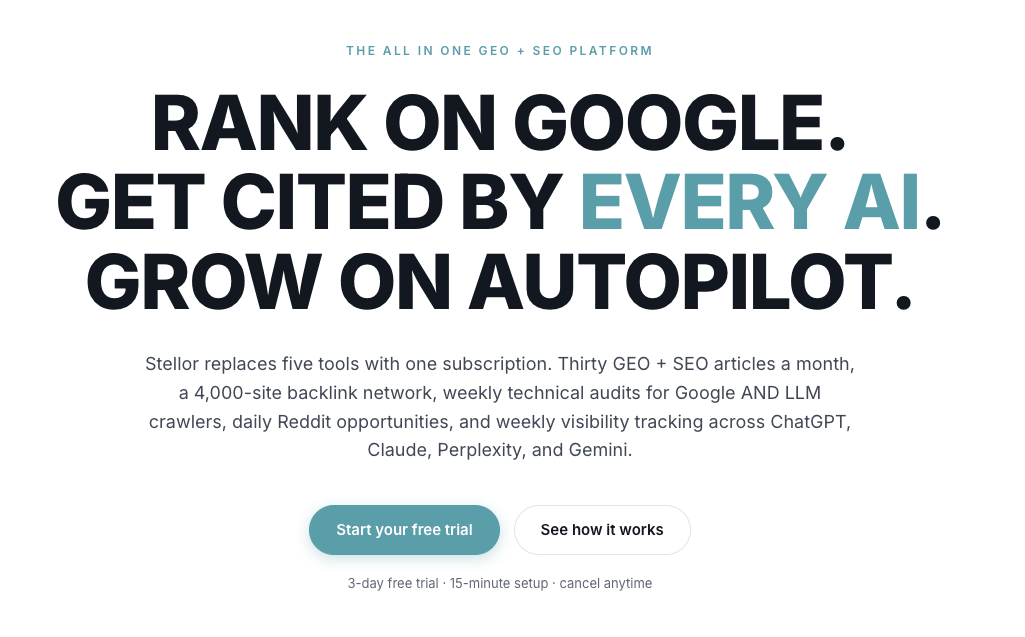
For portfolio-focused firms specifically, the platform publishes 30 GEO and SEO-optimized articles per month to your CMS, runs weekly audits against 11 technical checks (including schema completeness and Core Web Vitals), distributes backlinks through a 4,000-site network, and tracks your AI citation status across all four major AI engines every week. You see exactly which buyer prompts your firm is winning and which ones a competitor is answering instead.
The onboarding takes 15 minutes. Within 48 hours, you get a free AI Visibility Audit covering 25 buyer prompts, a competitor benchmark, and a 90-day action plan. Start your 3-day free trial — no credit card required, and you keep everything the platform produces even if you cancel.
Useful sources and validation tools
The go-to tools for validating schema, Core Web Vitals, and indexing are Google Search Console, Google’s Rich Results Test, PageSpeed Insights, and the schema.org/CreativeWork documentation.
Use these in sequence: PageSpeed Insights first to catch LCP and CLS issues, then Rich Results Test to validate CreativeWork schema, then Google Search Console to confirm indexing and monitor impressions after publishing.
- Google Search Console: Monitor impressions, clicks, indexing status, and Core Web Vitals for every project page. Run URL Inspection after publishing new pages.
- Rich Results Test: Paste any project page URL to confirm CreativeWork schema is valid and eligible for rich results.
- PageSpeed Insights: Diagnose LCP, INP, and CLS scores. Use the “Opportunities” section for specific image and rendering fixes.
- schema.org/CreativeWork: The authoritative reference for every property available in CreativeWork markup — use it to confirm field names and required vs. recommended properties.
FAQ
How long does portfolio SEO take to show results?
Portfolio page optimizations and schema typically influence rankings within 4–8 weeks. Thought leadership content compounds over 3–6 months, and redirect mistakes after a redesign can delay recovery by several months.
How many words should each project page have?
Aim for several hundred words per project page, structured as a case study covering the challenge, approach, deliverables, and measurable results. Two hundred words is a floor, not a target.
Can NDA projects rank in search?
Yes. Publish anonymized, process-oriented case studies that describe your methodology and outcomes without exposing confidential assets. Keyword-rich descriptions of your design thinking rank just as well as named client stories.
Does Webflow or Framer hurt portfolio SEO?
Both platforms can work for SEO, but JavaScript rendering delays and LCP issues are common on image-heavy portfolios. Audit Core Web Vitals and rendering behavior in Google Search Console after launch and after any major design change.
How do I get AI engines to cite my project pages?
Write the first 100 words of each project page as a direct answer: what you built, for whom, and what changed. Add CreativeWork schema, earn inbound links, and check citation status weekly using prompts that mirror real buyer queries. Trystellor automates this tracking across ChatGPT, Claude, Perplexity, and Gemini.
How often should I add new projects to my portfolio?
Add new project pages regularly and refresh existing pages multiple times a year. Regular updates signal to Google that your portfolio is active, which supports sustained rankings over time.