
To get more local patients fast, prioritize Google Business Profile depth, review velocity, procedure-specific service pages, consistent citations, and weekly technical fixes. Expect early movement in your Local Pack position within 60 to 90 days, with meaningful new-patient volume showing up in the 6 to 9 month range once your service pages start ranking. Automation tools like Stellor can handle the repeatable parts, content, audits, citation checks, so your team focuses on patients instead of spreadsheets.
TL;DR:
- Building a highly detailed Google Business Profile with specific services, photos, and frequent updates is essential for improving Local Pack rankings within 60 to 90 days.
- Maintaining a consistent stream of recent reviews, especially asking right after appointments and tracking review channels, enhances perceived trustworthiness and local visibility.
- Creating procedure-specific service pages with clear questions and local details improves conversion rates and brings in patients actively searching for those treatments.
- Regularly auditing citations for NAP consistency and fixing technical SEO issues like page speed and schema markup can generate noticeable Map Pack movement in less than a month.
- Automation tools like Stellor can handle ongoing content publishing, backlink building, and audits, speeding up progress toward more booked patients without greatly increasing staffing costs.
Table of Contents
- Dentist Local SEO Starts With Your Google Business Profile
- Building Review Velocity That Actually Converts Patients
- Service Pages That Turn Searches Into Booked Appointments
- Fixing Citations and NAP Consistency Across Directories
- Technical SEO and Schema Markup Priorities
- What to Publish for Local Rankings and AI Citations
- Tracking Progress: Timelines, Costs, and the KPIs That Matter
- Your 90-Day Local SEO Action Plan
- How Stellor Shortens the Path From Zero to Booked Patients
- What Most Dentists Get Wrong About Local SEO
- Try Stellor: See Your AI Visibility in 48 Hours
- Sources
- FAQ
Dentist Local SEO Starts With Your Google Business Profile
Google Business Profile signals make up roughly a third of what determines your Local Pack ranking, more than any other single factor. That’s not a minor detail. It means a half-finished profile is probably costing you more visibility than any blog post or backlink ever will.
Start with your primary category. Most practices default to “Dentist,” but if you do a high volume of Invisalign, implants, or pediatric work, a specialty-first category (Cosmetic Dentist, Pediatric Dentist, Orthodontist) can better match what patients are actually searching for. Google lets you add secondary categories too, so use them.
From there, work through these fixes:
- List 20 to 30 individual services in the Services section, each with a 200 to 300 character description that includes booking language (“Same-day crowns available, most insurance accepted”).
- Upload photos on a schedule, not once and done: exterior shots so patients recognize your building, interior shots of the waiting room and operatories, team photos, and before/after cases where you have patient consent.
- Name photo files descriptively before uploading (e.g., “smith-dental-waiting-room.jpg” instead of “IMG_4021.jpg”).
- Turn on messaging, publish weekly posts about promotions or new services, and fill out every attribute (wheelchair accessible, accepts new patients, languages spoken).
- Add a direct appointment booking link rather than sending patients to a generic contact page.
A Google Business Profile is not something you set up once and forget. Practices that post updates, answer patient questions, and refresh photos monthly see stronger local visibility than those that treat the profile as a static listing.
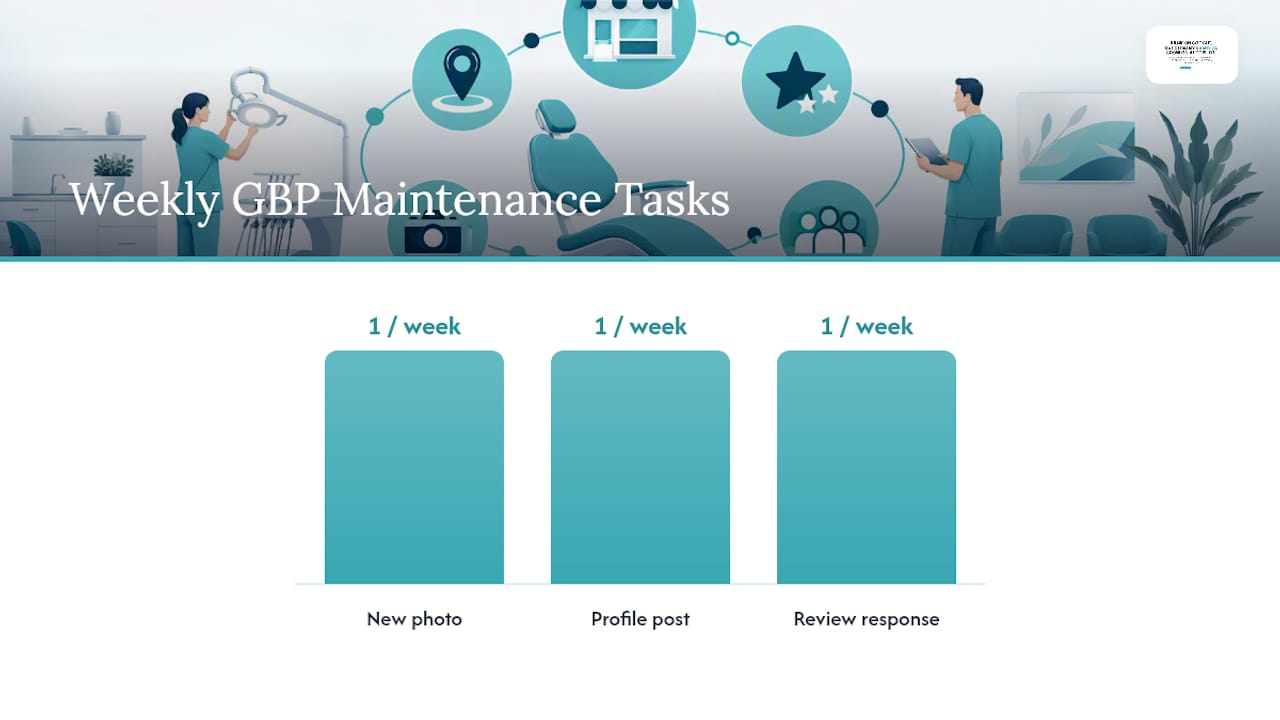
Pro Tip: Set a recurring 15-minute calendar block every Monday just for GBP maintenance, one new photo, one post, one review response. Small and frequent beats a quarterly overhaul.
Building Review Velocity That Actually Converts Patients
Review count matters less than most dentists think. What matters more is recency, a steady stream of fresh reviews signals to Google (and to patients scanning your profile) that you’re active and trusted right now, not that you were popular three years ago.
Here’s how to build that cadence without turning your front desk into a review-begging machine:
- Ask at the natural high point, right after checkout, when the patient is relieved and often grateful, not mid-treatment.
- Send a text with a direct review link within two hours of the appointment, timing matters more than the wording.
- Follow up once by email 48 hours later for patients who didn’t respond to the text.
- Train hygienists and front-desk staff to mention it verbally: “If today went well, we’d really appreciate a quick review.”
- Track which channel (text, email, in-person QR code) produces the most completed reviews and double down on it.
Negative reviews will happen. Respond promptly, acknowledge the concern, and move the conversation offline, but never confirm that someone is a patient or discuss treatment details in a public reply. HIPAA privacy rules govern what you can say publicly, even in response to a one-star review that names specific treatment. A safe response looks like: “We take feedback seriously and would like to understand what happened, please call our office directly.”
Pro Tip: Aim for a steady drip of new reviews every month, rather than a single large push after an office contest. Google’s algorithm and prospective patients both respond better to consistency than to spikes.
Service Pages That Turn Searches Into Booked Appointments
Generic service pages (“Cosmetic Dentistry”) rarely convert because they don’t match how people actually search. Pages built around a procedure plus a modifier, cost, urgent, sedation, or kids, convert at noticeably higher rates because they match a searcher who’s already decided and just needs a provider.
Think in terms of one primary keyword per page:
- “Invisalign cost [city]” instead of a general Invisalign overview
- “Emergency dentist open Saturday [city]” instead of “Emergency Dental Care”
- “Sedation dentistry for anxious patients” instead of “Sedation Options”
- “Kids’ dentist near [neighborhood]” instead of “Pediatric Services”
Structure each page to answer the questions a patient actually has before they call: Am I a candidate? What happens during the visit? What’s the realistic cost range? Use H2s that mirror those questions directly, then close with a clear appointment CTA above the fold and again at the bottom.
Aim for 800 to 1,500 words per page, enough to cover candidacy, process, and cost honestly, without padding. Link related service pages to each other (whitening links to veneers, veneers links to consultations) to build topical depth across your site.
If you serve multiple towns or neighborhoods with genuinely different patient bases, build separate location pages instead of cramming every city into one service page. If you’re a single-location practice, expanding your service pages will do more for you than manufacturing location pages you don’t need. Publishing these conversion pages before scaling blog content produces faster returns, since they capture patients who are ready to book right now.
Fixing Citations and NAP Consistency Across Directories
A mismatched phone number or an old suite address sitting on a directory somewhere is quietly working against you. Citation and NAP (name, address, phone) consistency is a core local ranking factor, and cleaning up mismatches often produces visible Map Pack movement within 30 days.
You don’t need to be listed everywhere. For a single-location practice, a focused set of high-value directories does the job:
- ADA Find-a-Dentist
- Healthgrades
- Vitals
- Zocdoc
- Yelp
- Google Business Profile
- Bing Places
- Apple Maps
- Your state dental association directory
- Your local chamber of commerce
- Any hospital or referral network you’re affiliated with
Run a NAP audit by searching your practice name plus “phone number” and checking each result against your actual current details. Common mismatches: an old suite number after an office move, a tracking phone number that doesn’t match your listed number, or “St.” versus “Street” inconsistencies that seem trivial but confuse aggregators.
Set a recurring quarterly check, and immediately update every directory any time you change your phone system, move suites, or rebrand. A single missed update after a move can undo months of citation work.
Pro Tip: Google your practice name in an incognito browser once a quarter. It’s the fastest way to spot a stale citation before it costs you rankings.
Technical SEO and Schema Markup Priorities
Technical problems are invisible to patients but very visible to Google, and increasingly, to AI answer engines. Schema completeness and technical health affect both your traditional rankings and your odds of being cited in an AI Overview or a ChatGPT response.
Fix these first, in this order:
- Mobile page speed and Core Web Vitals, most patients are searching from a phone in a moment of pain or urgency, and a slow site loses them before they even see your services.
- SSL certificate and any crawl errors flagged in Google Search Console.
- LocalBusiness and Dentist schema markup on your homepage and every location page.
- Service-specific schema on procedure pages, and FAQ schema on any page answering common patient questions.
- An llms.txt file and clearly structured, source-backed content, useful for AI crawlers trying to determine whether your page is worth citing.
Consult Google Search Central and Schema directly when implementing markup, both are free and authoritative on exact syntax. Schedule a recurring technical audit, weekly if you can manage it, and route flagged issues straight to whoever handles your site, whether that’s an in-house developer or an outside contractor.
What to Publish for Local Rankings and AI Citations
Your content plan needs two tiers working at the same time: conversion-focused service pages that capture people ready to book, and 2 to 4 authority posts a month that build the credibility search engines and AI tools look for.
Good topic examples split naturally by intent:
- Booking intent: “How much does a root canal cost in [city],” “Same-day crown vs. lab crown, which is faster”
- Research intent: “What to expect during your first Invisalign consultation,” “Is sedation dentistry safe for kids”
AI referral traffic and AI Overview citations for local search are climbing quickly, and structured, well-sourced content improves your odds of being the source an AI engine quotes when someone asks “best dentist for anxious patients near me.” That means citing real credentials, linking to authoritative dental sources, and using schema markup consistently, not just writing more.
Mention your actual neighborhood, nearby landmarks, and local details naturally. “Two blocks from Riverside Park” reads as more trustworthy to both patients and algorithms than a generic city name repeated for keyword density. For deeper tactics on this kind of local content signaling, see this breakdown of SEO strategies for local services.

Tracking Progress: Timelines, Costs, and the KPIs That Matter
Set realistic expectations up front. GBP and citation fixes typically show early movement within 60 to 90 days. Full ROI, meaning a measurable increase in booked appointments traceable to organic search, usually takes 6 to 9 months, since new service pages need time to earn rankings and trust.
Watch these KPIs monthly:
- GBP profile views and actions (calls, direction requests, website clicks)
- Organic phone calls, tracked through call tracking software, not just form fills
- Booked appointments attributed to organic or local search
- Review velocity (new reviews per month, not just total count)
- Local keyword positions for your priority procedure + modifier terms
| Approach | Typical Monthly Cost | Best Fit |
|---|---|---|
| In-house (staff time) | Staff hours, no direct fee | Practices with marketing-savvy staff and time to spare |
| Local SEO agency | Several hundred to a few thousand dollars | Practices wanting hands-on strategy and account management |
| SaaS automation platform | Flat monthly subscription | Practices wanting consistent output without managing vendors |
Set up call tracking numbers on your website and GBP separately, use UTM parameters on every campaign link, and connect your booking software to your analytics so you can see which channel actually produces a filled chair, not just a click. For a broader framework on connecting SEO work to real numbers, see this guide on measurable SEO results for local service businesses.
Your 90-Day Local SEO Action Plan
- Week 1 to 2: Claim and fully overhaul your Google Business Profile, run a complete NAP audit across your top 12 directories, and fix any glaring technical issues (broken SSL, slow mobile load, crawl errors).
- Week 3 to 6: Publish your three highest-priority service pages (start with your most profitable or most-searched procedures), launch your review request workflow, and correct every citation mismatch you found.
- Week 7 to 12: Begin your ongoing content cadence, start local backlink outreach, and review your KPI dashboard every two weeks to see what’s moving and what needs adjustment.
Assign ownership clearly: GBP maintenance and review requests usually work best handled in-house by front-desk staff, while service page writing, schema implementation, and citation audits are often faster to outsource. Verify progress with simple checks, search your top three procedure keywords in an incognito window every two weeks and track your Local Pack position over time.
How Stellor Shortens the Path From Zero to Booked Patients
Everything above is doable in-house, but it’s a lot of repeatable, unglamorous work. Stellor handles the repeatable parts: 30 GEO and SEO-optimized articles published to your site every month, a 4,000-site backlink network for citation and authority building, weekly technical audits with one-click fixes, a Reddit module that surfaces relevant local conversations, and weekly visibility tracking across ChatGPT, Claude, Perplexity, and Gemini.
Sign up and you get a free AI Visibility Audit within 48 hours, covering your current AI citation status, a competitor benchmark, a technical site report, and a 90-day plan showing exactly what publishes in the first 30, 60, and 90 days. Setup takes about 15 minutes, and the 3-day free trial requires no credit card.
What Most Dentists Get Wrong About Local SEO
Three things consistently separate practices that see real results from those that don’t. First, service menu depth, most practices list five or six generic services in GBP when they should list 20 or more specific ones. Second, review cadence beats review count every time; a slow steady drip outperforms a one-time push. Third, local backlinks from community sponsorships, chamber memberships, and local press mentions do more for trust signals than most dentists realize.
The biggest mistakes I see: treating GBP as a one-time setup task, letting NAP details drift after an office move or new phone system, and publishing thin service pages that read like a menu instead of answering a real patient’s questions. Fix your GBP and run a NAP audit this week, those two moves alone often produce visible movement before you’ve published a single new page.
— Cole
Try Stellor: See Your AI Visibility in 48 Hours
Stellor replaces the content writer, the link-building vendor, the technical auditor, and the AI tracking tool with one $199-a-month subscription, no five separate invoices, no waiting weeks for a writer to turn around a service page. For a dental practice trying to execute everything in this guide without hiring an in-house team, that consolidation is the real advantage: one dashboard instead of five logins, one strategy instead of five disconnected vendors pulling in different directions.
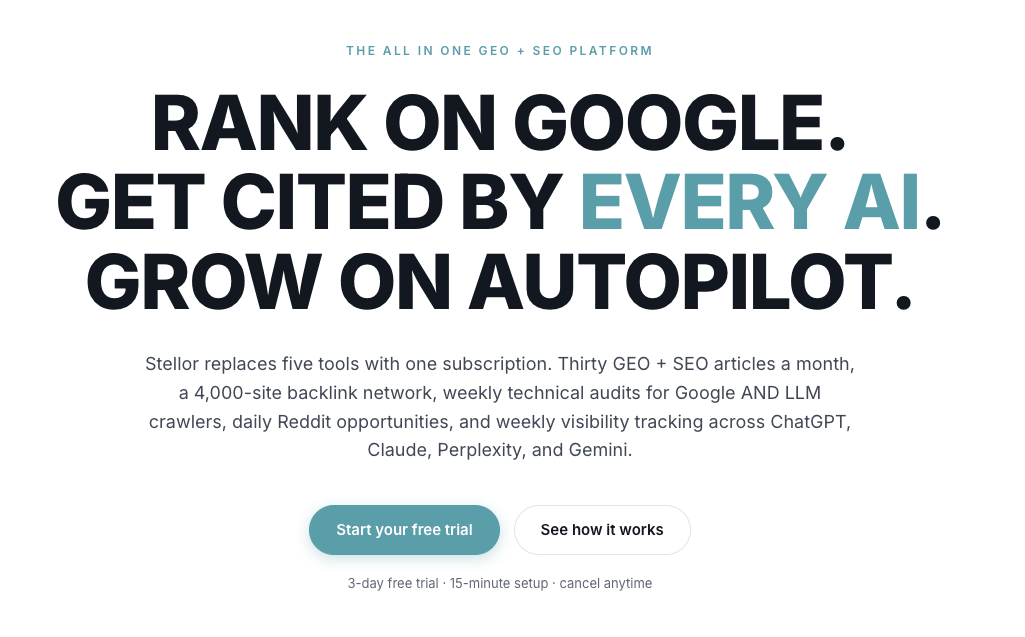
Start with the Stellor product page to see exactly what’s included, then activate your 3-day free trial, no credit card required, and request your free AI Visibility Audit to see where your practice currently stands against local competitors in ChatGPT, Claude, Perplexity, and Gemini before you commit to anything.
Sources
- The Dental SEO Guide: How to Win Local Search for Your Practice in 2026 | Pete Johnson
- SEO for Dentists: The Complete Guide (2026) | DentalBase
- Local SEO for Dentists: The Complete Guide to Ranking Where Your Patients Are Searching - HIP Creative
- HIPAA laws and regulations (HHS)
FAQ
What is local SEO for dentists?
Local SEO for dentists is the process of optimizing your Google Business Profile, website, citations, and reviews so your practice appears in Local Pack results and map searches when nearby patients search for dental services.
How do I do SEO for a dental clinic?
Start with your Google Business Profile, add complete services and photos, then build procedure-specific service pages, request reviews consistently, clean up citation mismatches, and fix technical issues like mobile speed and schema markup. Tools like Stellor can automate the content, backlink, and audit portions of that work.
What is SEO for dentists, exactly?
SEO for dentists applies standard search engine optimization, keyword targeting, technical fixes, content, and link building, specifically to the buyer behavior of dental patients, who search with location and urgency in mind (“emergency dentist near me,” “Invisalign cost [city]”).
How long does dentist local SEO take to show results?
Expect early Google Business Profile and citation improvements within 60 to 90 days, with fuller return on investment, meaning a measurable increase in booked appointments, typically arriving in 6 to 9 months.
How many reviews does a dental practice need?
There’s no magic number. A steady flow of new reviews every month matters more than hitting a specific total, since Google and patients both weight recent activity more heavily than an old pile of five-star ratings.
Can AI tools like ChatGPT recommend my dental practice?
Yes. AI answer engines increasingly cite local businesses when structured, source-backed content and complete schema markup make your site easy to reference, which is why AEO (answer engine optimization) now matters alongside traditional Local Pack rankings.