

Content velocity in SEO measures how fast you publish and how consistently that pace holds up over months, not weeks. Speed without those guardrails is just index bloat waiting to happen.
TL;DR:
- Publishing 8 to 12 posts per month is optimal for median organic growth, while higher volumes risk index bloat and declining engagement.
- Key metrics to monitor include indexation lag, active post ratio, and the ratio of discovered but not indexed pages, to avoid crawl waste.
- Fast publishing must be paired with quality control, including a two-week buffer, templated briefs, and automated metadata to sustain results.
- Growth should be scaled gradually based on domain authority, with lower cadence for new sites and higher for established ones, and monitored at 30, 60, and 90 days.
- A comprehensive content engine that automates audits, backlinks, and AI tracking enables safe velocity increases without sacrificing indexing or quality.
Table of Contents
- What Is Content Velocity SEO and How Do You Measure It?
- Why Does Publish Frequency Matter for SEO and AI Visibility?
- When Does High Publishing Velocity Hurt SEO?
- The Operational Playbook: Raising Speed Without Losing Quality
- What Publishing Cadence Fits Your Domain’s Maturity?
- What Tools and KPIs Keep Velocity Under Control?
- Measurement and Pruning: The Decision Rules That Protect Quality
- How a Managed GEO + SEO Engine Operationalizes Safe Velocity
- My 90-Day Priority Checklist for Raising Velocity Safely
- Trystellor: The Content Engine Built for Safe Velocity
- Sources
- FAQ
What Is Content Velocity SEO and How Do You Measure It?
Content velocity in SEO tracks publishing output over time, usually measured in pages per week or cluster throughput per month, and paired with quality and indexation data to see whether that pace is actually working. It’s not just “how many posts went live.” It’s whether Google indexed them, whether they’re getting sessions, and whether the pace is sustainable.
Most teams calculate it in a spreadsheet or CMS report with a few columns: publish date, page type (pillar, cluster support, refresh), indexation status pulled from Google Search Console, and 30-day organic sessions. Run that report monthly and patterns show up fast.
Here’s what to track at minimum:
- Raw velocity: pages published per week or month, broken out by content type
- Cluster throughput: how long it takes to fully publish a pillar page plus its supporting cluster pieces
- Indexation lag: days between publish and “indexed” status in Search Console
- Time-to-first-click: days between publish and the first recorded organic session
A site publishing four posts a week that all get indexed within 48 hours is in a very different position than one publishing the same four posts with a two-week indexation lag. The second pattern is often an early signal of crawl budget strain or thin content Google is deprioritizing.
Why Does Publish Frequency Matter for SEO and AI Visibility?
Velocity works in your favor when it’s paired with quality, because it compounds three things at once: crawl frequency, topical coverage, and AI citation odds. Sites publishing 8 to 12 posts per month saw median organic traffic gains in tracked case-study data, while pushing past a site’s actual production capacity tended to plateau or reverse those gains.
Three mechanisms explain the upside:
- Faster keyword coverage: publishing consistently lets you claim more of a topic cluster before a competitor does, which matters most in categories where search intent is still being defined
- Higher crawl frequency: Google tends to crawl domains more often when it learns new content shows up on a predictable schedule, which shortens the gap between publish and index
- Better AI citation odds: large language models favor sources that are clear, consistent, and easy to summarize, a pattern reinforced by research on machine summarization reliability
The AI citation piece is easy to underrate. ChatGPT, Claude, and Perplexity don’t reward volume for its own sake. They reward domains that answer a narrow question cleanly and keep doing it across dozens of related pages, because that consistency is what makes a domain easy to summarize and easy to trust as a source.
When Does High Publishing Velocity Hurt SEO?
Velocity stops being an asset the moment your systems can’t keep up with your pace, and it becomes what one industry analysis calls a “risk amplifier” rather than a ranking factor in its own right, according to Ranktracker’s framing of content velocity versus quality. Fast publishing multiplies whatever discipline (or lack of it) already exists on your domain.
Watch for these three failure modes in order of how early they show up:
- Index bloat and crawl waste. A spike in “Discovered, currently not indexed” inside Search Console means Google is finding pages faster than it’s willing to index them. That’s usually thin content, near-duplicate pages, or a domain publishing faster than its crawl budget supports.
- Falling active post ratio and per-post sessions. If the share of posts earning any organic traffic in a rolling 90-day window drops, or average sessions per post decline even as total post count climbs, you’re diluting attention across too many pages instead of concentrating it.
- Editorial quality slipping under deadline pressure. Rushed QA, missed internal links, and keyword cannibalization between near-duplicate posts are the human-side version of the same problem. A falling content score on your editorial scorecard almost always shows up a few weeks before the traffic data confirms it.
Any one of these should trigger a pause, not a push through. Two at once means your cadence has outrun your systems.
The Operational Playbook: Raising Speed Without Losing Quality
The teams that scale velocity safely all do a version of the same five things; restaurants especially can benefit from content creation for restaurants strategies to drive engagement and bookings. None of them are exotic. They just require discipline most editorial calendars skip.
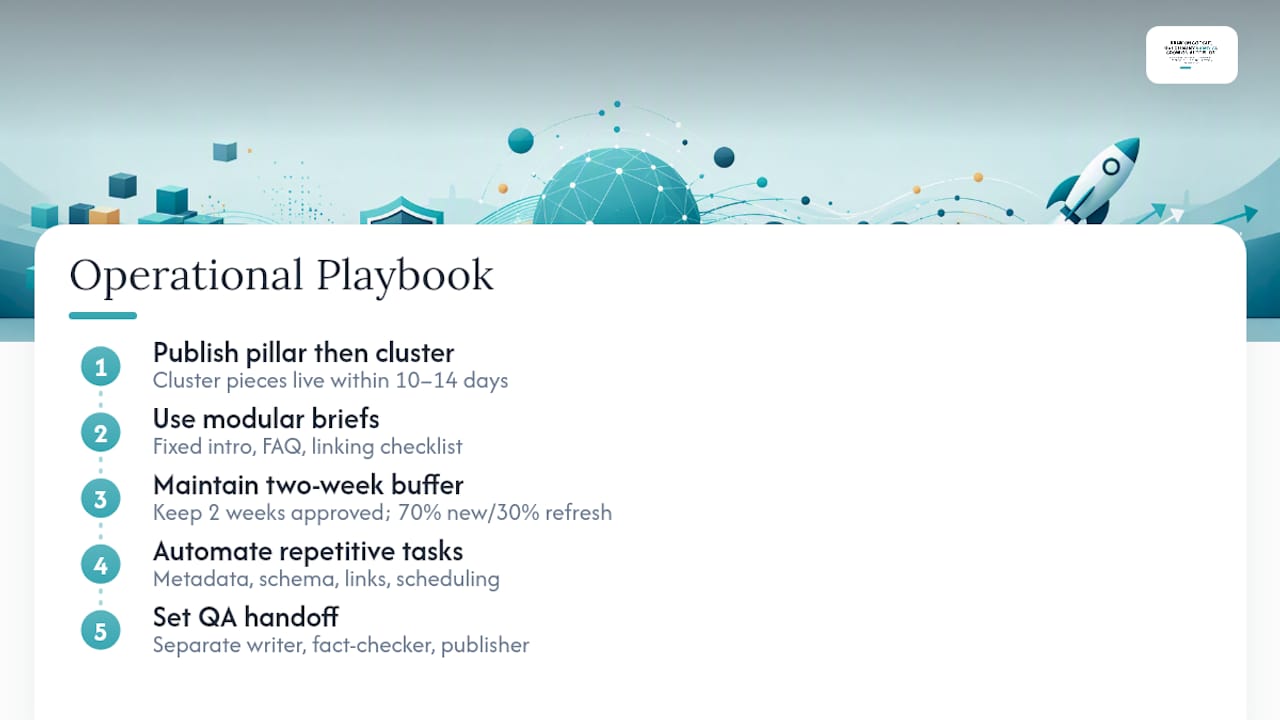
Publish the pillar, then the cluster, in a tight window. Sequencing matters more than raw output. Publish your pillar page, then get every supporting cluster piece live within 10 to 14 days, while the pillar is still fresh in Google’s crawl queue. This is the fastest way to build topical authority through content clusters instead of scattering related posts across months, which forces Google to re-evaluate topical relevance every time.
Use modular content and templated briefs. Templated editorial briefs cut time-to-publish significantly because writers aren’t reinventing structure for every post, according to Storyblok’s speed-to-market guidance. A modular brief with a fixed intro pattern, a fixed FAQ block, and a fixed internal-linking checklist turns a two-hour outlining process into 20 minutes.
Build a two-week content buffer and run a 70/30 split. Keep two weeks of fully approved content queued at all times so a single sick writer or a missed deadline doesn’t force a rushed post live. Pair that buffer with a 70% new content, 30% refresh allocation, a pattern that publishing-cadence research consistently ties to stronger ROI than an all-new-content approach, since refreshing an existing ranking page often returns more traffic per hour of work than a brand-new post starting from zero authority.
Automate the repetitive parts. Metadata generation, schema markup snippets, internal link suggestions, and scheduling are all mechanical tasks that don’t need a human making judgment calls every time. Automating them frees your editorial team to spend their attention on the parts that actually require judgment: accuracy, structure, and whether the piece answers the question it claims to answer.
Set a staffing model with a clean QA handoff. A sustainable velocity model usually separates the writer, the fact-checker, and the publisher into distinct steps with a defined handoff, even if it’s the same three people rotating roles. Skipping the handoff is how cannibalized keywords and duplicate claims slip through.
Pro Tip: Build your content buffer before you raise cadence, not after. A team that tries to increase output while running on empty inevitably cuts corners on the newest posts first, which are exactly the ones that need the most editorial attention.
What Publishing Cadence Fits Your Domain’s Maturity?
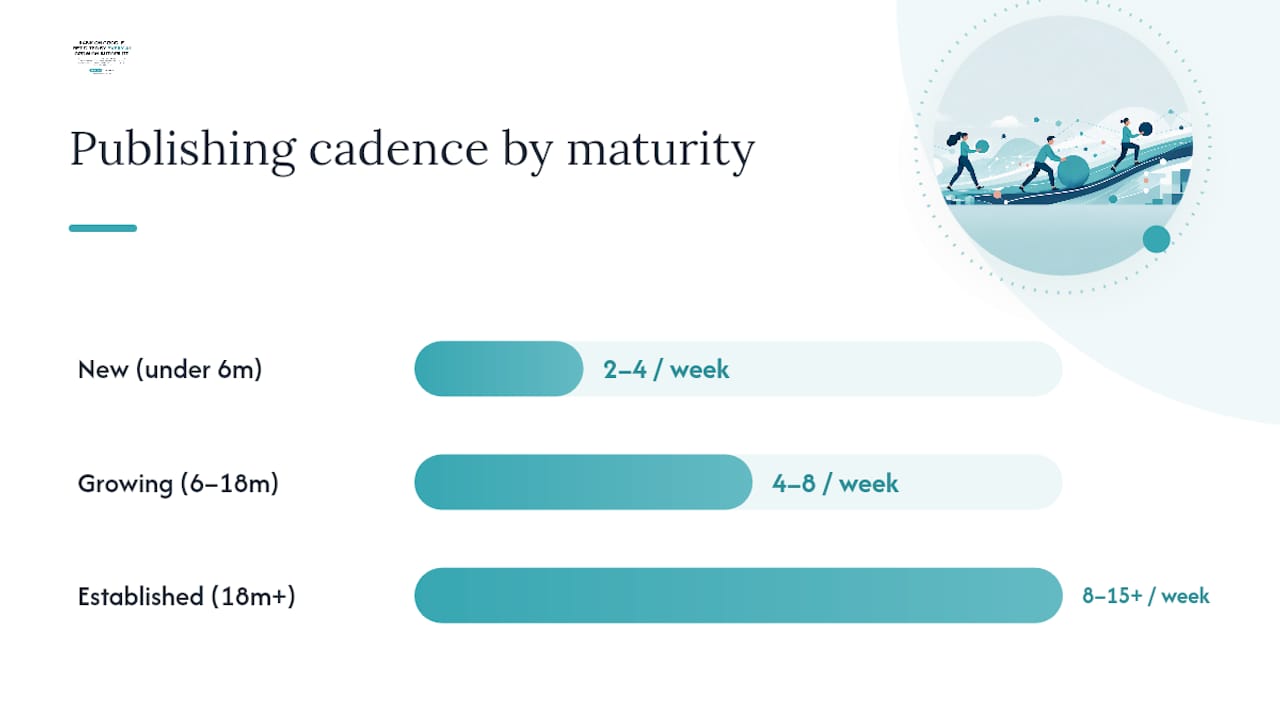
Cadence should scale with domain authority, not with how much budget got approved this quarter. Newer domains benefit from a conservative starting cadence, then scale up as authority and indexation performance prove the domain can handle more.
A workable set of buckets looks like this:
- New domains (under 6 months, low authority): 2 to 4 posts per week, weighted toward pillar and foundational pages, with almost no refresh budget since there’s nothing yet to refresh
- Growing domains (6 to 18 months, some ranking traction): 4 to 8 posts per week, split roughly 70/30 between new content and refreshes of early posts that are underperforming
- Established domains (18+ months, strong authority): 8 to 15+ posts per week is sustainable for teams with mature editorial systems, though the 70/30 new-to-refresh split still holds
Bump your weekly output by half, then monitor indexation rate and per-post sessions at the 30, 60, and 90 day marks. If either metric slips, hold the new cadence steady for another 30 days before touching it further, and shift a larger share of that period’s calendar toward refreshes instead of net-new pages. This mirrors how local service businesses testing content pace for lead generation validate cadence increases before committing to them long term.
What Tools and KPIs Keep Velocity Under Control?
Velocity only stays safe when it’s instrumented. That means a scorecard and a dashboard, not a gut check every few weeks.
Your editorial scorecard should gate every post before it publishes, with fields for target query match, internal link count, schema completeness, and a plain-language readability check. Set a minimum threshold, for instance nothing publishes below a 7 out of 10 on your internal scoring rubric, and enforce it the same way for the fiftieth post of the month as the first.
On the technical side, four numbers matter most:
- Indexation ratio in Google Search Console: indexed pages divided by submitted pages, tracked weekly, not just at launch
- Active post ratio: the share of published posts earning any organic session in a rolling 90-day window
- Per-post session baseline: average sessions per post in its first 90 days, tracked by content type so pillar pages aren’t compared against FAQ pages
- Crawl stats from Search Console’s Crawl Stats report, watching for rising “Discovered, currently not indexed” counts as an early warning sign
Sites publishing at a sustainable 8 to 12 posts a month in tracked studies held healthier median traffic gains than sites that pushed past their production capacity, which is the clearest evidence that instrumented cadence beats guessed cadence. CMS-side automation for metadata and schema, plus a properly configured llms.txt file using standard schema.org markup, rounds out the technical side so both Googlebot and AI crawlers can read your output cleanly.
Measurement and Pruning: The Decision Rules That Protect Quality
Two thresholds should trigger an automatic review, no debate needed.
When the data flags a problem, you have three fixes, not one default answer:
- Merge near-duplicate posts targeting the same query into a single stronger page, and 301-redirect the weaker one
- Canonicalize pages that legitimately serve slightly different intents but compete for the same keyword, so Google knows which one to rank
- Delete and redirect posts that never earned traffic and have no realistic path to relevance, since keeping them around only drags down your active post ratio
Planning your pruning strategy before you scale, not after the bloat shows up, is the difference enterprise content teams point to between velocity that compounds and velocity that collapses under its own weight.
Pro Tip: *When presenting cadence decisions to leadership, lead with the indexation ratio and active post ratio, not raw post count.
How a Managed GEO + SEO Engine Operationalizes Safe Velocity
A managed content engine is a useful reference model precisely because it has to solve this problem at scale, for every client, every week, without the failure modes above. Stellor runs 30 GEO and SEO-optimized articles per month per customer, built on a rolling buffer so cadence never depends on a single writer’s calendar.
What makes that sustainable rather than reckless:
- Weekly technical audits covering 11 checks, including schema completeness and indexation readiness, with one-click fixes so bloat gets caught before it compounds
- A 4,000-site backlink network that reinforces new pages with authority signals instead of leaving them to rank on content alone
- Daily Reddit engagement that surfaces the community threads AI models like ChatGPT already draw on for recommendations
- Weekly LLM visibility tracking across ChatGPT, Claude, Perplexity, and Gemini, showing exactly which prompts are returning citations and which competitors are winning them instead
My 90-Day Priority Checklist for Raising Velocity Safely
Weeks 0 to 4: map your topic clusters and audit current indexation ratio in Search Console before touching cadence. This is diagnostic work, not production work, and skipping it is the single most common mistake I see.
Weeks 9 to 12: review indexation and per-post session data against your baseline, decide whether to raise cadence again or shift budget toward refreshes, and run your first pruning pass on underperforming posts.
The biggest pitfall is testing cadence and quality changes simultaneously. You won’t know which variable moved the metric.
— Cole
Trystellor: The Content Engine Built for Safe Velocity
Trystellor replaces the five separate vendors most teams stitch together to manage cadence, technical health, backlinks, AI visibility, and community engagement, for a single $199 per month subscription. Instead of hiring a writer, a link-building agency, a technical auditor, and an AI-monitoring tool separately, you get 30 GEO and SEO-optimized articles a month, weekly technical audits with one-click fixes, access to a 4,000-site backlink network, daily Reddit opportunity alerts, and weekly LLM visibility tracking across ChatGPT, Claude, Perplexity, and Gemini, all built on the buffer-and-governance model this article just walked through.

If you’re a marketer or agency trying to raise publishing cadence without watching your indexation ratio collapse, this is the system built to do exactly that on autopilot. Check out Stellor’s product page and start a 3-day free trial no credit card required, to see what a properly instrumented content engine looks like on your own domain.
Sources
- HubSpot: Blogging frequency benchmarks
- The Seo Engine: Blog publishing schedule data
- Storyblok: How to improve speed to market — content velocity guide
- Ranktracker: Content velocity vs content quality
FAQ
What Is a Good Content Velocity for SEO?
There’s no single number that fits every domain.
How Many Blog Posts per Month Should You Publish?
Case-study data shows sites publishing 8 to 12 posts per month saw median organic traffic gains, while pushing past a site’s real production capacity tended to plateau or reverse those gains, according to tracked publishing-cadence research.
Can Publishing Too Much Content Hurt SEO?
Yes. High volume without matching quality control leads to index bloat, falling active post ratios, and keyword cannibalization, all of which show up in Search Console as rising “Discovered, currently not indexed” counts before traffic data even confirms the problem.
What’s the Difference Between Content Velocity and Content Quality?
Velocity measures how fast and how consistently you publish; quality measures whether each piece earns indexation, traffic, and citations. Velocity acts as a multiplier on whatever quality discipline already exists on your domain, not a separate lever.
How Does Stellor Help Teams Scale Content Velocity Safely?
The platform manages the full cycle including monthly articles, technical audits, backlink support, and AI visibility tracking, so cadence increases without the indexation and quality risks that come from scaling content production in-house without the systems to match.