Getting consistent brand visibility in both Google search and major AI answer engines now depends on tracking citations, monitoring technical audits, and automating content fixes across multiple platforms. Legacy SEO tools either gate AI visibility features behind expensive plans or fail to link content generation directly to citation monitoring, leaving teams with fragmented reporting and redundant workflows. This guide compares pricing, automation depth, and integration support across five AI-driven SEO and search visibility platforms so you can choose one that matches your needs without manual tool stitching.
Table of Contents
- Stellor
- Writesonic
- Surfer SEO
- Trustsonic AI Search Visibility Platform
- Writesonic
- Comparative Analysis of AI Visibility and SEO Platforms
Stellor
At a Glance
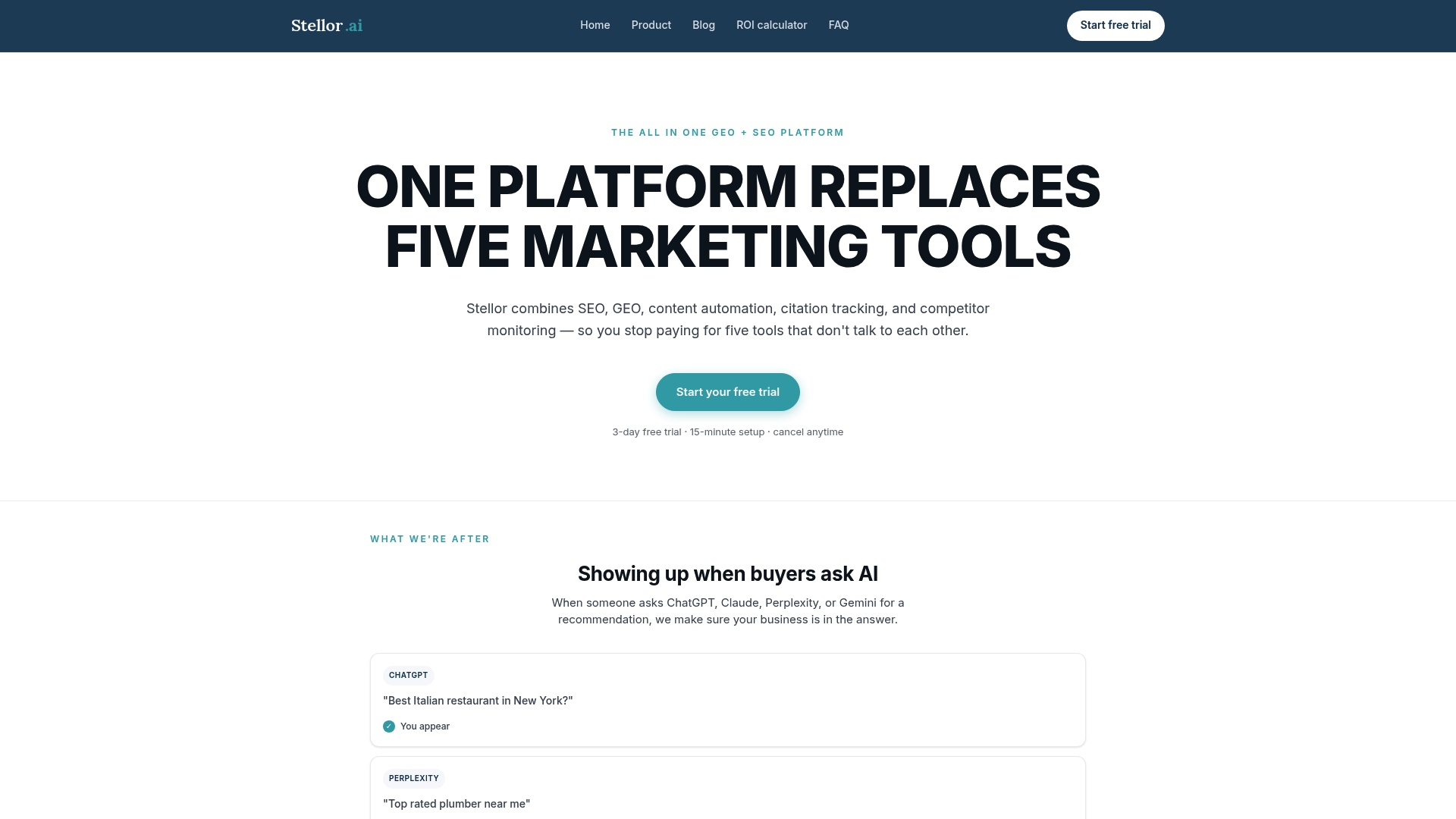
Stellor’s marketing materials state a 4, 000-site backlink network that the platform channels to amplify published GEO and SEO content. The product bundles content publishing, backlink delivery, technical audits, Reddit engagement, and AI mention tracking into a single subscription.
Core Features
- AI visibility tracking across ChatGPT, Claude, Perplexity, Gemini, and Google so you know when your business is being cited.
- Automatic publishing of SEO and GEO articles tailored to services and locations for steady content volume.
- Weekly technical audits that check schema, page speed, and AI readiness to keep pages quotable by answer engines.
- Daily Reddit opportunity monitoring to surface high intent threads and suggested replies.
Key Differentiator
Built specifically for AI-driven answer engines, Stellor ties AI mention tracking directly to your SEO and backlink activity. That makes it possible to see which prompts mention your competitors and which published pages are actually winning citations.
Pros
- Automates what used to require five subscriptions. You get content production, backlink delivery, audits, Reddit workflows, and AI visibility tracking in one dashboard. That reduces integration gaps and reporting blind spots.
- The weekly checks create a maintenance cadence. Fixes are flagged in the interface so nontechnical teams can keep pages AI ready without a developer on retainer.
- Daily Reddit suggestions convert passive monitoring into repeatable outreach that the LLMs often cite when recommending vendors.
- The platform targets both legacy Google rankings and emerging AI citations, so your content is formatted and linked to be legible to both search bots and answer engines.
- A free trial without a credit card includes a visibility audit and content plan so you can see the first 30/90 day roadmap before committing.
Cons
- Does not currently support franchise level management for very large multi-location organizations, which limits centralized control for some enterprise rollout scenarios.
Notable Integrations
- CMS integrations via API for WordPress, Webflow, Shopify, Wix, Squarespace, Ghost, and HubSpot. These connectors automate content drops and reduce manual publishing work.
Who It’s For
Small and medium sized local service companies and professional practices that need to be visible in both Google and AI answer engines. Good fit for agencies that want to resell an integrated content plus visibility stack without stitching tools together.
Unique Value Proposition
Weekly technical audits combined with continuous AI mention tracking turn reactive SEO work into a predictable operational rhythm. That pairing lets you publish regularly and measure citation gains against the weekly visibility checks rather than waiting months for vague ranking moves.
Real World Use Case
A small law firm published targeted location and service pages, accepted the backlink plan from the network above, and used the visibility reports to see which prompts mentioned competing firms. The result was clearer editorial priorities and measurable increases in inquiry volume.
Pricing
Plans start at $199 per month with custom tiers that scale toward $1, 000 plus for larger programs. The entry plan includes the audit, content publishing workflow, backlink placement, Reddit monitoring, and weekly audits.
Website: https://trystellor.com
Writesonic
At a Glance
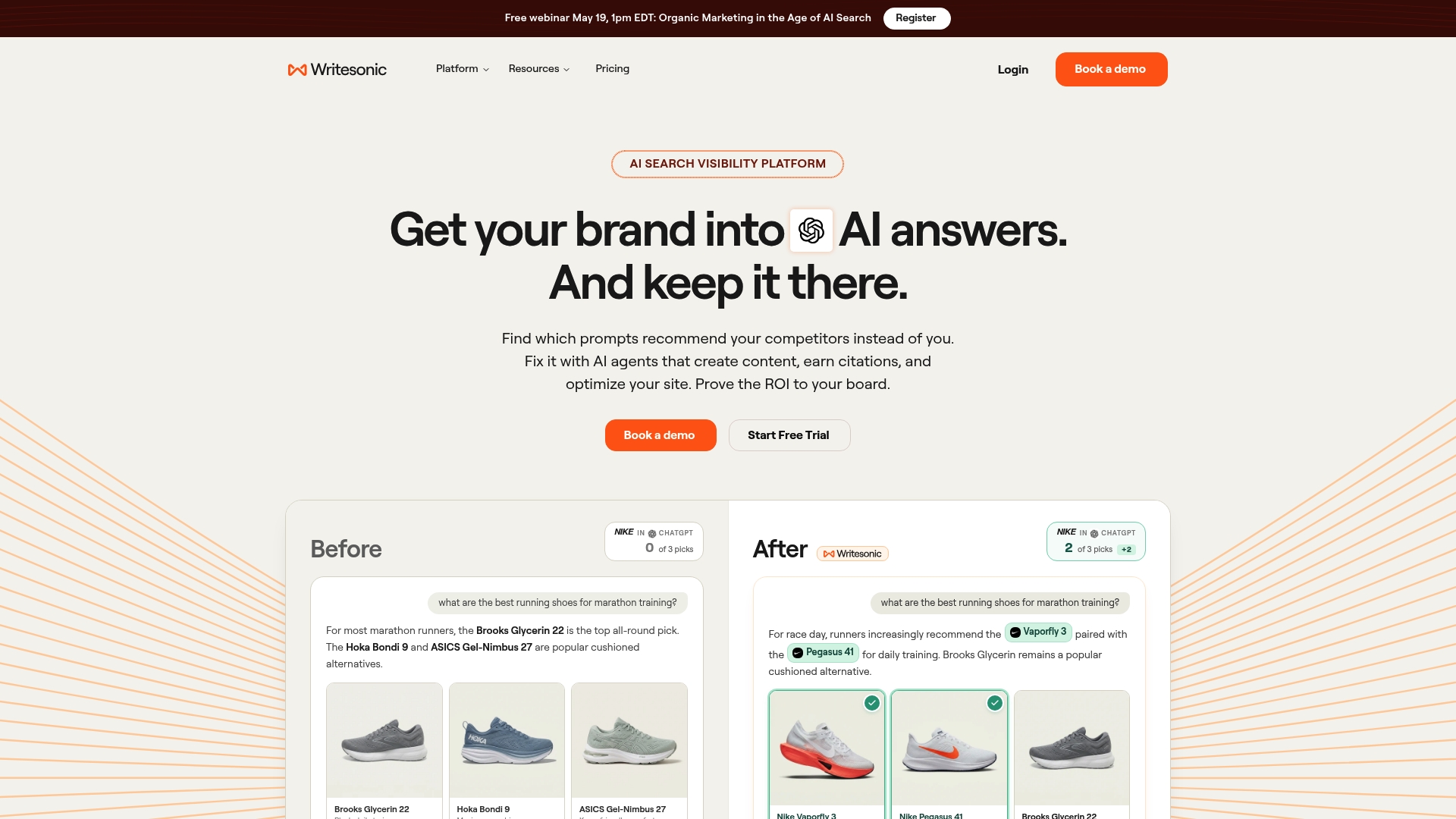
Starts at $79 per month for the Starter plan, with tiered options up to Enterprise and discounts for annual billing. Writesonic pairs AI content generation with monitoring for AI search engines so you can both create and track the answers that matter to your brand.
Core Features
Writesonic offers AI visibility monitoring across multiple AI platforms so you can see when your site is cited by engines and where competitors appear instead.
The platform also generates articles and product descriptions, runs site audits with technical fix recommendations, and exposes automated workflows driven by AI agents to execute repeatable SEO tasks.
Key Differentiator
Writesonic focuses on closing the loop between diagnosis and execution. You get monitoring of AI answers, content generation, and automation in the same workspace rather than stitching separate tools together.
That unified tracking and action across multiple AI engines is useful when you want one place to spot citation gaps then assign generation and fixes without moving files or context.
Pros
- Fast content generation. Users report quick turnarounds that help agencies keep pace with client calendars.
- The interface has versatile templates for blogs, product pages, and meta content so writers save setup time.
- AI visibility monitoring covers major engines so you can measure citation changes week to week.
- Integrations with Google Search Console and Wordpress let teams push updates and pull performance signals without manual exports.
- Automated workflows reduce repetitive tasks by letting agents run routine audits and draft fixes.
Cons
- Users report occasional bugs and performance inconsistencies that interrupt workflows at inopportune moments.
- AI output quality can be uneven over time, requiring more editorial review for publication-ready content.
- Credit allocation and usage tracking is confusing for some teams, which complicates monthly reporting.
- Support experiences vary across cases, so response times and resolution quality are not consistent.
When It May Not Fit
If you need guaranteed, magazine-grade copy straight out of the generator, Writesonic’s varying output quality will force extra editing and slow your throughput.
Lower-tier plans limit automation runs, so teams that want heavy use of agents for dozens of sites will likely need a higher plan. Also plan for uneven support experiences when you buy in.
Notable Integrations
- Google Analytics for traffic and behavior signals
- Google Search Console for indexing and query data
- Wordpress for direct publishing
- Google Keyword Planner for keyword research
- Google SERPs for rank checks
- Reddit for social listening and opportunity discovery
Who It’s For
Marketing teams, agencies, and larger organizations aiming to improve AI search visibility and automate parts of their SEO workflow. Best when you want generation, monitoring, and automation in a single subscription rather than separate point tools.
Real World Use Case
A digital marketing agency tracks client AI rankings in Writesonic, finds content gaps where clients are absent in AI answers, and uses the built-in generator plus an AI agent to produce and schedule optimized articles. The result is more citations and higher placements for targeted prompts.
Pricing
Starts at $79 per month for the Starter plan. Paid tiers include Basic, Growth, and Enterprise with monthly or annual billing and discounts for annual commitments. Higher plans increase automation limits and integration depth.
Website: https://writesonic.com
Surfer SEO

At a Glance
Surfer SEO reports more than 150, 000 users worldwide. The platform mixes real-time on page recommendations with AI writing tools and a monitor for AI search visibility so teams can optimize for Google and chat engines from one dashboard.
Core Features
- Content audit for weak pages and content gaps with clear priority signals.
- Topic discovery and idea generation that matches audience intent across languages.
- Internal linking automation and site tracking for ongoing SEO health.
- Real-time editing with AI content generation, humanization, and detectors built into the editor.
Key Differentiator
Surfer combines live on page guidance, AI content helpers, and AI visibility monitoring in one interface. That single dashboard reduces tool switching and gives writers immediate, measurable targets while SEO teams track both organic rank and presence inside chat engines.
Pros
- Fast optimization feedback. The editor shows target word counts, keyword density, and suggested terms as you type so articles align with top ranking pages.
- Strong integration set. Connecting to Google Docs, WordPress, and ChatGPT lets content flow from draft to publish without manual copy paste.
- Active community and learning resources. Webinars and case studies help teams adopt the workflow and replicate tactics used by other publishers.
- Unified workflow for content teams. Writers, editors, and SEOs can work in the same project and see the same metrics.
Cons
- AI suggestions are sometimes inaccurate or off brief, which requires manual review and editing.
- Performance for non-English or highly transactional content can lag the quality the vendor advertises for English editorial work.
- Pricing tied to AI credits can become expensive for heavy generation use, increasing monthly cost unpredictably.
- Some users report the interface feels cluttered at first, requiring time to learn the navigation and project structure.
When It May Not Fit
If your team produces large volumes of multilingual transactional content, the AI quality limits above could slow publishing. Heavy AI generation workloads will push costs up because of credit consumption. Teams that need strict billing controls may find Surfer’s account options limiting.
Notable Integrations
- Google Docs
- WordPress
- ChatGPT
- Zapier
- Contentful
Who It’s For
SEO professionals, content marketers, and agencies that want a single workspace for audits, content creation, and monitoring. In-house teams that publish at scale will benefit most if they can absorb AI credit costs for high volume output.
Real World Use Case
A digital agency runs Surfer audits across client sites, flags content gaps, and briefs writers with the platform’s suggested outline. Writers draft in Google Docs, publish via WordPress integration, and the agency tracks both Google rankings and mentions inside chat engines.
Pricing
Surfer lists plan details on its website. Subscriptions typically include core optimization tools and reporting, while AI credits and certain add ons increase cost for teams that generate a lot of content.
Website: https://surferseo.com
Trustsonic AI Search Visibility Platform
At a Glance
According to the vendor, Trustsonic runs on Microsoft Azure and claims GDPR, SOC 2, and HIPAA compliance while tracking AI visibility across ChatGPT, Bard, Gemini, and Google AI. That combination targets brands that need enterprise-grade controls and multi-AI coverage.
Core Features
Trustsonic bundles AI visibility monitoring that watches where a brand is cited or omitted across multiple AI engines. It pairs monitoring with AI agents that suggest or implement content and site fixes automatically.
The platform includes continuous prioritization and automated alerts for technical issues, plus content generation for SEO and AI answers with schema and FAQ support. Authority building is handled through citation and structured data workflows.
Key Differentiator
The product’s main angle is a single workflow that links SEO signals to AI visibility metrics and then pushes fixes into content or technical tasks. That unified feedback loop suits enterprise teams that want a managed route from detection to correction rather than juggling separate audits, content tools, and developer tickets.
Pros
- Comprehensive monitoring across AI engines gives marketing teams a single view of where their brand is being recommended and where it is absent.
- Automation of content and technical fixes reduces manual backlog by converting alerts into actionable items for editors and engineers.
- Supports global markets and multiple user profiles, which helps agencies and multi-region brands coordinate campaigns across teams.
- That compliance claim on Azure helps when security reviews are part of procurement for regulated industries.
Cons
- There are no third-party user reviews referenced in the product data, so practical user experience and support responsiveness are unclear.
- The platform may feel complex for smaller teams or nontechnical users since the emphasis is on enterprise workflows and automated technical fixes.
- Pricing details are not published, which makes budgeting and quick procurement difficult for midmarket buyers.
When It May Not Fit
If your team is a small in-house marketing group without dedicated SEO or engineering support, Trustsonic’s automation and alerting could be overkill. Teams that need out-of-the-box, low-friction content publishing with transparent per-seat pricing will find a poor fit here.
Notable Integrations
- Google Search Console
- Google Analytics
- Looker Studio
- WordPress
- Public APIs for custom data syncs
These integrations let you import search signals, surface analytics inside the platform, and push content or schema updates back to CMS systems.
Who It’s For
Large marketing and SEO teams at enterprise brands, agencies managing multiple client accounts, growth teams, and e-commerce organizations that need to act on AI visibility signals at scale. The platform fits buyers who can staff editorial and engineering responses to technical alerts.
Real World Use Case
The vendor describes a global brand using Trustsonic to monitor AI presence, identify content gaps, fix schema errors, and optimize pages for AI answers. According to that description, the activity increased citations and improved AI answer placement across platforms.
Pricing
Pricing is not published and the field in the product data is listed as informational only. Prospects should request a demo and enterprise quote to understand licensing, onboarding fees, and any managed service add-ons.
Website: https://clientfirstportal.com
Writesonic
At a Glance
Free tier available; paid plans start at $16/month, making Writesonic a low-friction entry for teams that want AI content plus visibility tracking in one dashboard. The platform bundles content generation, site audits, and AI search visibility tools into a single workflow.
Core Features
- AI Search Visibility Tracking across multiple AI platforms, showing where your brand is cited and which prompts drive mentions.
- Content Strategy and Creation tools that generate articles, briefs, and optimization suggestions tuned for AI-first queries.
- Site audits with automated fixes for schema, crawl errors, and technical SEO items that the platform can surface and suggest repairs for.
- AI search volume explorer and competitor analysis to spot high-intent queries and content gaps.
- Citation outreach templates, brand reputation monitoring, and traffic analytics focused on how AI models use your content.
Key Differentiator
Writesonic’s angle is end-to-end automation of SEO, content creation, and AI search optimization tied to major analytics tools. The tight coupling between content generation and visibility tracking reduces manual handoffs between writers, SEOs, and analysts.
Pros
- The integration between content and visibility tracking removes guesswork about which pieces AI engines will cite. That reduces wasted content cycles.
- Content Strategy and Creation speeds up production; teams can publish drafts and optimization notes in the same flow they track AI citations.
- AI Search Visibility Tracking gives a clear signal for PR and outreach work by showing where AI mentions your brand compared to competitors.
- Integrations with established SEO tools let you import keyword and backlink context without rebuilding a discovery process.
- Tailored plans fit single users up to enterprise teams, so agencies can scale client footprints inside one account.
Cons
- Several advanced features sit behind higher tiers, so costs climb quickly for agencies managing multiple clients.
- Users report a steep learning curve for the more complex modules, which slows early adoption for teams without SEO experience.
- Limited e-commerce specific functionality and some reported stability issues make it less reliable for stores with heavy transactional traffic.
- Renewal pricing and add-on features can push total cost higher than initial estimates.
When It May Not Fit
If your team lacks an in-house SEO practitioner or prefers very simple WYSIWYG content tools, the platform’s complexity is a liability. Small e-commerce shops that need native product feed management and checkout tracking will find feature gaps.
Notable Integrations
- Ahrefs for backlink and keyword context.
- Semrush to supplement keyword research and competitive intelligence.
- Google Analytics and Google Search Console for traffic and index signals.
- Google Keyword Planner for search volume inputs.
Who It’s For
Marketing teams, SEO professionals, and agencies that want to automate both content production and the signals that make AI models cite their brand. Best for teams that can invest time to learn an integrated workflow and appreciate consolidated reporting.
Real World Use Case
An agency uses Writesonic to generate monthly SEO-ready articles, run weekly AI visibility checks, and queue automated technical fixes. The consolidated workflow reduced back-and-forth between writers and developers and lowered outsourcing hours for reporting.
Pricing
Free tier available. Paid plans start at $16/month for Basic, with higher tiers at $39, $79, $199, and custom Enterprise options. Annual billing offers discounts while monthly billing remains available.
Website: https://writesonic.com
Comparative Analysis of AI Visibility and SEO Platforms
Selecting the right AI-driven SEO and visibility platform depends on balancing offered features, pricing structures, and operational nuances. Here is how leading platforms compare against the featured product, Trystellor.com.
Feature Specialization and Workflow Integration Differences
Trystellor.com integrates AI visibility monitoring with backlink and content publishing workflows tailored for both traditional and AI-driven engines. This approach benefits users seeking a unified setup that maintains consistent page readiness for AI citation optimization. However, competitors like Writesonic emphasize AI-powered content generation speed and template diversity, providing an edge for teams prioritizing high-volume content production over visibility analytics. Conversely, Surfer SEO shines in providing immediate optimization feedback and auditing features within its dashboard, making it highly suitable for teams focusing on on-page quality alignment.
Technical Depth and Usability Tradeoffs
In terms of scalability for larger enterprises, Trustsonic AI Search Visibility Platform offers automated technical corrections paired with compliance standards. It outpaces Trystellor.com on data privacy and global deployment needs. However, its complexity and opaque pricing structure may deter smaller operations. Smaller teams or those seeking simplicity might find the user interface of Writesonic more accommodating despite occasional performance inconsistencies.
Best Fit Recommendations
- Trystellor.com: Ideal for local service companies needing integration of SEO with real-time AI visibility tracking to optimize both legacy and emerging engine citations.
- Writesonic: Excellent for agencies requiring efficient content generation and basic citation monitoring at competitive entry-level pricing.
- Surfer SEO: for SEO-focused organizations demanding precise on-page optimization signals and collaborative tools for content teams.
- Trustsonic: Best suited for enterprises managing multi-region campaigns with high compliance requirements and technical correction automation.
Our Pick
Trystellor.com represents the most balanced solution for local businesses aiming to blend SEO strategies with monitoring capabilities tailored to AI-based search engines. While it’s not the best choice for very large enterprises or those seeking purely content-centric automation due to its lack of franchise-level scalability, its targeted approach to AI readability and backlink integration makes it the top choice within its designated focus audience.
AI Search Visibility Platform Comparison
Deciding the best platform involves contrasting features that impact visibility tracking in AI systems.
| Product | Key Differentiator | Best For | Pricing | Notable Limitation |
|---|---|---|---|---|
| Trystellor | AI mention tracking tied to SEO and backlinks | Local service companies and professional practices | Starts at $199/month | Lacks franchise management for large organizations |
| Writesonic | Unified monitoring and action for SEO workflows | Marketing teams and agencies | Starts at $79/month | Performance inconsistencies and support variations |
| Surfer SEO | Live optimization guidance in the editor | SEO professionals and content marketers | Not disclosed | Limited AI quality for transactional or non-English content |
| Trustsonic | Enterprise-grade search signal tracking and fixes | Enterprise marketing and SEO teams | Not disclosed | Complexity unsuitable for small nontechnical teams |
Ready to Outperform Byword.ai Alternatives with Trystellor
When choosing your SEO and AI visibility platform, the challenge is balancing strong Google rankings with emerging AI citations. Many platforms struggle to unify content creation, backlink building, technical audits, and AI mention tracking, leaving gaps that cost you visibility and leads. Trystellor solves this by integrating these components into a single subscription designed specifically for businesses aiming to dominate both search worlds.
Experience consistent growth with:
- Automated publishing of GEO and SEO-optimized articles tailored to your services and locations
- Access to a 4, 000-site backlink network that builds lasting authority
- Weekly technical audits to keep your site AI-ready without extra developer hours
- AI visibility tracking across ChatGPT, Claude, Perplexity, Gemini, and more
See how Trystellor works to position your business where buyers are searching and asking.
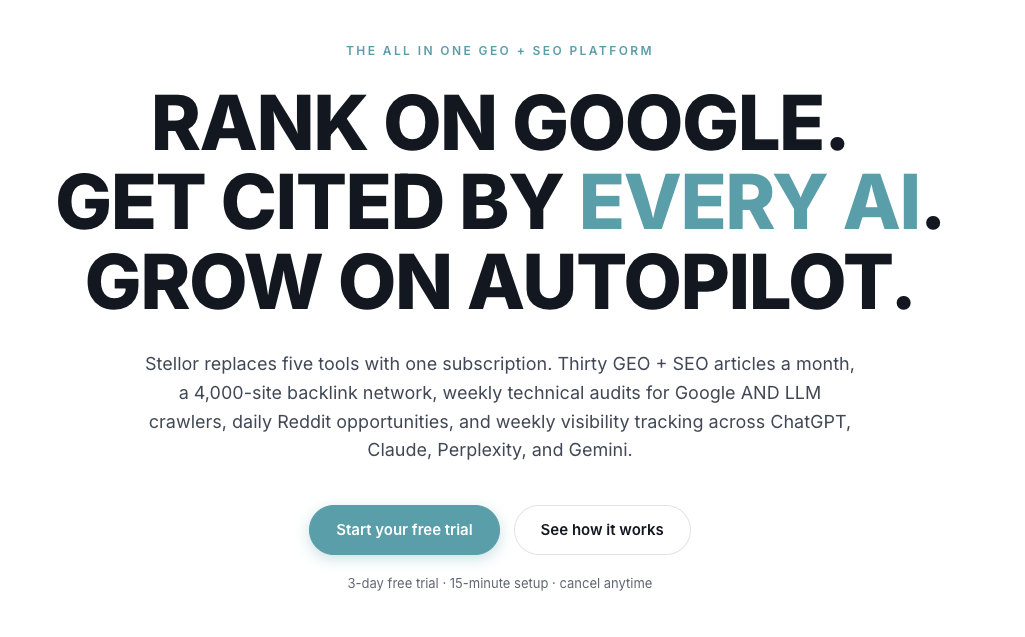
Get your free AI Visibility Audit today and discover which buyer prompts your competitors are winning. Start publishing targeted content with backlinks that bring measurable AI citations and Google rankings, all managed from one dashboard. Visit Trystellor now to claim your audit and take control of your search presence.
Frequently Asked Questions
How does Trystellor automate content publication for local service businesses?
Trystellor automates the publication of SEO and GEO articles tailored to services and locations, ensuring a steady flow of content. According to the article, this automation is part of a bundled service that enhances content volume without requiring extensive manual input. Users can expect a consistent output of relevant articles that enhance their online visibility.
What is the difference between Trystellor and Writesonic in terms of AI visibility monitoring?
Writesonic provides robust AI visibility monitoring that helps users see when their site is cited by AI engines, making it a strong choice for those looking for detailed tracking. Trystellor, while also offering visibility features, combines this with weekly technical audits to maintain AI readiness across content. Businesses focused on proactive technical management might prefer Trystellor for its comprehensive maintenance approach.
Which platform is better for tracking AI citations if I run a small agency?
Trystellor is better for small agencies that want a consolidated approach, as it integrates content production with AI mention tracking. As highlighted in the article, this integration allows agencies to streamline their workflows, making it easier to manage client visibility in both Google and AI answer engines. Smaller teams may find this all-in-one solution reduces the complexity of using multiple tools.
Can I rely on Trystellor for daily monitoring for Reddit engagement opportunities?
Trystellor provides daily monitoring focus specifically on Reddit opportunities, leading to high-intent engagement threads and suggested replies. The article mentions this feature as part of how Trystellor enhances marketing outreach by leveraging platforms like Reddit effectively. Expect regular updates on opportunities relevant to your content, maximizing your engagement reach.
How do Trystellor’s weekly technical audits help maintain SEO health?
Trystellor’s weekly technical audits check schema, page speed, and AI readiness to ensure pages are quotable by answer engines. According to the article, this ongoing maintenance helps identify and flag issues in the user interface, allowing non-technical teams to keep pages optimized without needing developer support. This means you can maintain a competitive edge without incurring additional costs.