

TL;DR:
- Trystellor is a platform that helps flooring contractors improve their local SEO and AI citations for $199 monthly. It publishes GEO content, manages listings, tracks reviews, and monitors AI visibility to generate organic leads within a few months. The platform offers a quick setup, a free trial, and consolidates multiple marketing tools into one system.
Trystellor is the strongest single platform for flooring contractors who want to rank on Google and get cited by AI engines like ChatGPT and Perplexity at the same time. It publishes numerous GEO and SEO-optimized articles monthly to your site, backs them with a 4,000-site backlink network, runs weekly technical audits, and tracks your citations across ChatGPT, Claude, Perplexity, and Gemini, all for $199/month. Setup takes 15 minutes, your free AI Visibility Audit arrives within 48 hours, and most flooring contractors see their first organic leads within a few months.
Here is what to do right now:
- Start a 3-day free trial at Trystellor (no credit card required).
- Run your free AI Visibility Audit to see exactly which AI engines are citing your competitors instead of you.
- Claim and optimize your Google Business Profile if you have not already done so.
- Schedule your 90-day content plan during onboarding so your service and location pages go live in the first 30 days.
For the technical foundation behind local search, Google Search Central and schema.org/LocalBusiness are the two authoritative references every flooring contractor’s site should be built against.
Table of Contents
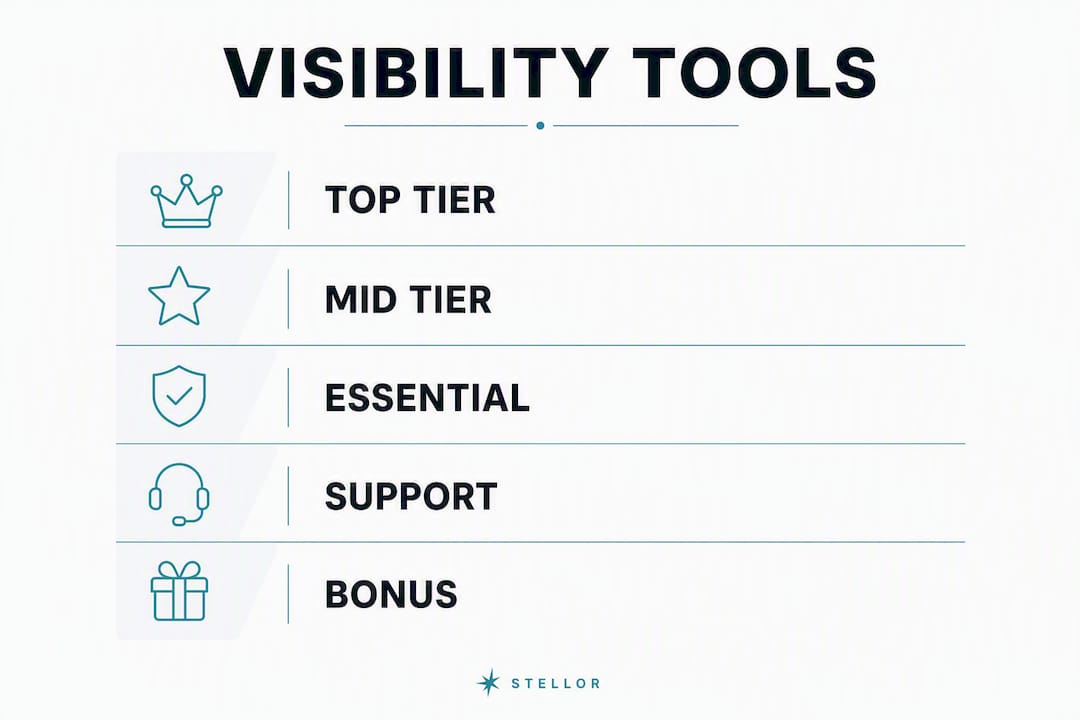
- What are the best online visibility tools flooring contractors actually need?
- How do you choose the right visibility solution for your flooring business?
- What does pricing look like, and what ROI should you expect?
- Your first 90 days: a practical implementation plan for flooring contractors
- Why Trystellor is built for flooring contractors
- Key Takeaways
- The visibility gap most flooring contractors are not measuring
- Trystellor gives flooring contractors a measurable edge at $199/month
- Useful sources and further reading
- FAQ
What are the best online visibility tools flooring contractors actually need?
Most flooring contractors do not have a marketing problem. They have a visibility architecture problem. The phone stops ringing not because the work is bad, but because the right buyer cannot find you at the moment they are searching. The fix is not one magic tool. It is a set of coordinated categories, each handling a distinct layer of your digital presence.
GEO content platforms
A GEO content platform publishes service pages, location pages, and comparison guides that target the specific queries your buyers type. Think “hardwood floor installation in [your city]” or “best LVP flooring contractor near me.” Without these pages, you are invisible to the majority of high-intent local searches. The must-haves: automated publishing cadence (at least 20 pages per month to build authority fast), schema markup on every page, internal linking structure, and llms.txt configuration so AI crawlers can read and cite your content.
Local listings and Google Business Profile management
Your Google Business Profile (GBP) is the single highest-leverage asset for a flooring contractor. It controls your appearance in the local map pack, which sits above organic results for most service queries. Platforms that manage listings across 50+ directories reduce the administrative cost of keeping your NAP (name, address, phone) consistent and can lift your Maps ranking faster than content alone. Must-haves: bulk listing sync, duplicate detection, GBP post scheduling, and Q&A management.

Review and reputation management
Review velocity, meaning how frequently new reviews arrive, is one of the strongest signals Google uses to rank local businesses. A contractor with 4.8 stars and 12 reviews posted in the last 30 days will outrank one with 4.9 stars and no recent activity. Look for tools that automate post-job review requests via SMS or email, flag negative reviews for fast response, and track your star rating trend over time.
On-site SEO and conversion-focused website features
Your website needs more than a homepage and a contact form. Project galleries with before-and-after photos, service-specific landing pages (hardwood, LVP, tile, carpet), and location pages for every city you serve all contribute to both rankings and conversion rate. Schema markup on your LocalBusiness and Service pages tells Google exactly what you do and where.
Analytics and closed-loop attribution
Closed-loop attribution connects your ad spend and content directly to booked jobs, which is the only metric that actually matters to a flooring business owner. Google Analytics 4 (GA4) and Google Search Console give you organic traffic data. Call tracking tools like CallRail add the phone layer. The goal is a single dashboard where you can see: visitor source → form fill or call → booked estimate → closed job.

CRM and job-management integrations
A CRM built for trade contractors, such as DripJobs for epoxy and specialty coating work, connects leads to proposals, follow-ups, and job costing in one place. Without CRM integration, you cannot close the attribution loop. Must-haves: lead source tagging, proposal automation, and two-way sync with your accounting or estimating software.
Paid ads and tracking
Google Local Services Ads (LSAs) and Google Ads are the fastest way to generate calls while your organic presence builds. LSAs are pay-per-lead and show above standard ads for queries like “flooring contractor near me.” Must-haves: conversion tracking tied to phone calls and form fills, UTM parameters on all landing page URLs, and a negative keyword list to filter out DIY and rental queries.
AI visualizers and room-measurement tools
Flooring-specific visualizers let homeowners upload a photo of their room and see different flooring options applied in real time. These tools increase time-on-site, reduce quote abandonment, and give your sales team a concrete talking point. For a look at how measurement and comparison tools work in adjacent home improvement categories, decking comparison tools offer a useful parallel for the kind of analytics-driven product selection experience buyers now expect.
Pro Tip: Combine your listing management tool with an automated post-job review request sent within 24 hours of job completion. That pairing, consistent NAP across directories plus a steady stream of fresh reviews, is the fastest way to climb the Google Maps local pack without spending a dollar on ads.
How do you choose the right visibility solution for your flooring business?
Prioritize integrations, GEO content capacity, closed-loop attribution, and onboarding speed. Everything else is secondary.
The four questions that narrow the field fast
Before you book a demo, answer these four questions about your business:
- How many locations do you serve? A solo installer in one city needs different content depth than a crew covering five metro areas. Multi-location businesses need location-page automation at scale.
- Do you have a CRM? If yes, your visibility platform must integrate with it. If no, factor in whether the platform includes basic lead tracking.
- What is your current GBP status? Claimed and optimized, claimed but neglected, or unclaimed? The answer determines how much ground you need to make up in the first 30 days.
- What is your monthly marketing budget? Flat subscription platforms offer predictable costs. Pay-per-booked-estimate models can work but require you to validate attribution and exclusivity claims carefully during any trial period.
Vendor questions to ask during a demo
- What is your content publishing cadence, and who writes the pages?
- Where do your backlinks come from, and can you show me a sample profile?
- How long until I see my first organic lead?
- Can you publish service pages and location pages for my specific cities and floor types?
- Which CRM, accounting, and job-management tools do you integrate with natively?
- What is your support SLA, and who is my onboarding contact?
- Do I own the content if I cancel?
Red flags to walk away from
- Vague backlink claims with no publisher list or sample profile.
- No trial period or a setup fee that locks you in before you see results.
- No access to your own site analytics or Google Search Console data.
- Local listings coverage limited to fewer than 20 directories.
- No milestone-based onboarding timeline, just a promise that “results take time.”
Your 15-minute demo verification checklist
Run through these eight items during any demo or trial to verify claims quickly:
- Ask to see a live content calendar with actual article titles for a flooring contractor.
- Request a sample backlink report showing referring domains and their relevance.
- Confirm GBP sync is included and ask how long it takes to push updates.
- Test the review request workflow end-to-end in the demo environment.
- Verify GA4 and Search Console integration with a live data pull.
- Ask for a call tracking demo showing how phone leads are attributed to source.
- Confirm CRM integration with the specific tool you use (or plan to use).
- Ask to see the AI visibility tracking dashboard and a sample weekly report.
What does pricing look like, and what ROI should you expect?
Flat subscription platforms with content and backlinks included tend to produce the lowest cost-per-booked-job for flooring contractors over a 6–12 month horizon. Pay-per-lead models can generate faster early results but often carry higher per-job costs and require careful exclusivity verification.
Pricing shapes in the market
| Plan type | What’s included | Typical price range | Best for |
|---|---|---|---|
| Entry-level subscription | GBP management, basic listings, review requests | $50/mo | Solo installer, 1 location |
| Growth subscription (GEO + SEO) | Content publishing, backlinks, audits, LLM tracking | $199/mo | Small crew, 1–3 locations |
| Full-service agency bundle | Ads management, content, CRM, reporting | — | Multi-location, established brand |
| Pay-per-booked-estimate | Pre-qualified in-person estimates, exclusivity per territory | Varies by market | Contractors who want zero upfront risk |
Price ranges above are illustrative market estimates. Trystellor’s published starting price is $199/month.
A worked ROI example
Assume you invest $199/month in a GEO + SEO subscription. Over 90 days, the platform publishes 90 targeted pages covering your top services and cities. By month 3, those pages drive 24 organic visitors per month who request a quote. At a 25% close rate, that is 6 booked jobs per month. At an average flooring job value of $2,500, that is $15,000 in monthly revenue from a $199 investment. Payback on the first month’s subscription happens with a single closed job.
Those assumptions are conservative. The lead generation process for SEO growth compounds over time: pages published in month 1 keep generating traffic in months 6, 12, and beyond, unlike paid ads that stop the moment you pause spend.
When to expect results
- Days 1–30: Listings go live, GBP is optimized, technical errors are fixed. You may see a small uptick in map pack impressions.
- Days 30–90: New service and location pages begin indexing. First organic leads typically appear in this window for contractors in mid-competition markets.
- Months 3–6: Content authority compounds. Organic lead volume grows month over month as more pages rank.
- Months 6–12: A steady organic channel that reduces dependence on paid ads and lowers your blended cost-per-booked-job.
Closed-loop attribution is what proves this timeline to yourself. Tag every inbound channel with UTM parameters, connect call tracking to your CRM, and pull a monthly report that shows source → lead → booked estimate → closed job. Without that chain, you are guessing.
Your first 90 days: a practical implementation plan for flooring contractors
A prioritized 90-day plan focused on GBP and listings, quick on-site conversion fixes, content for your top services and locations, and measurement setup will produce your first attributable organic leads before the quarter ends.
The 30-day GEO playbook for home services covers the first phase in detail. Here is the full 90-day sequence:
Days 1–7: audit and claim
- Claim and fully complete your Google Business Profile (photos, services, hours, service area).
- Run a listings audit to find duplicate or inconsistent NAP entries across directories.
- Audit your website for missing service pages, broken links, and missing schema markup.
- Set up GA4 and Google Search Console if not already active.
- Install call tracking on your primary phone number.
- Identify your top 5 service + location keyword combinations (e.g., “hardwood floor installation Denver”).
- Owner: business owner or office admin. Outcome: clean baseline data and no duplicate listings.
Weeks 2–4: publish and convert
- Publish service pages for your top 3–5 floor types (hardwood, LVP, tile, carpet, epoxy).
- Publish location pages for every city or neighborhood you actively serve.
- Add a project gallery with before-and-after photos, tagged by floor type and city.
- Add schema markup (LocalBusiness, Service) to every new page.
- Launch an automated post-job review request via SMS or email.
- Owner: marketing point person or platform. Outcome: indexed pages and first review requests sent.
Month 2: test and build reputation
- Run a small Google LSA or Google Ads test ($300–$500) targeting your highest-margin service.
- Monitor GBP for new questions and respond within 24 hours.
- Track review velocity: aim for at least 4 new reviews per month.
- Check Search Console for impressions on new pages and identify quick-win keyword gaps.
- Owner: owner or estimator. Outcome: first paid leads and measurable review growth.
Month 3: optimize and scale
- Pull your closed-loop attribution report: which sources produced booked estimates?
- Double down on the content topics and locations driving the most qualified traffic.
- Expand your location page set to secondary markets.
- Review AI visibility tracking to see which prompts your business is winning or losing.
- Owner: owner. Outcome: confirmed organic leads and a repeatable content + attribution cycle.
What to do if leads do not appear by week 6
Check these four things in order: (1) confirm GA4 is tracking all traffic sources correctly, (2) verify UTM tags are firing on every ad and email link, (3) check that new pages are indexed in Search Console (not just published), and (4) review your call tracking setup to confirm calls are being attributed rather than counted as direct traffic.
Why Trystellor is built for flooring contractors
Trystellor combines GEO content publishing, a 4,000-site backlink network, weekly technical audits, and LLM visibility tracking into one platform at $199/month, replacing what most flooring businesses currently piece together across five or more separate tools.
Feature comparison
| Dimension | Trystellor | Entry-level listing tools | Full-service agency |
|---|---|---|---|
| Best for | Solo installer to multi-location crew | Solo installer, 1 location | Multi-location, established brand |
| Primary features | 30 GEO/SEO articles/mo, 4,000-site backlinks, weekly audits, LLM tracking (ChatGPT, Claude, Perplexity, Gemini), Reddit module | GBP sync, basic listings, review requests | Ads management, content, CRM, custom reporting |
| Pricing / trial | $199/mo, 3-day free trial, no card required | $50/mo, varies | —, typically no trial |
| Ease of use / time to value | 15-min setup, AI Visibility Audit in 48 hrs, first content live in days | Fast setup, limited content output | Slow onboarding, 4–8 week ramp |
| Local listings & review management | Included in platform | Core feature | Included, often outsourced |
| Integrations | CRM, accounting, job-management via API | Limited | Custom, varies by agency |
| Support & onboarding | 90-day action plan, dedicated onboarding, content you keep if you cancel | Self-serve or basic support | Account manager, high-touch |
What onboarding actually looks like
Setup takes 15 minutes. You provide your services, locations, and brand voice. Trystellor indexes your existing site and delivers a free AI Visibility Audit within 48 hours. That audit shows your current citation status across 25 buyer prompts, a competitor benchmark, a full technical site report, a backlink profile review, a Reddit opportunity map, and a custom 90-day content calendar. You keep the audit even if you cancel.
The home services GEO + SEO page shows exactly how this works for trade contractors. For flooring specifically, the platform publishes pages targeting queries like “LVP flooring contractor [city],” “hardwood floor refinishing near me,” and “best tile installer [metro area]” from day one.
Connecting strong digital visibility to the quality of the work you deliver matters. Flooring pros who invest in professional installation standards and then back that with consistent online content build a reputation that compounds: better reviews, more citations, and higher-quality leads over time.
Key Takeaways
The best online visibility tools for flooring contractors combine GEO content publishing, local listings management, closed-loop attribution, and AI visibility tracking into one coordinated system rather than five disconnected subscriptions.
| Point | Details |
|---|---|
| Start with GBP and listings | Claim and fully optimize your Google Business Profile in week 1; it is your highest-leverage free asset. |
| Content volume drives authority | Publishing 30 targeted service and location pages per month builds topical authority fast enough to shift rankings within a quarter. |
| Attribution closes the loop | Require call tracking, UTM tagging, and CRM integration to confirm which channels produce booked jobs, not just traffic. |
| Expect leads in 60–90 days | Most flooring contractors in mid-competition markets see first organic leads within 60–90 days of launching a GEO + SEO content program. |
| Trystellor replaces five tools | At $199/mo with a 3-day free trial, Trystellor consolidates content, backlinks, audits, LLM tracking, and Reddit engagement into one platform. |
The visibility gap most flooring contractors are not measuring
There is a version of this conversation that stops at Google rankings. Get your GBP right, publish some service pages, run a few ads, and wait for the phone to ring. That approach worked well enough in 2020. It is no longer sufficient.
The shift that most flooring contractors are missing is the AI layer. When a homeowner in your market asks ChatGPT “who are the best hardwood floor installers near me,” the answer does not come from your Google ranking. It comes from what AI crawlers have read, indexed, and decided to cite. If your site lacks schema markup, llms.txt configuration, and the kind of structured, authoritative content that LLMs quote, you are invisible in that channel entirely, regardless of where you rank on page one.
The contractors who will dominate local flooring markets over the next two to three years are the ones building presence on both surfaces simultaneously. That means traditional SEO mechanics (GBP, backlinks, service pages) running in parallel with AI-specific signals (structured data, citation-worthy content, Reddit presence in threads that LLMs actually read). The tools that only address one of those surfaces are already behind.
What I find most telling is the attribution gap. Most flooring businesses cannot answer the question “which of my marketing channels produced a booked job last month?” without guessing. Closed-loop attribution is not a luxury feature for enterprise contractors. It is the minimum standard for knowing whether your $199 or $1,500 monthly spend is working. Build that measurement layer first, then scale what the data confirms.
Trystellor gives flooring contractors a measurable edge at $199/month
Flooring contractors who want to rank on Google and get cited by AI engines without hiring a content team, a link-building agency, a technical SEO consultant, and a Reddit manager separately now have one alternative: Trystellor’s GEO + SEO platform. For $199/month, you get numerous GEO and SEO-optimized articles published to your site every month, a 4,000-site backlink network, weekly technical audits covering both Google and AI crawler requirements, LLM visibility tracking across ChatGPT, Claude, Perplexity, and Gemini, and a Reddit module that surfaces high-intent threads in your market daily.
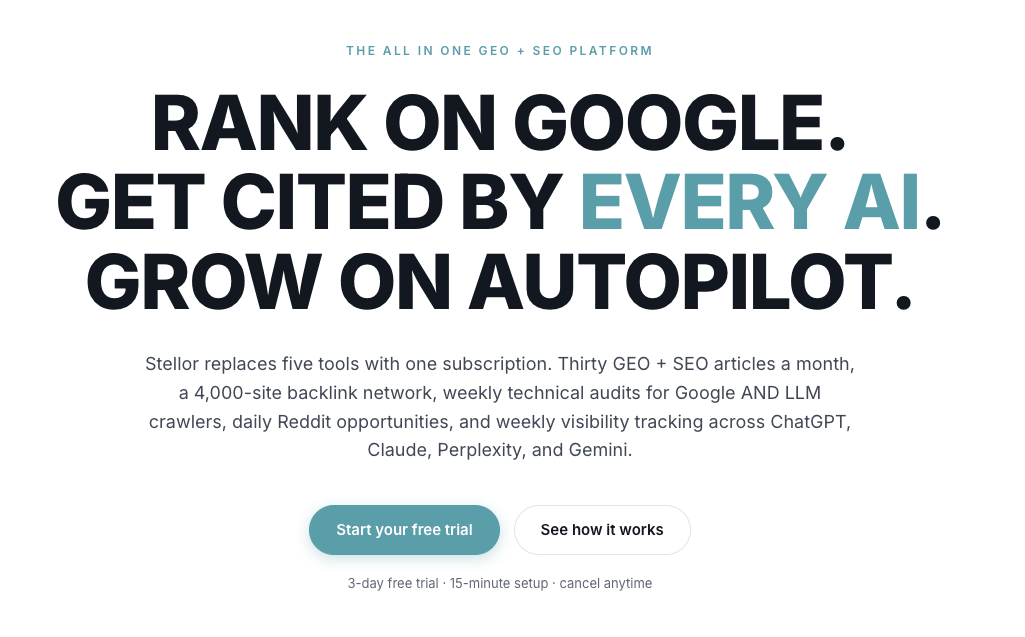
The 3-day free trial requires no credit card. Onboarding takes 15 minutes. Your AI Visibility Audit, including a 90-day content calendar specific to your services and locations, arrives within 48 hours. You keep every piece of content Trystellor publishes, even if you cancel. Start your free trial at Trystellor and see exactly where your flooring business stands in AI search today.
Useful sources and further reading
- Trystellor product page — full platform details, pricing, and trial signup
- 30-day GEO playbook for home services — step-by-step first-month content plan
- Lead generation tactics for service businesses — tactical methods for flooring contractors
- Marketing automation workflows for SEO — how to automate and measure your visibility program
- GEO + SEO for home service businesses — Trystellor’s home-services landing page
- SEO for roofers: local lead generation guide — parallel tactics that translate directly to flooring
- Google Search Central — authoritative technical SEO documentation
- schema.org/LocalBusiness — structured data reference for local service businesses
- Stellor blog — GEO + SEO insights, playbooks, and local visibility guides
FAQ
Is there an app to see flooring in your room before buying?
Yes. Several flooring-specific visualizer apps let homeowners upload a photo of their room and preview different floor types and colors applied in real time. Contractors who embed these tools on their website typically see longer session times and higher quote request rates.
What tools do flooring contractors use for online marketing?
Most flooring contractors use a combination of Google Business Profile for local map visibility, a website with service and location pages, review management software, call tracking, and either a CRM or job-management platform. The gap for most is a coordinated content and backlink strategy that builds organic authority over time.
What is the best CRM for epoxy flooring contractors?
DripJobs is purpose-built for epoxy and concrete coating contractors, with lead tracking, proposals, follow-ups, and job costing in one platform. For general flooring businesses, any CRM that supports lead source tagging and integrates with your estimating software will work.
How long does it take for SEO to generate leads for a flooring contractor?
Most flooring contractors in mid-competition markets see their first organic leads within 60–90 days of launching a GEO + SEO content program. Steady organic channel growth, where inbound leads reduce dependence on paid ads, typically develops over 6–12 months.
Does Trystellor work for flooring contractors specifically?
Yes. Trystellor publishes 30 GEO and SEO-optimized articles per month targeting your specific services and locations, from “hardwood floor installation [city]” to “LVP flooring contractor near me.” The platform also tracks whether your business is being cited by ChatGPT, Claude, Perplexity, and Gemini when buyers ask for flooring recommendations in your market.