

Your highest-value backlinks come from several sources: manufacturer dealer and certified-installer pages, trade association directories like PHCC, local news coverage, and supplier or distributor listings, with community sponsorships close behind. Start by auditing what you already have, picking 20 to 30 realistic targets, then running outreach and local PR at the same time. A complete Google Business Profile makes every one of those links work harder, and a platform like Stellor can help you keep the content and link work moving together.
TL;DR:
- Complete your Google Business Profile and standardize your business name, address, and phone number across listings; inaccurate addresses can suspend service area profiles.
- Manufacturer listings take little effort once you hold the required certification, while trade association directories may require licensing proof, fees, and continuing education.
- Audit existing referring domains, score prospects by authority, relevance, and effort, then verify each placement directly and record its URL, date, and contact.
- Review links monthly for relevance, referral traffic, and anchor text diversity; ignore merely weak links, and disavow only genuinely toxic or spammy domains.
- Before funding a sponsorship, confirm that the organization will link to your website; many do not include web listings unless sponsors ask.
Table of Contents
- Why backlinks still move the needle for home services
- Prioritized backlink source types for home-service contractors
- A step-by-step outreach and activation workflow
- Content assets and PR hooks that attract local backlinks
- Low-cost community link tactics that scale for small teams
- How to measure backlink value and detect risky links
- Strategies for acquiring backlinks from customer testimonial pages and reviews
- Techniques to leverage partnerships with complementary local businesses for backlinks
- How to use social media and online forums to generate backlinks relevant to home services
- The role of citations and NAP consistency in backlink effectiveness for local SEO
- What we see working for home-service clients
- How Stellor can accelerate and safely automate backlink plus content work
- FAQ
- Sources
- Primary sources and recommended tools
Why backlinks still move the needle for home services
Google has said plainly that the number of websites linking to your business contributes to what it calls “prominence,” one of the three factors (along with relevance and distance) that determine your local ranking. But prominence only kicks in once the basics are covered. Google also states that a complete Business Profile, meaning accurate address, category, and hours, is the baseline it uses to match your listing to a search before popularity signals like backlinks even get factored in.
That order of operations matters for contractors. A plumber with an incomplete profile can lose to a competitor with a fully filled-out listing, even when the first has more backlinks. Fix the profile first, then build links.
Not all links carry the same weight, either. A link from a generic business directory tells Google almost nothing about your credibility. A link from a manufacturer’s certified-installer page or a trade association directory tells a different story entirely: it says a third party with standards verified that you meet them. Industry research on link building for home service businesses points to exactly this pattern, finding that dealer directories from equipment manufacturers and associations like PHCC and NECA function as endorsement signals that generic directories simply can’t replicate.
- Manufacturer and association links verify your credentials to both customers and search engines.
- Local news and chamber links signal geographic relevance that national directories can’t fake.
- Supplier “find a contractor” pages combine industry trust with local specificity.
There’s a newer reason to care about this, too. AI answer engines like ChatGPT, Claude, Perplexity, and Gemini tend to pull from sources they consider credible and citable when they recommend a local business. A backlink profile built on association directories, manufacturer pages, and local news coverage reads as more trustworthy to these systems than a pile of low-value directory links, which strengthens your odds of being the contractor an AI names when someone asks for a recommendation.
Quality concentrated in the right places beats volume spread thin.
Prioritized backlink source types for home-service contractors
Not every link opportunity deserves the same amount of your time. Here’s how we’d rank them, from highest impact to lowest, with the effort each one typically takes and where to start.
1. Manufacturer dealer and certified-installer pages
If you install or service branded equipment, whether that’s HVAC systems, water heaters, or security hardware, the manufacturer almost certainly runs a dealer locator or certified-installer directory. These links carry serious weight because they come from the same brands your customers already trust, and they confirm you meet a documented technical standard. Effort is low once you’re certified: most manufacturers just need your license number and certification proof to add you. Starter action: pull a list of every brand you install, search “[brand name] dealer locator” or “[brand name] certified installer,” and submit your information to each one this week.
2. Trade association directories
Membership in PHCC, ACCA, or NATE does two things at once: it builds your technical credibility and it earns you a listing with a backlink most competitors skip because they never bothered to join. Qualification usually means proof of licensing, sometimes a membership fee, and occasionally continuing education requirements. Effort is moderate, mostly paperwork and a membership cost, but the payoff compounds because these directories rarely expire and rarely get crowded out. Starter action: check whether your state has a PHCC or ACCA chapter and request a membership application.
3. Local news and PR coverage
A mention in your local paper or TV station’s website carries editorial authority that’s nearly impossible to buy. Contractors earn this by being useful during a newsworthy moment: a cold snap, a flood, a holiday safety reminder. Effort is higher because it requires timing and a pitch, but a single placement can outweigh dozens of weaker links. Starter action: build a short list of local reporters who cover home and consumer topics, and save their contact information for the next weather event.
4. Supplier and distributor vendor lists
Plumbing supply houses, electrical distributors, and HVAC wholesalers often maintain “find a contractor” pages for customers who come to them looking for installation help. These links pair industry relevance with local specificity. Effort is low: a phone call or email to your sales rep is often enough. Starter action: ask your primary supplier rep whether they maintain a contractor directory and whether you’re on it.
5. Property manager and realtor vendor lists
Property management companies and real estate brokerages keep preferred-vendor lists for maintenance and pre-sale repairs. Getting on one means a steady referral stream plus a backlink from a locally relevant, often well-trafficked site. Effort is moderate and relationship-dependent. Starter action: identify major property managers in your service area and ask how their vendor approval process works.
6. Community sponsorships
Sponsoring a youth sports team, school fundraiser, or local festival can earn a mention on the organization’s website, sometimes with your logo linked to your site. Effort and cost are both low, often a few hundred dollars. Starter action: reach out to a local league or school event and ask whether sponsors receive a web listing.
7. .edu and .gov mentions
Technical schools, trade programs, and county resource pages sometimes link out to local contractors as examples of career paths or approved vendors. These are rarer and need genuine relationships, often through apprenticeship programs or facility maintenance contracts. Effort is high but the authority payoff is significant.
8. Linkable content assets
Original guides, calculators, or local data pieces attract links from other sites naturally, without you asking. Effort is highest since it requires real content investment, but the links keep arriving long after the content is published.
Pro Tip: Skip mass directory submissions entirely. Spend that time getting into 20 to 30 sources from this list instead, since the research consistently shows concentrated quality beats scattered volume for local ranking power.
A step-by-step outreach and activation workflow
Turning this list into results means running a repeatable process, not a one-time sprint.
Step 1: Audit what you already have
Pull your referring domains from a tool like Ahrefs, Semrush, or Moz. Export the full list, then filter for domain authority and topical or geographic relevance. Tag each link as local or national, and flag anything from a manufacturer, association, or news outlet separately since these are your strongest existing assets.
Step 2: Prioritize with an impact-versus-effort matrix
Score each opportunity on two axes: impact (a mix of authority and relevance) and effort (whether it needs a relationship, a certification, or just a form submission). Manufacturer dealer pages usually land in the high-impact, low-effort quadrant if you’re already certified. Local news sits in high-impact, high-effort. Use this matrix to pick your first 20 to 30 targets rather than chasing everything at once.

Step 3: Build your outreach kit
Before contacting anyone, assemble:
- Proof of licensing and any manufacturer certifications
- A short, factual bio of the owner or lead technician
- A few high-quality photos of completed work
- One or two co-branded content or sponsorship package ideas
Step 4: Run outreach with a follow-up cadence
Send your first message with a clear ask and the value you bring, whether that’s proof of certification, a co-branded guide, or a sponsorship. Follow up after a reasonable interval if you hear nothing, then try once more with a slightly different angle. After that, move on. Our guide to local backlink tactics walks through a full pre-outreach checklist if you want a template to start from.
Step 5: Confirm and document every placement
Never assume a link is live just because someone agreed to add it. Check the page directly, screenshot it, and log the URL, date, and contact person in your tracker.
Stick to safe, sustainable tactics throughout this process: avoid buying links outright, and skip automated mass-submission services that blast your business across hundreds of low-quality directories. Our safe link building checklist covers how to structure a backlink campaign that search engines and AI crawlers both read as legitimate.
Pro Tip: Keep a simple spreadsheet or CRM tracker with columns for target, contact, status, and link status. Save your best-performing outreach templates and reuse them with personalization tokens for the contact’s name and specific detail about their site.
Content assets and PR hooks that attract local backlinks
Some content earns links without any outreach at all, because it gives journalists, associations, and suppliers a reason to point to it on their own.
Seasonal maintenance guides work well because they’re genuinely useful and timely: a furnace tune-up checklist before winter, or an AC readiness guide before the first heat wave. Original data or incident reports, like a summary of service calls after a major storm, give local reporters something concrete to cite. Cost calculators and repair-versus-replace tools solve a real decision homeowners face, which makes them a natural link target for anyone writing about home maintenance. Event-driven preparedness pieces, published just ahead of a known seasonal risk, give you a reason to pitch local media at the exact moment they’re looking for expert sources.
- Seasonal maintenance guides timed to weather patterns in your region
- Original incident or service-call data after storms or extreme weather
- Interactive cost calculators or repair-versus-replace decision tools
- Preparedness guides published ahead of known seasonal risks
To get media attention, package these assets as something a reporter can use fast: a short, press-ready summary, a clearly local angle, and one quotable statement from the owner or lead technician. Reporters are more likely to link back when you make their job easy.
Suppliers are another underused channel. Many manufacturers and distributors look for seasonal checklists, how-to videos, or installation photo galleries they can host on their own sites. Offering to co-create one of these, properly credited and linked back to you, turns a one-time content project into an ongoing source of referral traffic and authority.
Low-cost community link tactics that scale for small teams
You don’t need a marketing department to run these. Most take a phone call, a modest budget, and some follow-through.
Sponsoring a youth sports team or school event is often the cheapest entry point. Budgets can range from a logo on a jersey to a festival booth, and most organizations list sponsors on a dedicated page, sometimes with the sponsor’s name linked to their website. Always ask directly whether sponsors get a web mention before you commit, since not every organization does this by default. Community sponsorship examples, including how organizations typically structure sponsor recognition pages, are covered well in this guide to community involvement from a moving company that has built a sponsorship program from the ground up.
Partner listings with non-competing local businesses are another low-cost win. A plumber and an electrician, or a landscaper and a pest control company, can formalize a referral relationship with a dedicated page on each site that links to the other. Realtors and property managers often maintain similar vendor pages.
- Ask organizations directly whether sponsorship includes a web mention before paying
- Formalize referral partnerships with non-competing trades on a dedicated linked page
- Request an acknowledgment link after volunteering time or donating services locally
Volunteering time or donating services to a local nonprofit often earns a mention on their site’s donor or volunteer page. If it doesn’t happen automatically, a short email asking for an acknowledgment link usually works, since most organizations are glad to credit a contractor who helped them.
Pro Tip: Before any sponsorship or donation, ask directly: “Will this include a link to our website on your site?” Many organizations will say yes if you simply ask, but very few offers it unprompted.
How to measure backlink value and detect risky links
Once you’re earning links, you need a way to know which ones are working and which ones might be hurting you.
Track these metrics on a regular basis: total referring domain count, domain authority or domain rating, topical relevance (does the linking site relate to home services), geographic relevance (is it local to your service area), referral traffic the link actually sends, and anchor text patterns across your whole profile.
- Referring domain count and domain authority or DR from your audit tool
- Topical and geographic relevance of each linking site
- Referral traffic generated by the link, not just its existence
- Anchor text diversity, since repetitive exact-match anchors can look manipulative
Run this as a monthly workflow: export your link data, filter by the metrics above, flag anything that looks off, and manually investigate flagged links before deciding what to do. Most of the time, the right move is to ignore low-value links and outrank them with better ones. Reserve disavowing links for rare cases of genuinely toxic or spammy sites pointing at you, since disavowing too aggressively can remove links that aren’t actually causing harm.
The most common pitfall contractors fall into is signing up for bulk directory submission services or purchasing links in batches. These tactics can flag your profile as manipulative and rarely deliver the local or industry relevance that actually moves rankings. A safer alternative is the same approach we’ve outlined throughout: fewer links, better sources, documented placements.
Strategies for acquiring backlinks from customer testimonial pages and reviews
Customer reviews are usually thought of as a trust signal, but they can double as a backlink source when handled right. Many review platforms and local business directories allow a clickable link back to your website from your business profile, so claiming and fully completing every review platform listing where you have a presence (Google, Yelp, Angi, and trade-specific platforms) is a direct, low-effort way to add a legitimate link.
Beyond the review platforms themselves, ask satisfied customers if you can feature their testimonial on a dedicated page on your site, then ask if they’d be willing to share or link to it from their own business or personal site, particularly if the customer is a local business owner themselves. B2B service relationships, like a contractor who works regularly with a property manager, often produce exactly this kind of mutual link opportunity.
Case study pages built around a specific completed project, with a customer quote and photos, also give customers a concrete page to point to when they recommend you to neighbors or colleagues online. The key is making the page specific and detailed enough that linking to it feels like a genuine recommendation rather than a generic plug.
Techniques to leverage partnerships with complementary local businesses for backlinks
Complementary trades make natural link partners because you’re not competing for the same job, just adjacent ones. A roofer and a gutter installer, a landscaper and an irrigation specialist, or a plumber and a water treatment company all serve overlapping customers without overlapping services.
The simplest version of this is a mutual referral page: each business lists a handful of trusted partners on a dedicated page, with a link to each one. This works best when the relationship is real, meaning you actually refer work to each other, since a reciprocal link with no underlying relationship can look thin to both customers and search engines.
A stronger version involves actual joint content or events: a co-hosted homeowner workshop, a joint seasonal checklist covering both trades, or a bundled service package promoted on both company websites. These naturally produce links because each partner has a reason to point customers to the other’s site for the full picture. Start with one or two trades you already refer work to regularly, and formalize what’s likely already an informal relationship into a linked partner page on both sites.
How to use social media and online forums to generate backlinks relevant to home services
Social media links themselves typically carry little direct ranking weight since most platforms mark outbound links as nofollow, but they still generate something valuable: visibility that leads to backlinks elsewhere. A well-shared seasonal guide or before-and-after project post on Facebook or Instagram can catch the attention of a local blogger, reporter, or community page admin who then links to it from their own site.
Local community forums and neighborhood platforms like Nextdoor work similarly. Answering questions genuinely and linking to a relevant guide on your site, only when it truly helps, builds a reputation that leads other members or group admins to reference your business directly.
Reddit deserves specific mention here. Home-service subreddits and city-specific community boards are places homeowners actively ask for contractor recommendations, and AI answer engines like ChatGPT increasingly pull from these discussions when generating recommendations. Participating authentically, answering real questions instead of dropping links, builds the kind of presence that leads to organic mentions and, over time, actual backlinks when forum members write their own blog posts or reviews referencing your help.
The role of citations and NAP consistency in backlink effectiveness for local SEO
NAP stands for name, address, and phone number, and keeping these identical across every directory, citation, and backlink source is one of the quieter factors behind local ranking success. Inconsistent information, like a business listed as “Smith Plumbing LLC” on one site and “Smith Plumbing” on another, can confuse search engines about whether they’re looking at the same business, which weakens the trust signal even a strong backlink should provide.
This matters especially for service-area businesses that don’t operate from a storefront. Google requires service-area businesses to specify their coverage by city or postal code on their Business Profile, and using an inaccurate or virtual address can lead to profile suspension entirely, which would undo the value of every link you’ve built pointing back to that profile.
Before launching any backlink campaign, audit your existing NAP consistency across your website, Google Business Profile, major directories, and any association or manufacturer listings you’re already on. Fix mismatches first, since a backlink pointing to inconsistent business information works against you rather than for you.
What we see working for home-service clients
A short list of manufacturer listings and association memberships, paired with steady local PR, can outperform contractors who chase volume through mass directory submissions. The quality-over-quantity principle is worth keeping in mind.
What compounds the effect is pairing that link work with a steady content cadence. When we publish 30 GEO and SEO-optimized articles a month for a client alongside new link acquisition, each new piece of content gives the next round of outreach something fresh to point to, and each new link gives the content more authority to rank on. The two reinforce each other instead of working in isolation.
If you’re starting from zero, here’s a 30-day checklist: audit your current backlinks, claim every manufacturer dealer listing you qualify for, join one trade association, secure one local sponsorship, and publish one genuinely useful local guide.
— Cole
How Stellor can accelerate and safely automate backlink plus content work
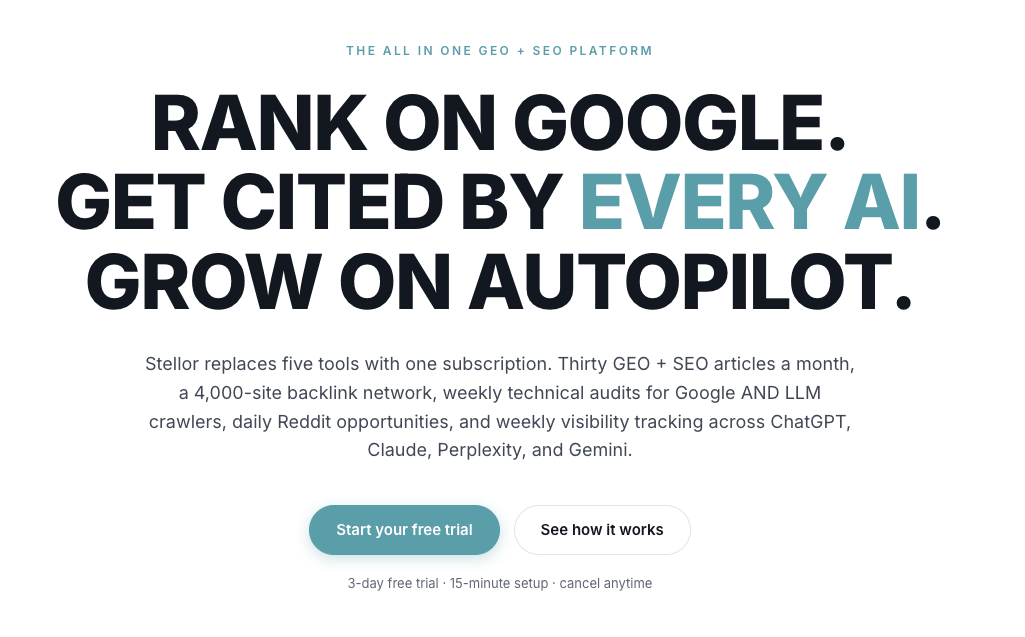
Running the playbook above by hand takes real time: auditing links, writing outreach, publishing content, tracking what’s live. We built Stellor to bring content and link work together in one platform. That means 30 GEO and SEO-optimized articles published to your site every month, access to a 4,000-site vetted backlink network, weekly technical audits, and visibility tracking across ChatGPT, Claude, Perplexity, and Gemini so you know exactly where you stand with AI-driven recommendations, plus a Reddit engagement module that surfaces real conversations worth joining.
You can try the full platform with a 3-day free trial, no credit card required. If you want to see the projected impact first, run your numbers through our ROI calculator before you start.
FAQ
How do I get good backlinks to my website?
Focus on sources that verify your credentials: manufacturer dealer and certified-installer directories, trade association listings like PHCC or ACCA, local news coverage, and supplier vendor pages. A focused set of 20 to 30 quality links from relevant, local sources typically outperforms hundreds of generic directory submissions.
What is the 80/20 rule in SEO?
In practice, it means focusing your effort on the highest-quality, most relevant tactics, which may drive better results. For home-service backlinks, that means prioritizing manufacturer and association links over mass directory submissions, since those few sources carry outsized ranking weight.
How to maximize local SEO?
Start with a fully complete Google Business Profile, since Google uses that completeness to match your listing to searches before factoring in popularity signals like backlinks. From there, build local, industry-relevant backlinks and keep your name, address, and phone number consistent across every listing.
What is a link building service?
A link building service helps a business earn backlinks from other websites to improve its search visibility, typically through outreach, content creation, or partnerships with relevant sites. Some platforms, including Stellor, combine link building with content publishing and technical audits into one managed service rather than treating it as a separate task.
How much does professional backlink help cost for a home-service business?
Costs vary widely depending on whether you’re paying for manual outreach, a full-service agency, or an all-in-one platform. Stellor’s all-in-one GEO and SEO platform, which includes backlink network access alongside content and audits, is available to try through a 3-day free trial with no credit card required.
Sources
- Link building for home service businesses in 2026: what works now | Service Scalers
- Guidelines for representing your business on Google - Google Business Profile Help
- Local SEO for Home Service Businesses: The Complete Guide
- Manage your service areas for service-area & hybrid businesses - Google Business Profile Help