

The best backlink strategy for local businesses is narrow, not broad: chase relevant local links from directories, press, sponsorships, and community partners, then point each one at the right page. A homepage link from a citywide news story helps brand prominence; a link from a neighborhood blog about your plumbing service should land on that service page. Do this before any outreach, and check that every target URL is live, canonical, and redirect-free.
TL;DR:
- Focusing on relevant local links from authoritative sources like media, directories, and community partners typically yields faster and more impactful results than broad link campaigns.
- Prioritize linking to specific pages such as service pages or location details, rather than always defaulting to the homepage, to improve relevance and ranking accuracy.
- Audit each link opportunity for domain reputation, topical relevance, and proper landing page setup to avoid wasting effort on low-quality or ineffective placements.
- Use proper disclosing tags like rel=“sponsored” for paid links and avoid practices such as bulk buying or irrelevant directory listings that violate Google’s policies and risk penalties.
- For best results, combine local content creation, community engagement, and strategic outreach, leveraging automation platforms to save time and maintain technical compliance.
Table of Contents
- Why Local Backlinks Matter for Local SEO Rankings
- Prioritized Local Link-Building Tactics You Can Run This Month
- How to Audit and Prioritize Your Link Opportunities
- Link Quality, Compliance, and Avoiding Link Spam
- Local Content That Attracts Links Without Cold Outreach
- Getting Your Site Ready Before You Ask for a Single Link
- Three Backlink Mistakes That Quietly Sink Local Rankings
- A Managed Path for Teams That Don’t Have Time to Do This by Hand
- Sources
- FAQ
Why Local Backlinks Matter for Local SEO Rankings
Local rankings run on three inputs, according to Google’s own Business Profile guidance: relevance, distance, and prominence. Backlinks feed the third one. A link from your county’s chamber of commerce or a local news outlet tells Google your business is a known, credible entity in that community, which lifts prominence.
Here’s the part most local SEO advice skips: links cannot move the other two levers. No backlink shrinks the physical distance between your storefront and a searcher. No backlink manufactures relevance for a service you don’t actually offer. If your plumbing company gets ranked for “electrician near me,” a backlink campaign won’t fix that mismatch. Fix the on-page content and category settings first.
What backlinks can do, when they’re genuinely local and contextually placed, is compound over time. A few things worth keeping in mind as you plan:
- Links help Google discover new pages and understand what those pages are about, so where you point a link matters as much as who is linking.
- Prominence is a “Google-wide” signal, meaning it reflects your reputation everywhere, not just within Google Business Profile itself.
- A single high-authority local link often outperforms a dozen weak directory listings, because relevance and topical fit matter more than raw volume.
Treat backlinks as a trust signal layered on top of an already-accurate, fully verified Business Profile. Without that foundation, even a strong local link building push underperforms.
Prioritized Local Link-Building Tactics You Can Run This Month
Not every tactic deserves equal time. Some pay off in a week; others take a quarter to show movement. Here’s the order that tends to work best for local businesses running lean marketing teams, ranked roughly by effort-to-payoff ratio.
- Clean up local directories and citations. Audit your listings on data aggregators and industry-specific directories, fix inconsistent name, address, and phone (NAP) details, and claim any unclaimed profiles. Effort: low. Payoff: fast, usually visible within two to four weeks, mostly through improved consistency rather than dramatic ranking jumps.
- Pitch local media and community news outlets. A short, factual pitch tied to something newsworthy (an anniversary, a hire, a local partnership) beats a generic press release. Effort: medium. Payoff: moderate to high, and the resulting link often carries real topical authority.
- Host or sponsor a local event. Sponsoring a 5K, a school fundraiser, or a small business expo usually earns a link from the event page and sometimes a mention in event coverage. Effort: medium and it costs money, but it also builds real community goodwill beyond SEO. Payoff: medium, delayed by weeks until the event page publishes.
- Set up cross-promotions with adjacent local businesses. A landscaper and a fencing company, or a bakery and a coffee roaster, can trade honest recommendations on their respective “recommended partners” or resource pages. Effort: low. Payoff: modest per link, but compounds fast since these relationships tend to renew themselves.
- Build localized content that other sites want to reference. A neighborhood guide, a “best parks for dog walking in [city]” post, or a small-business resource hub gives local bloggers and community sites a reason to link naturally. Effort: high upfront, low ongoing. Payoff: slow to start (often two to three months) but durable once it ranks.
- Get featured in local roundups and “best of” lists. Search for “best [your service] in [city]” and reach out to the sites already ranking for it, offering a quote, a photo, or a unique data point. Effort: low to medium. Payoff: high when it lands, since these pages already rank and pass real referral traffic.
- Reclaim unlinked brand mentions. Set a Google Alert or use a mention-tracking tool for your business name, then email sites that mentioned you without linking and ask for a simple addition. Effort: low. Payoff: quick wins, often within days, since you’re not asking for new content, just a courtesy edit.
- Run a competitor backlink gap analysis. Pull a competitor’s referring domains through Ahrefs, Semrush, or a similar tool, filter for local and regional sources, and target the ones you’re missing. Effort: medium. Payoff: high, because you’re chasing links a Google-verified competitor already earned in your exact category.
Pro Tip: If you run a single location, spend most of your time on tactics 2, 3, and 6 first. They build reputation fastest in a small radius. Multi-location businesses should lean harder on tactic 8 and localized content per storefront, since generic company-wide pages dilute relevance across cities.
Single-location businesses should work top to bottom roughly in this order, since local media and event sponsorships build reputation in a concentrated area fast. Multi-location operators should treat each location as its own mini-campaign, since a link earned for one storefront rarely helps another city’s rankings.
How to Audit and Prioritize Your Link Opportunities
Before you send a single outreach email, run every prospective link and every existing one through a short scorecard. This is where a lot of local link building efforts quietly fail: businesses collect links without checking whether the destination page can actually use them.
Audit each opportunity against these factors:
- Referring domain reputation. Is the site a real, actively maintained local publication or directory, not a link farm padded with irrelevant categories?
- Topical relevance. Does the linking page discuss your service, your city, or your industry, rather than mentioning you in passing on an unrelated topic?
- Anchor text and surrounding context. Does the link sit inside a sentence that actually helps a reader, rather than a bare “click here” or a stuffed keyword phrase?
- Landing page readiness. Is the destination page live, free of redirect chains, and using the correct canonical tag? A pre-outreach audit of the target URL prevents wasted placements.
- Link placement on the page. Is it in the body content where readers will see it, or buried in a footer with fifty other links?
Score each prospect on relevance, traffic potential, how well it fits editorially with the publisher’s normal content, how easy the placement is to secure, and how much compliance risk it carries. Then map destinations by intent: send broad brand mentions to your homepage, city-specific coverage to the matching location page, and service-specific mentions to the corresponding service page. Once a link lands, add internal links from that page to related service and location pages so the authority spreads instead of pooling in one spot.
Link Quality, Compliance, and Avoiding Link Spam
Google’s spam policies name specific practices to avoid: buying links that pass ranking credit without disclosure, joining excessive link exchanges, using automated link-building schemes, and getting listed in low-quality directories stuffed with unrelated businesses. Any of these can trigger a manual action, and recovering from one takes far longer than building the link would have.
Paid placements aren’t off limits, but they need to be labeled correctly. Google’s guidance on qualifying outbound links is clear: use rel="sponsored" for paid placements and advertorials, rel="ugc" for user-generated content like forum posts or reviews, and rel="nofollow" when you simply don’t want to vouch for a link. If you sponsor a local event or pay for an advertorial, ask the publisher to add the sponsored tag before the piece goes live.
Watch for these red flags:
- Directory sites that accept any business in any city with no editorial review.
- “Guest post” offers from sites with no topical connection to your industry or region.
- Footer link exchanges where dozens of unrelated local businesses link to each other.
The safer path is contextual editorial coverage: a real mention inside a real article, disclosed when it’s paid, and never bought in bulk through a middleman.
Local Content That Attracts Links Without Cold Outreach
Some content formats earn links almost passively, which matters if you’d rather build a reputation than chase editors. Neighborhood guides, data-driven posts built around local statistics, dedicated event pages, “best of” roundups featuring other businesses, and resource pages built for residents (parking guides, seasonal safety tips, local regulation summaries) tend to get picked up and linked without a single email.
When you do need outreach, keep it short: name the specific page you’re referencing, explain in one sentence why your resource adds value to their readers, and ask for nothing more than a look. Follow up once, a week later, and then let it go. Monitoring relevant Reddit threads in your city’s subreddit and answering questions honestly, without a sales pitch, builds the same kind of community trust and often gets your business mentioned organically later.
- Track new referring domains and lost links monthly using Google Search Console or a backlink tool like Ahrefs.
- Watch referral traffic from each new link inside your analytics platform, not just the raw link count.
- Note whether your business starts showing up in AI answer engines like ChatGPT or Perplexity for local queries, since citation-worthy content and mentions on community sites increasingly feed those answers too.
Pro Tip: A resource page with real local data, like average repair costs in your metro area, tends to outlast trendier content by years. Directories change ownership and disappear; a genuinely useful local guide keeps earning links long after you publish it.
If you want a deeper breakdown of specific tactics, local SEO link building strategies that actually work covers execution details for several of the formats above.
Getting Your Site Ready Before You Ask for a Single Link
Outreach wastes time when the destination page isn’t ready. Run this checklist first:
- Confirm the target page is live, indexable, and free of redirect chains or broken canonical tags.
- Verify the page includes accurate LocalBusiness schema and local metadata that matches your Google Business Profile.
- Check that name, address, and phone details on the page match your Business Profile exactly. Mismatches quietly erode the prominence signal you’re trying to build.
- Test page speed and mobile usability, since a slow or broken page undercuts the value of any link pointing to it.
This is roughly the workflow a managed platform automates end to end: publishing pages built to the checklist above, delivering links against them, running audits weekly to catch drift, and tracking whether the business shows up when people ask ChatGPT or Perplexity for a local recommendation. For businesses juggling this manually alongside daily operations, that automation closes the gap between “we know what to do” and “we actually did it every week.” For more on the technical side, see this SEO audit checklist for local service businesses.
Three Backlink Mistakes That Quietly Sink Local Rankings
The most common error is chasing volume. Fifty weak directory links move nothing; three relevant, contextual ones move rankings. Fix: filter every prospect for topical and geographic relevance before you count it.
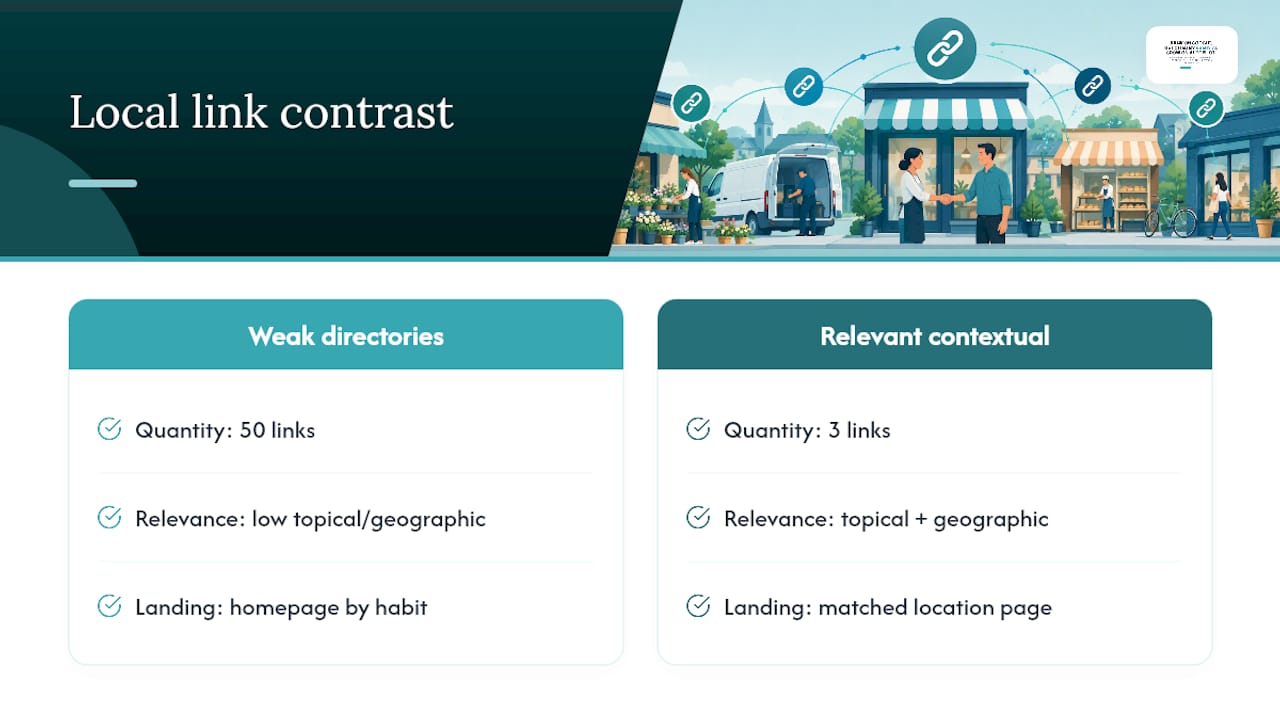
The second mistake is linking everything to the homepage out of habit. A local reporter’s story about your new location deserves that location page, not a generic front door. Fix: map every incoming link to the page it actually matches.
The third is paying for placements without asking for rel="sponsored". That’s a policy risk, not a shortcut. Fix: build the tag request into your sponsorship contract from day one.
— Cole
A Managed Path for Teams That Don’t Have Time to Do This by Hand
Everything in this guide is doable manually: directory cleanup, media pitches, sponsorships, competitor gap analysis, schema checks, all of it. The tradeoff is time. A one-person marketing team running a single location can usually keep pace. A multi-location business trying to run this playbook across five cities, every month, without dropping the compliance details, usually can’t. That’s the gap Stellor was built to close.
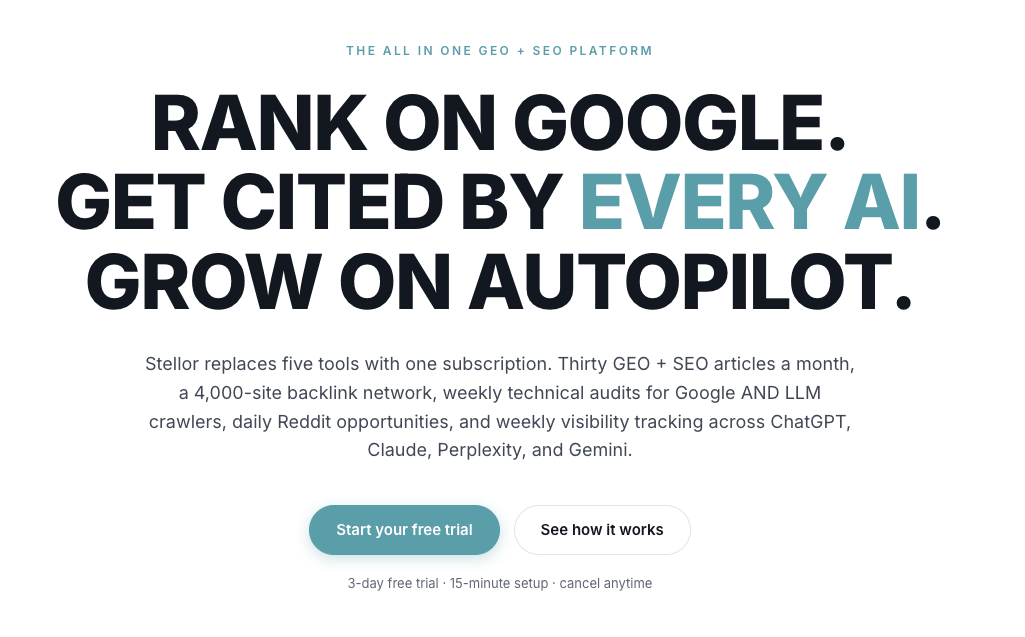
A single platform can replace the five-vendor stack most local businesses cobble together, content writer, link builder, technical auditor, PR contact, and AI tracking tool. It publishes GEO and SEO-optimized articles mapped to your services and locations, delivers backlinks through a vetted backlink network instead of manual outreach, runs weekly technical audits against relevant checklists, and tracks whether your business gets cited by AI platforms such as ChatGPT, Claude, Perplexity, and Gemini when someone asks for a recommendation. It provides opportunities to engage on Reddit so you’re not manually scanning threads for a chance to mention your business naturally.
If you’re already doing local link building by hand and hitting a ceiling on time, not strategy, start a free 3-day trial, no card required, and see what the platform maps out for your first 90 days.
Sources
The technical and policy claims in this guide come straight from Google’s own documentation, not secondhand summaries:
- SEO Link Best Practices for Google | Google Search Central
- Tips to improve your local ranking on Google - Google Business Profile Help
For readers building out a full Business Profile alongside their link strategy, this guide to Google Business Profile covers the setup details this article assumes.
FAQ
What Is a Good Backlink Strategy for a Local Business?
A good backlink strategy prioritizes relevant, local sources, directories, press, sponsorships, and community partners, over generic high-volume link building. Each link should point to the page that matches its context: homepage for brand mentions, location pages for city-specific coverage, service pages for specific offerings.
What Is the 80/20 Rule in SEO?
The 80/20 rule in SEO holds that roughly 20% of your efforts, the highest-relevance, highest-authority tactics, drive most of your ranking results. For local backlinks, that usually means a handful of genuine local media and community links outperform dozens of low-quality directory listings.
Are Backlinks Still Relevant for Local SEO?
Yes. Backlinks remain one of the core inputs behind prominence, one of the three factors Google names in its local ranking guidance, alongside relevance and distance. They can’t fix a mismatched category or a far-away storefront, but they build the reputation signal Google uses to judge how well known your business is.
What Are Effective Strategies for Local SEO Beyond Links?
Beyond backlinks, effective local SEO includes a fully verified and accurate Google Business Profile, consistent NAP data across every listing, localized service and location pages, and steady review generation. A managed workflow like Stellor ties these pieces together with weekly audits so nothing drifts out of sync.
How Long Does It Take to See Results From Local Link Building?
Directory cleanups and unlinked mention reclamation can show movement within two to four weeks. Media placements, sponsorships, and localized content typically take two to three months to fully register in rankings, since Google needs time to recrawl and reassess prominence signals.