

Safe link building means earning editorial, relevant links that would exist for the user even if search engines ignored them entirely. That distinction matters because Google Search Central’s spam policies treat manipulated placements as a ranking risk, not a shortcut. The right move in 2026 is to prioritize link earning through strong content and honest outreach, reserving the disavow tool for genuine spam cleanup rather than routine maintenance.
TL;DR:
- Links should be earned through content that would exist independently of search rankings, with relevance to the site’s topic to avoid manipulation detection.
- A strict refusal policy helps prevent risky link placements, eliminating paid, automated, reciprocal, or low-quality links before outreach begins.
- Building assets like original research, visualizations, or regional guides increases the likelihood of earning legitimate, authoritative links.
- Outreach should target relevant sites with editorial standards, and the use of transparent, value-driven pitches enhances safe link acquisition.
- Managed services that provide content, diversified backlinks, and ongoing audits help maintain a safe profile and reduce manual review errors.
Table of Contents
- What safe link building means in 2026
- Start with a refusal policy and risk checklist
- Build assets that earn links before you pitch
- Link building tactics that still work
- Tactics that look easy but create risk
- Anchor text and internal-link strategy for safety and clarity
- How to measure link quality and detect risky patterns
- When a managed service makes sense and what to require from vendors
- Author perspective: practical trade-offs and a 90-day checklist
- How Stellor helps teams build safe backlink profiles
- Sources
- FAQ
What safe link building means in 2026
Every safe link passes one test: would this link exist if search rankings did not exist? A journalist citing your data because it’s useful passes. A paid placement in a footer widget does not. That single question filters out most of the guesswork SEO teams struggle with when evaluating a link opportunity.
Relevance is the second filter. A link from a topically aligned site carries more weight with both Google’s algorithms and the AI answer engines now shaping buyer research. When ChatGPT, Claude, Perplexity, or Gemini generate a recommendation, they lean on multi-source validation, meaning your brand needs to show up consistently across genuinely relevant, independently operated sites rather than one manufactured cluster. A link farm might have fooled an algorithm in 2015. It won’t convince an LLM cross-checking your credibility against Reddit threads, review sites, and industry publications.
Google’s link spam documentation spells out what counts as manipulation:
- Buying or selling links that pass ranking credit, including exchanging goods or services for links.
- Large-scale link exchanges or “link to me and I’ll link to you” arrangements.
- Automated programs or services that generate links at scale.
- Widely distributed footer or template links that appear on every page of a site regardless of relevance.
- Advertorials or sponsored content that pass ranking credit without disclosure.
None of these are ambiguous. They describe links built to move a ranking needle, not links built because a piece of content earned trust. Teams that keep asking the editorial-intent question before every placement rarely end up on the wrong side of a manual action. Teams that outsource that judgment to whoever promises the fastest turnaround usually do.
Start with a refusal policy and risk checklist
Most link building risk gets introduced before outreach even starts, when a team says yes to an opportunity it should have declined. A written refusal policy removes the guesswork and gives everyone on the team, including freelancers and agencies, the same standard to work from.
A workable refusal policy includes:
- No paid placements that pass ranking credit, regardless of how the payment is framed.
- No guaranteed placements or keyword-forced anchor text specified by the linking party.
- No automated link creation tools or bulk submission services.
- No participation in reciprocal exchange networks, even when the partner site looks topically relevant.
- No links from sites whose primary business model is selling links.
Red flags to watch for during vetting include short-lived placements that disappear within weeks, templated sites with thin or duplicated content, links buried in sitewide footers, and outreach emails offering “guaranteed DA 50+ placements” in bulk. Any of these should trigger an automatic pass.
Enforcement only works when it’s documented. Log every declined opportunity with a one-line reason, require vendor sign-off on placement lists before payment, and reference your outreach standard operating procedure in every contractor brief. Majestic’s 2026 guidance on safe link building makes a similar point: AI tools can speed up prospecting and flag risky patterns, but a human still has to make the final call on whether a placement fits.

Pro Tip: Keep a shared spreadsheet of declined opportunities with the reason for each rejection. It trains new team members faster than any policy document.
Build assets that earn links before you pitch
Outreach without something worth linking to is just cold email. The teams that build durable link profiles start with assets designed to be cited, not just published.
The strongest categories are:
- Original research or survey data that nobody else has published.
- Interactive tools or calculators that solve a specific problem in one visit.
- Data visualizations that make a complex trend easy to screenshot and share.
- Regional or industry-specific guides that answer a narrow question better than generic content.
Design matters as much as the idea. A study with unclear sourcing gets ignored by journalists and AI crawlers alike. Include a visible methodology, cite your sample size and date range, and structure the piece so a single chart or stat can be lifted and credited on its own. Modular formatting, meaning clear headers, standalone data points, and defined terms, helps both a reporter skimming for a quote and a language model parsing your page for a citation-worthy fact.
A regional guide built around a specific service niche tends to earn links faster than a broad national piece, simply because it answers a question few competitors have bothered to answer well. The same logic applies to local link building strategies built around specific service categories rather than generic advice.
Distribution decides whether the asset gets seen at all. A practical playbook includes:
- Direct outreach to journalists and niche newsletter writers who cover the topic regularly.
- Expert roundups where you contribute a data point or quote in exchange for a byline link.
- Authentic community seeding, including thoughtful replies in relevant Reddit threads where the asset genuinely helps the conversation.
- Cross-promotion with partners who reach the same audience, coordinated so the narrative stays consistent across channels.
Coordinating with your broader marketing team on proven marketing tactics for shareable content keeps the asset’s story consistent whether it’s picked up by a reporter, a partner site, or a social post. The goal is one strong asset earning a dozen links over a year, not a dozen thin pages earning nothing.
Pro Tip: Publish the raw dataset behind any original research alongside the write-up. Journalists link to sources they can verify themselves.
Link building tactics that still work
Once you have an asset worth citing, the outreach process itself needs a repeatable structure. Guessing your way through cold emails wastes time and burns goodwill with editors who remember spammy pitches.
- Build a prospect list filtered by topical fit first, not just domain metrics. A site covering your exact niche with modest traffic beats a broad, unrelated site with a bigger audience.
- Check whether the site has an editorial model, meaning real writers, an editorial calendar, and a history of linking out to sources rather than accepting payment for placements.
- Confirm the site sends real referral traffic by checking whether other cited pages show engagement, not just a backlink profile padded with junk.
- Write a value-first pitch that leads with what the editor’s readers gain, not what you want. Mention the specific article you’re referencing and why your data adds something their piece is missing.
- Follow up once, briefly, after a week. Editors are busy, not ignoring you out of malice.
- When guest posting or working through HARO-style journalist requests, disclose any payment relationship and use
rel="sponsored"on paid links, per Google’s guidance on link crawlability and disclosure.
Guest posting still works when it’s built around genuine expertise rather than a link quota. An editor accepting a guest post because the pitch adds real value to their readers is fundamentally different from paying for a slot on a content farm. The line is disclosure and editorial control: if the site’s editor has full say over whether your piece runs and how it’s framed, you’re likely on safe ground.
Keep your PR and content teams looped into outreach so the narrative around your brand stays consistent. A journalist who covers you for a data story and later sees a contradictory pitch from your outreach team will notice, and that inconsistency costs more trust than a single declined link ever would.
Tactics that look easy but create risk
Some tactics promise fast results because they skip the part where a real editor decides your link belongs on their site. They’re also the tactics most likely to trigger a manual action or get algorithmically discounted.
- Paid placements that pass ranking credit without disclosure. Google’s historical guidance on buying and selling links has consistently treated undisclosed paid links as a policy violation, and that stance hasn’t softened.
- Reciprocal link exchanges, even topically relevant ones. John Mueller has stated directly that systematic “you link to me, I link to you” arrangements violate Google’s guidelines and can be devalued or penalized regardless of relevance.
- Automated link builders that submit your site to hundreds of directories or comment sections overnight.
- Low-quality directory listings, sitewide footer links, and widget links designed purely to distribute anchor text at scale.
The safer alternative isn’t to avoid paid visibility altogether. It’s to separate paid reach from link equity. Run sponsored content clearly labeled as sponsored, with a nofollow or sponsored attribute on any link inside it. Use PR spend to build visibility and brand mentions, not to manufacture backlinks. A brand mention with no link still helps AI answer engines recognize your business as a credible, frequently cited source, which matters more in 2026 than it did five years ago.
Anchor text and internal-link strategy for safety and clarity
Anchor text distribution is one of the easiest things to get wrong without realizing it. A profile stacked with exact-match commercial anchors (“best roofing contractor near me” repeated across dozens of links) reads as manipulated even when every individual link was earned honestly.
A safer mix looks like:
- Branded anchors (your company name) making up the largest share.
- Naked URL anchors, where the link is just the raw web address.
- Generic anchors like “this guide” or “read more.”
- A small minority of descriptive, topical anchors that mention your service without forcing an exact commercial phrase.
Google’s own guidance on link crawlability recommends anchor text that’s descriptive and concise, and specifically warns against stuffing keywords into anchors just to signal relevance. A good test: read only the anchor text out of context. If it sounds natural as a sentence fragment, it’s probably fine. If it reads like a keyword phrase dropped into a sentence, rewrite it.
Internal linking plays a supporting role here. A well-linked pillar page, like a local SEO optimization guide that connects to related service and location pages, spreads topical authority across your own site instead of relying entirely on external links to prove relevance. That reduces how much weight any single external link needs to carry, which lowers your overall risk exposure.
How to measure link quality and detect risky patterns
Not every link in your profile deserves equal trust, and auditing that profile regularly catches problems before they become manual actions. The signals worth tracking are topical relevance, real organic referral traffic from the linking page, whether the link sits in genuine editorial content or a template, and how long the link has stayed live.
Pattern detection matters as much as individual link quality. Watch for:
- A sudden spike in links using the same exact-match anchor phrase.
- A large volume of new links appearing in a short window with no corresponding PR or content event to explain it.
- Low domain diversity, where most links trace back to a small cluster of related sites.
When you spot a problem link, the first move is contacting the publisher directly to request removal. Google’s own disavow guidance is explicit that the tool is meant for a considerable volume of spammy links that have caused or are likely to cause a manual action, not for routine link cleanup. Google’s algorithms already ignore most low-quality links automatically, and misusing disavow on links that were never a real threat can do more harm than leaving them alone.
Automated monitoring tools flag anchor-text spikes and sudden volume changes faster than manual review, giving teams the lead time to investigate before a pattern becomes a penalty. Ongoing tracking, not a one-time audit, is what actually catches manipulation early.
When a managed service makes sense and what to require from vendors
Handling link building entirely in-house works fine at small scale. It stops working once you need consistent monthly output, weekly technical audits, and visibility into how AI answer engines are citing your brand, all at the same time. That’s usually the point where a managed vendor starts making sense.
Before signing with any vendor, require:
- Full transparency on where links will be placed, including the actual site list, not just aggregate metrics.
- Proof of placement after the fact, not just a promise before payment.
- Clear disclosure practices for any paid or sponsored content in the campaign.
- A flat refusal to guarantee rankings or use automated link schemes, since any vendor promising guaranteed rankings is telling you they don’t understand how Google’s algorithms work.
Vendors that combine content production, backlink placement, technical audits, and AI visibility reporting into one workflow remove a lot of the coordination overhead that causes mistakes in the first place. That’s the gap a platform like Stellor is built to close: weekly audit checklists paired with a managed backlink network mean fewer disconnected vendors making conflicting decisions about the same site.
Author perspective: practical trade-offs and a 90-day checklist
Safe link building is slower than the shortcuts, and that’s the actual trade-off, not a marketing line. Speed tempts every team at some point, usually right after a competitor jumps three spots and nobody can explain why. The measured risk worth taking is testing a new content format or outreach channel, never testing a paid placement scheme to see if this time it goes unnoticed.
AI prospecting tools are genuinely useful for narrowing a list of a thousand sites down to fifty worth pitching. They’re not useful for deciding which fifty deserve a “yes.” That judgment call stays human, every time.
A 90-day checklist that holds up:
- Days 1 to 30: build one linkable asset with clear sourcing and modular data.
- Days 31 to 60: run outreach against a vetted prospect list, tracking response rates by pitch angle.
- Days 61 to 75: audit the resulting links for anchor diversity and placement context.
- Days 76 to 90: review any vendor relationships against the due-diligence checklist above.
— Cole
How Stellor helps teams build safe backlink profiles
Most teams don’t lack the knowledge to build links safely. They lack the hours to build linkable assets, vet placements, run weekly audits, and track AI citations at the same time. Stellor was built to close that gap without asking you to hire five separate vendors.
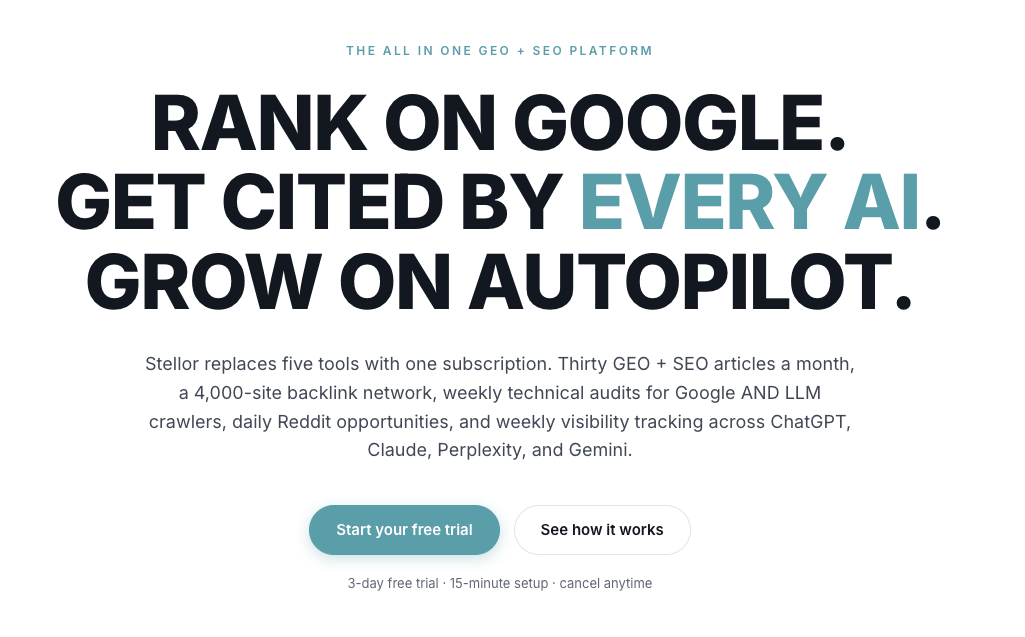
Stellor publishes 30 GEO and SEO-optimized articles a month to your CMS, each built around a real buyer query with schema markup and internal linking already in place. Backlinks come through a 4,000-site network of vetted publishers, so placements stay diversified instead of clustering on the same handful of low-quality domains. Weekly audits catch anchor-text and technical issues before they compound, and the Reddit module surfaces authentic threads worth joining instead of leaving that research to guesswork.
- 30 articles per month, aligned to your services and brand voice.
- A 4,000-site backlink network built for natural diversification.
- Weekly technical audits covering schema, speed, and crawlability.
- LLM visibility tracking across ChatGPT, Claude, Perplexity, and Gemini.
You can see the full breakdown on the Stellor product page, and start a 3-day free trial with no credit card required to see what it surfaces for your own site.
Sources
- Spam policies for Google Web Search | Google Search Central | Documentation | Google for Developers
- SEO link best practices for Google | Google Search Central | Documentation | Google for Developers
- Disavow links tool guidance | Google Support
- Google says no really, link exchanges are against our guidelines | SERoundTable
- Safe link building in 2026 | Majestic blog
FAQ
What should you avoid in link building?
Avoid any link tied to payment that passes ranking credit, systematic link exchanges, and automated or bulk link-building services, all of which Google’s spam policies treat as manipulation. Also avoid keyword-stuffed anchor text and links placed in sitewide footers or widgets with no editorial context.
What are safelinks?
“Safelinks” generally refers to links earned through genuine editorial value, meaning content a publisher chose to cite because it helped their readers, not because of payment or exchange. The safest links pass a simple test: they would exist even if search rankings didn’t.
What is link building and how does it work?
Link building is the process of earning links from other websites that point back to your site, which search engines and AI answer engines use as a signal of credibility and relevance. It works best when it starts with content worth citing, followed by outreach to editors and publishers who genuinely serve the same audience.
How much does link building cost?
Costs vary widely depending on whether you handle outreach in-house, hire a specialist, or use a managed platform, and no single published rate applies across the industry. Managed platforms that bundle content, backlinks, and audits into one subscription, such as plans starting at $199 per month, can offer more predictable costs than piecing together separate freelancers and tools.
When should you use the disavow tool instead of contacting a publisher?
Contact the publisher first and request removal for any individual problem link. Reserve the disavow tool for a considerable volume of spammy links tied to a manual action or clear risk of one, exactly as Google’s disavow guidance recommends, since Google’s algorithms already discount most low-quality links automatically.