

TL;DR:
- In 2026, Google emphasizes the importance of context and surrounding words over anchor text for ranking signals. Descriptive, relevant, and diverse anchors improve both SEO and user experience, especially internally. Prioritize contextual coherence and natural language flow to optimize link integrity and accessibility effectively.
What anchor text best practices actually require
The core rule is simple: anchor text should be descriptive, reasonably concise, and directly relevant to the page it links to. Google’s own guidance frames it as a readability test: read the anchor text out of context and ask whether it clearly communicates what the destination page covers. If the answer is no, rewrite it.
What’s changed in 2026 is the weight Google places on the words surrounding the link. The anchor string itself is now a classification signal, not a ranking lever. The words surrounding a link often carry more relevance weight than the anchor text itself, which means engineering keyword-rich anchors into thin or off-topic sentences actively reduces link value.
The practical implications for SEO professionals:
- Use descriptive, specific anchor text that tells both users and crawlers exactly what they’ll find on the destination page
- Keep anchors contextually coherent: the surrounding sentence must logically justify the link’s existence
- Maintain anchor diversity across your backlink profile: branded anchors, partial-match phrases, naked URLs, and topical variants all belong in a healthy mix
- Avoid exact-match overuse in external links, where the penalty risk is highest
- Apply keyword-rich descriptive anchors freely in internal links, where you have full editorial control and Google treats exact-match more leniently
- Follow Google Search Central’s link guidelines as your baseline, and cross-reference with Moz and Semrush for distribution benchmarks
Why anchor text matters for SEO and user experience
Anchor text, also called link text, is the visible, clickable portion of a hyperlink. It typically appears in a different color and is underlined, signaling to users that it leads somewhere. Good anchor text tells readers what to expect before they click and gives search engines context about the destination page’s topic.
Google uses anchor text as a relevance signal when evaluating pages and discovering new content to crawl. When multiple internal links all use the same focus keyphrase pointing to different pages, Google can struggle to determine which page should rank for that topic, creating internal competition. Thoughtful, varied anchor text prevents that confusion.
From a user experience standpoint, clear link text builds trust. A link labeled “personal injury attorney fees” sets an accurate expectation. A link labeled “click here” tells the user nothing and forces them to guess. Moz and Semrush both treat anchor text quality as a measurable factor in link profile health, and natural anchor text flow that prioritizes readability supports both engagement and sustainable rankings.
The SEO and accessibility objectives here are not in conflict. Descriptive anchors help screen reader users navigate content just as effectively as they help Googlebot classify pages. That alignment is what makes anchor text one of the highest-leverage, lowest-cost optimizations available to any SEO team.
Types of anchor text and how each one functions in your link profile
Understanding the anchor types and their risk profiles is the foundation of any effective linking strategy. Each type sends a different signal, and the right mix depends on whether you’re managing internal or external links.
- Exact match: The anchor text is the precise target keyword, such as “project management software.” Powerful for relevance signaling but carries the highest penalty risk in external backlinks. Keep exact-match anchors to a minimal proportion of total external backlinks; a high concentration represents elevated algorithmic risk.
- Partial match: A natural phrase that includes the keyword alongside other words, such as “the best project management tools available.” Safer than exact match and more editorially natural. Aim for a moderate share of external anchors.
- Branded: Your brand name or a variation of it, such as “Trystellor” or “Stellor’s platform.” This is the naturally dominant type in healthy backlink profiles, and branded anchors should represent 35–45% of external links.
- Naked URL: The raw URL used as anchor text, such as “trystellor.com.” Common in citations, forum posts, and directory listings. Naked URLs typically comprise a smaller share of external anchors.
- Generic: Phrases like “click here,” “read more,” or “this article.” These carry no ranking signal and are best avoided in editorial content, though they appear naturally in some contexts.
- LSI / topical: Semantically related phrases that describe the topic without using the exact keyword, such as “organizing team workflows.” Low risk and a positive relevance signal. Aim for a moderate share of external anchors.
- Image links: When an image serves as a link, Google uses the image’s
altattribute as the anchor text. Descriptive alt text is required for these links to pass relevance signals correctly.
For internal links, the calculus shifts. Exact-match and partial-match anchors are both appropriate and beneficial internally because Google treats internal linking as normal editorial practice, not a manipulation signal. Use descriptive, keyword-relevant anchors freely across your internal link structure.
How to place anchor text for internal and external links
Placement determines whether a link passes its full potential value or gets discounted before Google even evaluates the anchor string.

For internal links, the priority is site architecture clarity. Every page you care about should have at least one internal link pointing to it. Links placed in the main body content carry more weight than those in sidebars, footers, or navigation modules. Build topic clusters by grouping related articles around a pillar page, with all cluster articles linking to the pillar using descriptive anchors that reinforce topical relevance. Vary the anchor text across different links pointing to the same destination: use the primary keyword in one, a partial-match variation in another, and a long-tail phrase in a third. A solid internal linking strategy distributes crawl equity efficiently and signals topical authority to Google.
For external backlinks, your control is limited but your defaults matter. When writing guest posts, suggest a partial-match or branded anchor in your draft. Never request exact-match anchors in an outreach pitch. Sophisticated publishers treat exact-match requests as a red flag, and the pattern it creates is precisely what Google’s algorithms are designed to flag. For niche edits, specify branded or partial-match anchors contractually and offer two options to give the editor flexibility.
Visual clarity also affects link performance. Use color contrast and underlining to make links visually distinct from surrounding text. This helps all users, including those relying on assistive technology, identify clickable elements without confusion. For home services sites, where users often scan quickly for specific information, this kind of clarity directly affects click-through rates. The home remodeling content approach of using clear, descriptive navigation links illustrates how anchor clarity translates to better user engagement in practice.
What 2026 SEO research says about anchor text optimization
The most consequential shift in how Google evaluates anchor text is the move from string matching to contextual coherence analysis. The May 2024 Google API documentation leak included references suggesting Google evaluates “fullLeftContext” and “fullRightContext,” meaning the text surrounding a link carries independent relevance weight. A branded anchor placed in a paragraph discussing link building tools for SaaS companies passes a strong topical signal. The same branded anchor dropped into a paragraph about cooking recipes passes close to zero.
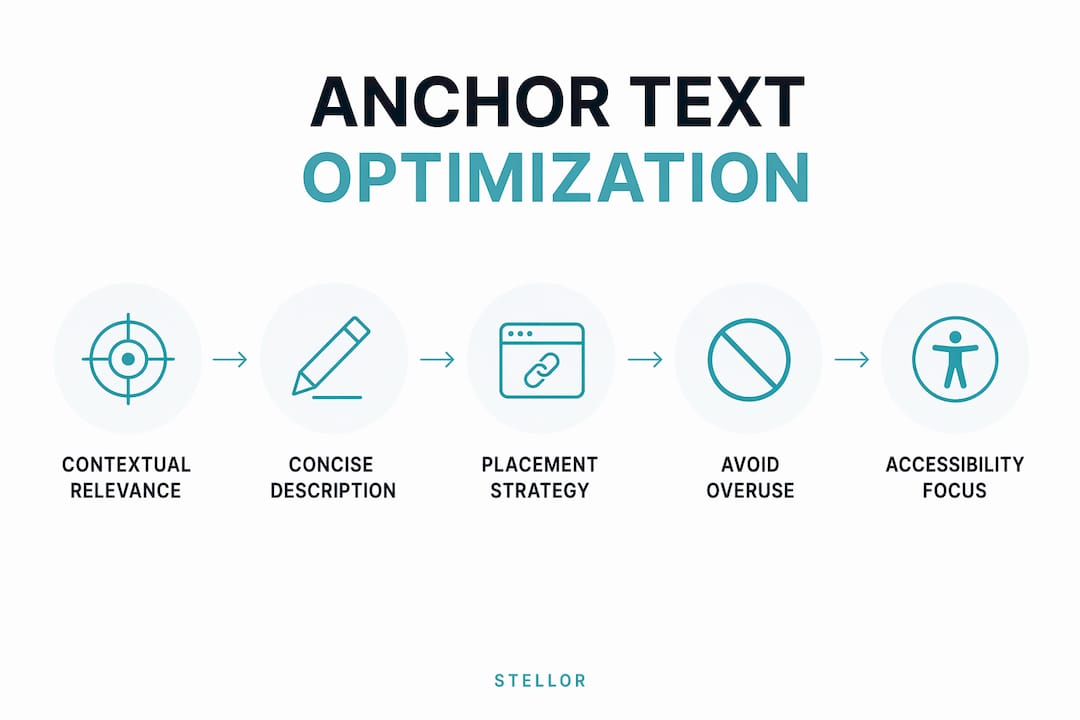
The contextual coherence test that governs 2026 evaluation requires three conditions: the anchor accurately describes the destination page, the surrounding sentence logically justifies the link’s existence, and the destination page fulfills the implied promise of the anchor. Fail any one of these, and the link’s value is discounted regardless of how well-chosen the anchor string is.
The penalty risk from exact-match overuse is real and documented. A law firm that used “personal injury lawyer” in 47% of its anchors lost 89% of its organic traffic after the March 2024 core update. That’s not an edge case; it’s a pattern that repeats across competitive niches whenever exact-match concentration climbs above the 8–10% threshold.
Pro Tip: When placing a guest post, write a substantive two-to-three sentence paragraph around your link before finalizing the placement. A contextually rich surrounding paragraph with a branded or partial-match anchor outperforms an exact-match anchor dropped into thin, boilerplate content every time.
For SEO teams managing local SEO link building, the practical takeaway is to prioritize building new branded, partial-match, and naked URL links rather than trying to surgically remove existing exact-match anchors. Dilution through addition is faster and more reliable than disavow-first strategies.
How anchor text affects accessibility for screen reader users
Anchor text is one of the most direct points of contact between your content and users who rely on screen readers. Screen reader software reads link text aloud, often in isolation from the surrounding paragraph, so a link labeled “click here” or “read more” gives the user no usable information about the destination.
The Web Content Accessibility Guidelines (WCAG) require that link purpose be determinable from the link text alone, or from the link text together with its programmatically determined context. In practice, this means every link should make sense when read out of context. “Download the 2026 SEO audit checklist” works. “Here” does not.
For SEO professionals, the accessibility requirement and the SEO requirement are identical: descriptive, specific anchor text. A link that passes the screen reader test almost always passes Google’s contextual coherence test as well. The in-house SEO team checklist for 2026 should include an accessibility audit of all anchor text, particularly in navigation elements and calls to action where generic phrasing tends to accumulate.
Image links require special attention. When an image serves as a hyperlink, the alt attribute of the img element functions as the anchor text for both screen readers and Google’s crawler. An empty or missing alt attribute on a linked image creates an accessibility failure and a crawlability gap simultaneously.
Key Takeaways
Anchor text optimization in 2026 is about contextual coherence first, anchor string second: the surrounding sentence and paragraph carry as much relevance weight as the link text itself.
| Point | Details |
|---|---|
| Contextual coherence is primary | The words surrounding a link carry more relevance weight than the anchor string itself in Google’s current evaluation framework. |
| Exact-match threshold for external links | Keep exact-match anchors to a minimal proportion of external backlinks; a higher concentration represents elevated algorithmic risk. |
| Branded anchors dominate healthy profiles | Branded anchors should account for 35–45% of external backlinks, reflecting a naturally dominant type in healthy link profiles. |
| Internal links follow different rules | Exact-match and descriptive anchors are appropriate and beneficial internally, where Google treats them as normal editorial practice. |
| Accessibility and SEO align completely | Descriptive anchor text that satisfies WCAG screen reader requirements simultaneously satisfies Google’s contextual coherence test. |
FAQ
What makes good anchor text?
Good anchor text is descriptive, concise, and directly relevant to the destination page. Google’s guidance recommends reading the anchor text out of context: if it clearly communicates what the linked page covers, it passes the test.
What should you avoid with anchor text?
Avoid excessive use of exact-match keyword anchors in your external backlinks, generic phrases like “click here,” and anchors that don’t match the content on the destination page. Excessive concentration of exact-match anchors can lead to significant organic traffic loss after a core update.
What are good anchor text examples?
“Download the 2026 SEO audit checklist,” “local link building strategies,” and “Google Search Central guidelines” are all strong examples. They describe the destination specifically, flow naturally in a sentence, and give both users and search engines clear context.
How do you improve anchor text across an existing site?
Audit your internal links with a crawler like Screaming Frog to identify generic anchors (“click here,” “read more”) and replace them with descriptive phrases. For external backlinks, focus on building new branded and partial-match links to dilute any existing exact-match concentration rather than pursuing disavow campaigns first.
Trystellor’s platform publishes SEO-optimized articles to your CMS, each built with the internal linking structure and descriptive anchor text that Google’s 2026 contextual evaluation rewards. The Trystellor platform also runs weekly technical audits covering internal link depth and anchor text patterns, so over-optimization issues surface before they become traffic problems. Start with a free AI Visibility Audit at Trystellor, no credit card required, and see exactly where your site stands across Google and every major AI answer engine.