
TL;DR:
- AI visibility tracking measures how often and prominently your brand appears in AI-generated answers across platforms like ChatGPT. It uses daily automated monitoring and key metrics to evaluate brand mentions, citation quality, and sentiment. Improving your AI citation rate requires fixing technical access issues and creating content that directly answers buyer questions.
AI visibility tracking is the process of measuring how often and how prominently your brand appears in AI-generated answers across platforms like ChatGPT, Claude, Gemini, and Perplexity. Unlike traditional SEO, which tracks keyword rankings on a results page, this discipline monitors whether AI answer engines cite your business when buyers ask questions you should be winning. For business owners and marketing professionals in 2026, this is no longer optional. AI answer engines are now a primary discovery channel, and if you are not measuring your presence there, you are flying blind.
What is AI visibility tracking and why does it matter?
AI visibility tracking measures brand mentions, citation frequency, and sentiment across AI answer engines using daily automated monitoring. Daily data refresh across ChatGPT, Claude, Gemini, and Perplexity gives businesses a real-time picture of how AI platforms represent them to buyers. That 24-hour data cycle matters because AI models update their outputs constantly, and a citation you earned last week may disappear this week without warning.
The industry now uses three core metrics to quantify this presence. The AI Visibility Score combines mention frequency with citation quality into a single weighted number. Share of Voice compares your brand mentions against competitors across the same set of prompts. Brand Sentiment measures the tone of how AI platforms describe your business, whether positive, neutral, or negative. Together, these metrics turn a vague question (“Does ChatGPT know who we are?”) into a measurable performance channel you can manage like paid search or email.
Generative Engine Optimization, or GEO, is the recognized industry term for the practice of optimizing content so AI answer engines cite it. AI visibility tracking is the measurement layer that tells you whether your GEO efforts are working. You need both. Tracking without optimization produces reports. Optimization without tracking produces guesses.
How AI visibility tracking works: key metrics and data sources
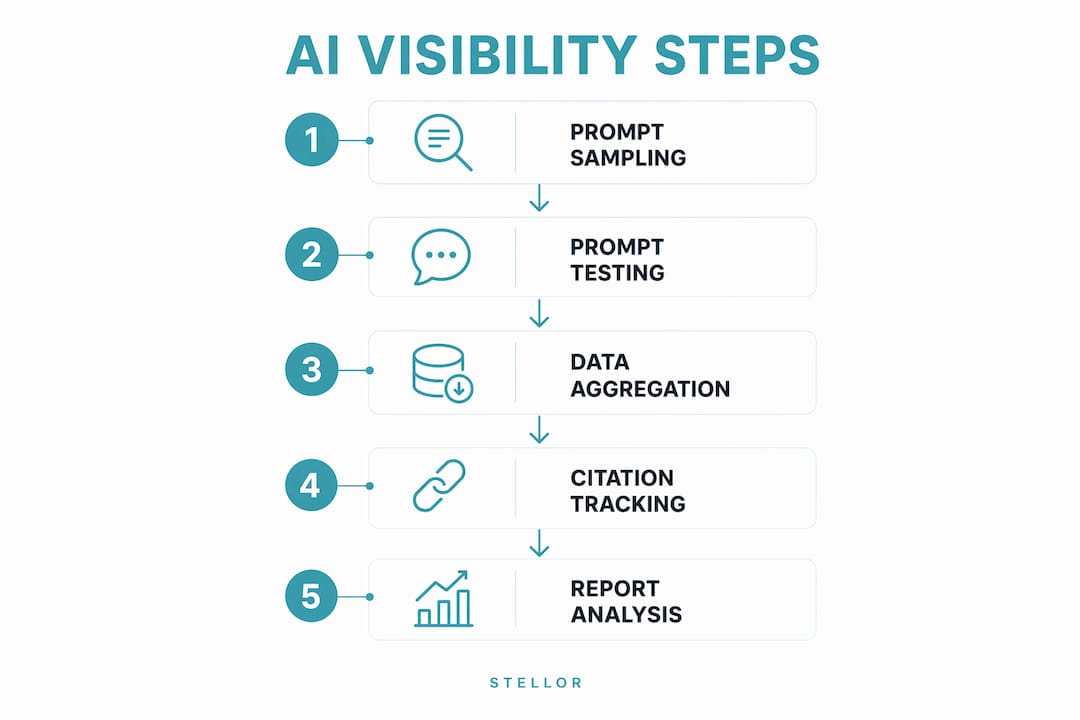
The measurement process starts with prompt sampling. Your tracking system submits buyer-intent queries to each AI platform, such as “best HVAC contractor in Denver” or “top-rated contract attorney,” and records whether your brand appears, where it appears, and how it is described. Multiple prompt runs per query are required for statistical reliability because AI models produce variable outputs. A single query on a single day tells you almost nothing. Repeated daily queries across dozens of prompts produce a stable AI Visibility Score you can trend over time.

The data sources behind reliable tracking are official APIs, not scraped outputs. Official API calls to GPT-4o, Claude Sonnet, Gemini 2.5 Pro, and Perplexity Sonar deliver consistent, reproducible results. Scraping AI interfaces introduces noise and violates platform terms of service. Any visibility analytics platform worth using pulls data through direct API connections.
The three metrics work together as a diagnostic system:
- AI Visibility Score: A weighted, trended score that reflects how often your brand appears and how prominently it is cited. Scores are trended daily with up to two years of history, so you can see whether your visibility is growing or shrinking over time.
- Share of Voice: The percentage of relevant AI responses that mention your brand versus competitors. This metric identifies which prompts you are losing and to whom.
- Brand Sentiment: The qualitative tone attached to your citations. An AI that mentions your business but describes it as “mixed reviews” is not a win.
Pro Tip: Run your prompt set across all four major AI platforms simultaneously. Each model draws on different training data and citation patterns, so your Share of Voice on Perplexity may look very different from your Share of Voice on Gemini.
Common challenges and misconceptions in AI visibility tracking
The biggest mistake business owners make is treating AI visibility as an extension of their Google ranking. AI citation is a distinct channel with its own funnel, separate from traditional SEO rankings. A page that ranks number one on Google may never be cited by ChatGPT, and a page buried on page three may be quoted constantly by Perplexity. The mechanics are different, and conflating them leads to bad decisions.
The AI citation funnel has three stages, and most businesses lose visibility at stage one without knowing it:
- Indexation: The AI crawler must be able to access and read your page. If your robots.txt file blocks AI crawlers, or if a nosnippet meta tag tells the crawler not to excerpt your content, your page will not be cited regardless of how good the content is. These are called “zombie pages.” They exist, they rank, but AI never touches them.
- Potential citation: The AI model must judge your content as authoritative and relevant enough to quote. This depends on content quality, structured data, schema markup, and the authority signals your backlink profile sends.
- Actual referral: The AI must cite your brand in a response that a real buyer reads and acts on. This is the only stage that drives traffic and leads.
Most businesses only measure stage three, if they measure anything at all. That is like measuring sales without measuring leads or website visits. You cannot fix a funnel you cannot see.
Random single queries also produce misleading data. If you ask ChatGPT “best plumber in Austin” once on a Tuesday morning and your business appears, that is not evidence of strong AI visibility. Statistical stability requires consistent monitoring with repeated queries over time. One data point is an anecdote. Thirty days of daily queries is a trend.
Pro Tip: Audit your robots.txt file and meta tags before investing in content. Blocking AI crawlers by accident is the most common and most fixable cause of poor AI citation rates.
How to improve your AI visibility and manage your brand presence
Improving your AI citation rate starts with fixing technical access, then building content authority. Technical site health directly impacts AI visibility, and no amount of content investment compensates for a crawler that cannot read your pages. Start with a technical audit focused on AI-specific signals: schema completeness, llms.txt configuration, structured data integrity, and internal linking depth.
Once technical access is confirmed, focus on content that matches buyer intent at the prompt level. AI models answer questions, so your content must answer the same questions your buyers ask AI. A service page that describes what you do is less citable than a page that answers “What should I look for in an HVAC contractor?” with specific, structured information. For practical guidance on building AI-friendly service content, the approach applies directly to local and home service businesses.
Use your AI visibility reports to prioritize fixes. The data tells you which prompts you are losing, which pages are failing to generate citations, and which competitors are winning the answers you should own. That is a prioritized work list, not just a report.
The table below compares two content approaches by their impact on AI citation potential:
| Content approach | AI citation potential |
|---|---|
| Generic service description (“We offer HVAC repair”) | Low. AI models rarely cite undifferentiated claims. |
| Question-answering format with structured data and schema | High. AI models prefer citable, structured answers to specific buyer questions. |
| Thin pages with no internal links and blocked crawlers | None. Zombie pages are invisible to AI regardless of content quality. |
| Authority-backed content with backlinks and clear entity markup | High. Trust signals and entity clarity increase citation probability significantly. |
Cross-referencing AI visibility data with crawl metrics identifies pages that are high quality but uncited due to technical or internal linking issues. This combination reveals exactly where to focus your next sprint. For home service businesses specifically, improving AI presence follows a clear sequence: fix technical access, build topical authority, then track citation growth weekly.
What tools and technologies support effective AI monitoring?
The market for AI monitoring tools now spans three distinct categories, and understanding the difference saves you from buying the wrong solution.
Visibility dashboards track brand mentions and citation frequency across AI platforms. They answer the question “Is my brand appearing?” These are the entry point for most business owners. Look for tools that use official API connections rather than scraping, deliver daily data refresh, and provide Share of Voice benchmarking against named competitors.
Brand mention trackers and sentiment platforms go one layer deeper. They analyze the tone and context of AI citations, not just their presence. A mention that frames your business negatively is worse than no mention at all. Sentiment tracking catches this before it affects buyer decisions.
Advanced LLM observability platforms serve teams building or managing AI applications. These tools capture multi-step agent paths, run automated evaluations, and alert on quality, latency, and errors. That level of depth goes beyond what most marketing teams need, but it is the right tool for engineering teams monitoring AI product performance.
For business owners and marketing professionals, the most practical setup combines a visibility dashboard with a technical SEO crawler. The dashboard shows you where citations are missing. The crawler shows you why. Together, they close the loop between content strategy and AI performance metrics.
Key features to require in any visibility analytics platform:
- Multi-provider daily querying across ChatGPT, Claude, Gemini, and Perplexity
- Official API usage with no scraping
- Ranked action lists that tell you what to fix first, not just what is broken
- Alerting when your citation rate drops or a competitor gains ground
- Integration with website crawl data to diagnose technical blockers
Successful teams also simulate AI outcomes before publishing new content. Real-time evaluation and tracing lets you predict whether a page will be cited before it goes live. That is a significant advantage over publishing and waiting weeks to see results. For businesses in home services, understanding effective website structure is a practical starting point for building pages that AI crawlers can read and cite.
Platforms like Trystellor combine GEO and SEO into a single subscription, which means AI visibility data feeds directly into content production and technical audits without requiring separate tools or manual data transfers.
Key Takeaways
AI visibility tracking is a distinct performance channel that requires daily monitoring, technical site health, and structured content to produce measurable citation growth across AI answer engines.
| Point | Details |
|---|---|
| Track the full citation funnel | Monitor indexation, potential citation, and actual referral, not just final mentions. |
| Use official APIs for data | Reliable AI performance metrics require direct API calls, not scraped outputs. |
| Fix technical blockers first | Robots.txt and nosnippet tags silently kill AI citations before content quality matters. |
| Repeat queries for accuracy | Daily prompt sampling across multiple runs produces statistically stable visibility scores. |
| Integrate GEO with SEO | Combining AI visibility data with crawl metrics reveals exactly which pages to fix and why. |
Why AI visibility is the metric most businesses are still ignoring
I have worked with enough marketing teams to know the pattern. They spend months refining their Google rankings, then someone asks “Are we showing up in ChatGPT?” and the room goes quiet. Nobody knows. Nobody has checked. And when they do check, the results are usually worse than expected.
The uncomfortable truth is that AI visibility and traditional SEO rankings have almost no correlation for most local and mid-market businesses. You can rank on page one for your core service terms and still be completely absent from AI-generated recommendations. The citation funnel operates on different signals: structured data, entity clarity, content that directly answers questions, and technical access that most sites have not configured for AI crawlers.
What I find most valuable is treating AI visibility as a weekly scorecard, not a quarterly report. The businesses that gain ground fastest are the ones checking their Share of Voice every week, identifying which prompts they lost, and making one or two targeted content or technical fixes in response. That cadence compounds. A business that makes 50 small, data-driven improvements over a year ends up in a very different position than one that runs a big content push twice a year and hopes for the best.
The other shift worth making is moving from raw data to ranked actions. A dashboard that shows you 200 data points is not useful if you do not know which three to act on. The best AI monitoring tools translate visibility data into a prioritized fix list. That is the difference between a report and a tool. For a deeper look at how GEO and SEO work together, the Trystellor blog covers the practical mechanics in detail.
— Cole
Trystellor makes AI visibility measurable and manageable
Tracking your AI citation rate across ChatGPT, Claude, Gemini, and Perplexity used to require stitching together five separate tools. Trystellor replaces all of them with a single platform that monitors your AI visibility daily, benchmarks your Share of Voice against competitors, and delivers a ranked list of fixes every week.
The platform publishes 30 GEO and SEO-optimized articles per month to your CMS, runs weekly technical audits across 11 AI-specific signals, and tracks your citations across 25 buyer prompts from day one. Every insight connects directly to a content or technical action. Pricing starts at $199 per month. Explore the full platform features and start a three-day free trial with no credit card required.
FAQ
What is AI visibility tracking?
AI visibility tracking measures how often and how prominently your brand is cited in AI-generated answers across platforms like ChatGPT, Claude, Gemini, and Perplexity. It uses daily automated monitoring and metrics like AI Visibility Score and Share of Voice to quantify your presence.
How is AI visibility different from SEO ranking?
AI citation is a separate channel from Google ranking. A page that ranks well on Google may never be cited by an AI answer engine, because AI models evaluate content based on structured data, entity clarity, and crawler access rather than keyword position alone.
Why do I need daily monitoring instead of weekly or monthly?
AI models update their outputs constantly. Daily repeated queries across multiple prompts produce a statistically stable visibility score. Monthly snapshots miss the week-to-week shifts that reveal whether your content or technical fixes are working.
What technical issues most commonly block AI citations?
Robots.txt rules and nosnippet meta tags are the most common blockers. These technical settings prevent AI crawlers from reading or excerpting your pages, creating zombie pages that exist but are never cited regardless of content quality.
How do I start improving my AI visibility?
Run a technical audit to confirm AI crawlers can access your pages, then build content that directly answers the buyer-intent questions your customers ask AI platforms. Use a local SEO foundation as your baseline, then layer GEO-specific optimizations like schema markup and llms.txt configuration on top.