

AI prompt tracking measures when and how answer engines like ChatGPT, Claude, Gemini, and Perplexity cite your brand in response to specific saved prompts. The starting move is simple: build a pilot set of 50 to 200 prompts your buyers actually use, then add prompt-level observability, following patterns like OpenTelemetry tracing, so every citation (or miss) is logged and versioned. A platform like Trystellor automates that polling across models weekly, but you can start manually with a spreadsheet and a scheduler.
TL;DR:
- Tracking prompts related to mid- and late-stage buyer intent queries yields the most actionable insights on AI citation share and revenue impact.
- Prioritizing a manageable set of 50 to 200 prompts, sampled weekly or daily for top prompts, maximizes signal while controlling costs.
- Implementing version control and traceability for prompts and responses is essential to accurately diagnose changes in citation performance.
- Combining scheduled polling with in-application observability provides a comprehensive approach to monitor AI citations and model performance.
- Running a focused pilot helps identify prompts that truly influence revenue, preventing waste on irrelevant or vanity metrics.
Table of Contents
- What Is AI Prompt Tracking and Why Does It Matter?
- How Do You Choose Which Prompts to Track?
- How Do You Set Up AI Prompt Tracking Technically?
- Which Metrics Actually Matter for AI Visibility?
- How Do Prompt Versioning and Tracing Work Together?
- How Do SEO, Marketing, and Engineering Teams Use This Data?
- How Does Stellor Run Prompt Tracking at Scale?
- Where Teams Get Prompt Tracking Wrong
- Get Managed AI Prompt Tracking Without Building the Stack Yourself
- Sources
- FAQ
What Is AI Prompt Tracking and Why Does It Matter?
AI prompt tracking is the discipline of saving a defined set of prompts, running them against large language models on a schedule, and logging whether, how, and in what context your brand gets mentioned. It replaces the old habit of checking keyword rankings with a new habit: checking citation rankings inside an AI-generated answer.
The mechanics are different from keyword tracking in ways that trip up experienced SEOs. Google ranking tracks a fixed URL against a fixed query with a stable algorithm you can reverse-engineer over time. Prompt tracking has to account for paraphrase matching (a user asking “best plumber near me” versus “who should I call for a leaking pipe in my area” often triggers the same citation logic), entity recall (does the model actually associate your business name with the service category, or just mention you in passing), and personalization (ChatGPT’s memory features and Gemini’s account context can shift answers between users). You also have to consider where the model is pulling its answer from. Retrieval-augmented generation pipelines pull from live web results, cached indexes, or in some cases forum threads on Reddit, and each source behaves differently.
Prompt tracking pays off fastest on queries with real commercial weight:
- Comparison prompts (“best CRM for small teams,” “top-rated roofing contractor vs [competitor]”)
- Local discovery prompts (“plumber open now near downtown Austin”)
- High-intent recommendation prompts (“who should I hire for a kitchen remodel”)
- Category-definition prompts where the model is deciding who the credible players even are
Picture a mid-size accounting firm that used to rank third organically for “small business tax accountant.” Under AI prompt tracking, they discover ChatGPT never mentions them at all for that exact phrasing. Instead, Perplexity cites them only when the prompt includes the word “audit support.” That single data point tells them more about their actual AI visibility than a page-one Google ranking ever could. Tracking AI inputs at this level of specificity is what separates a marketing team guessing at AI visibility from one measuring it.
How Do You Choose Which Prompts to Track?
Most teams make the same mistake on day one: they track whatever prompts are easiest to think of instead of the ones tied to revenue. A working framework fixes that.
- Map prompts to the buyer journey. Early-stage prompts (“what is a CRM,” “how does invoice factoring work”) build category awareness. Mid-stage prompts (“best invoicing software for freelancers”) drive consideration. Late-stage prompts (“[Your Brand] vs [Competitor] pricing”) close deals. Weight your pilot toward mid and late stage first since that’s where AI citations move revenue fastest.
- Build out five prompt categories. Brand prompts (your company name plus a qualifier), comparison prompts (you against named competitors), local prompts (service plus geography), task prompts (how-to queries where a tool or vendor gets recommended), and attribute prompts (queries built around a specific feature or price point, like “cheapest project management tool with time tracking”).
- Source prompts from three places. Convert your top 50 to 100 SEO keywords into natural-language questions. Mine Reddit threads and forum posts in your category for the exact phrasing real buyers use when asking for recommendations, since that phrasing often maps directly to what a user types into ChatGPT. Then query the LLMs themselves: ask ChatGPT or Perplexity “what would someone ask if they wanted to find a [your category]” and harvest the variants it generates.
- Filter with a simple prioritization matrix. Score each candidate prompt on four axes: intent fit (does it map to a buying decision), estimated volume proxy (use Google Search Console impressions or a tool like Semrush as a stand-in, since no LLM publishes prompt-level search volume), ease of measurement (can you reliably detect a citation in the output), and cost (some models charge per token, so a prompt polled daily across four models adds up).
- Set a pilot checklist before you scale. Cap the pilot at 50 to 200 prompts, since Moz’s guidance on prompt tracking points to that range as the sweet spot for signal without runaway cost. Sample weekly at minimum, daily for your top 10 brand and comparison prompts. Define success criteria up front, such as “citation share above 20% on five priority comparison prompts within 60 days.”
Pro Tip: Run your first 20 candidate prompts through a structural scorer like PromptPrepare’s CRISP framework before you commit to tracking them. A poorly structured prompt gives you noisy, inconsistent results no matter how good your monitoring setup is.
The prioritization step matters more than most teams expect. Tracking every prompt you can think of feels thorough, but it inflates cost and buries the handful of prompts that actually move revenue under a pile of vanity data.
How Do You Set Up AI Prompt Tracking Technically?
You have two real architectural choices, and most mature setups end up using both.
Scheduled polling treats prompts like a monitoring job. A script or a platform sends your saved prompt list to each model’s API on a set cadence, logs the raw response, and parses it for brand mentions, competitor mentions, and citation context. This is cheap to start and works well for marketing-owned prompt sets where you care about the output, not the internal mechanics of how it was generated.
Instrumented application observability goes deeper. If your own product uses an LLM (a chatbot, a search feature, an AI assistant), you instrument the code itself so every prompt sent and every response received gets logged as a trace, complete with prompt version, token count, latency, and cost. This is the approach engineering teams already use for uptime and performance monitoring, extended to cover prompts.
A complete setup usually needs these pieces working together:
- A prompt registry that stores every version of every tracked prompt, so you know exactly what wording produced what result
- Trace spans that carry prompt ID, model name, token usage, and latency, following the pattern Datadog’s Agent Observability uses to attach prompt name and version directly to LLM traces
- A polling scheduler that runs your pilot prompts against each target model on a fixed cadence
- Storage with a retention policy, since raw LLM outputs pile up fast and most teams only need 90 days of granular history plus rolled-up trends beyond that
- A replay playground where you can re-run a specific prompt version against a specific model to verify a citation change wasn’t a fluke
For tooling, Datadog’s prompt tracking feature versions prompts as first-class observability objects, letting you filter traces by prompt version and compare performance side by side. Traccia, an OpenTelemetry-based SDK, handles automatic token and cost tracking along with prompt management helpers like load_prompt and prefetch_prompts, which makes it a solid fit if your engineering team already works in OpenTelemetry. PromptLedger offers a prompt registry and execution API for teams that want centralized version control without building it from scratch. For a lighter lift, a polling script hitting each model’s API on a cron job gets a marketing team real data within a day.
Before any of this goes live, run a security pass: strip customer data and API keys from logged prompts, truncate long responses in storage rather than keeping full raw text indefinitely, and confirm nobody on the team is accidentally logging personally identifiable information inside a prompt template.
Which Metrics Actually Matter for AI Visibility?
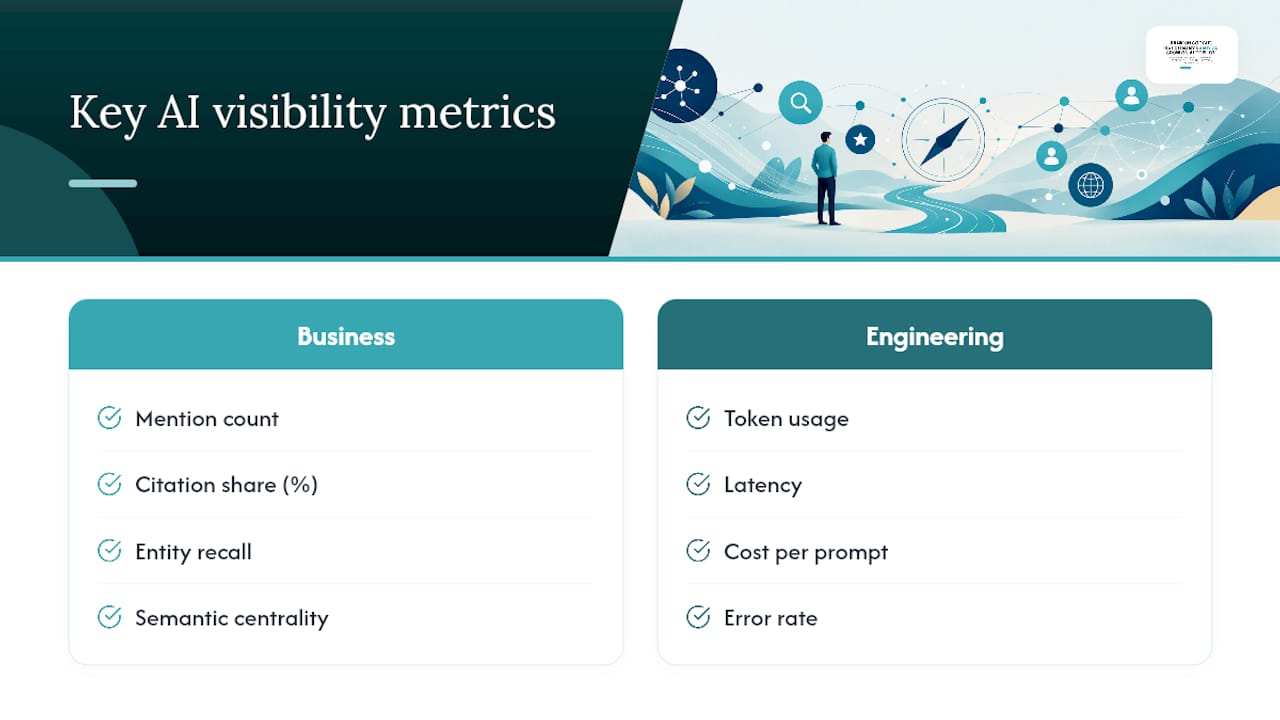
Business-facing metrics and engineering metrics answer different questions, and a good dashboard needs both.
On the business side, track mention count (raw frequency your brand appears across polled prompts), citation share (your mentions as a percentage of all brand mentions across a prompt category, which tells you how you stack up against named competitors), entity recall (whether the model correctly associates your brand with the right category or attribute, not just a passing name-drop), semantic centrality (how close to the core of the answer your mention sits versus a buried afterthought), and answer extract position (whether you’re cited in the first sentence of the response or three paragraphs deep, which correlates with how much a user actually reads).
On the engineering side, track token usage per prompt run, latency per model call, per-prompt cost (which varies significantly between models and matters once you’re polling hundreds of prompts daily), and error or regression rate (how often a prompt run fails, times out, or returns a malformed response you can’t parse).
By the numbers: A pilot of 50 to 200 prompts sampled across multiple models gives most marketing teams the highest signal-per-dollar ratio before committing to full-coverage tracking, according to Moz’s prompt tracking research. Scaling past that range without a clear cost model is where most teams start bleeding budget on noise instead of insight.
Set your sampling windows deliberately. Weekly polling works for most brand and comparison prompts. Daily polling makes sense only for your top 5 to 10 highest-priority prompts, since model outputs can shift day to day based on retrieval sources and caching. Define a significance threshold before you react to a single data point. A drop that holds for three consecutive weeks is a trend worth investigating.
For dashboard layout, group by prompt category first (brand, comparison, local, task, attribute), then break out model performance within each category, since a prompt that wins consistently on Claude might disappear entirely on Gemini. Set alerts for citation share drops past your significance threshold and for cost spikes past a daily budget ceiling.
How Do Prompt Versioning and Tracing Work Together?
Prompt tracking without version control is just a log of numbers you can’t explain. If your citation share dropped 15 points last Tuesday, the first question is: did the prompt wording change, did the model change, or did the world change? Without a versioned record, you can’t answer that.
A prompt registry solves this by treating every prompt like source code. Each edit gets a version number, a timestamp, and a diff against the previous version. When citation performance shifts, you check whether the shift lines up with a prompt edit or happened independently, which tells you whether the fix is on your end or the model’s.
Tracing extends that discipline into the runtime layer. Following an OpenTelemetry-style pattern, every prompt execution generates a span carrying the prompt ID and version, token and cost metrics, latency, and any guardrail signals (did the model refuse, hedge, or return a low-confidence answer). Traccia implements this directly, giving you zero-configuration instrumentation and decorators for LLM function calls, so a prompt change and its downstream effect on latency or cost show up in the same trace.
This is also where data lineage and AI lineage stop being interchangeable terms. Data lineage tracks what raw data fed into a system. AI lineage tracks the full chain: the prompt that was sent, the sources the model retrieved from, the decision path it took, and the final output it generated. Collibra’s research on this distinction makes the point directly: data lineage alone can’t explain why an AI cited your competitor instead of you, because it doesn’t capture the prompt, the retrieval step, or the model’s reasoning. You need AI lineage to answer “why,” not just “what.”
Marketing teams that only track outcomes (did we get cited or not) without tracking the full lineage behind that outcome end up unable to explain their own wins or losses to leadership. The trace is the evidence.
Engineering-side tools worth knowing here include tamper-evident trace stores, which append-only log every action for audit purposes. This matters more than it sounds like it should the moment a regulated client asks “prove that your AI recommendation process didn’t manipulate this result.”
- Redact customer identifiers and API keys before any prompt or response gets written to a log
- Truncate long responses in storage rather than retaining full raw text indefinitely
- Never let secrets or credentials pass through a prompt template unfiltered
- Keep an append-only audit trail for any prompt tracking tied to compliance-sensitive claims
How Do SEO, Marketing, and Engineering Teams Use This Data?
Prompt tracking only pays off once the data turns into action across three functions.
- SEO workflow: identify prompts where your brand’s citation share dropped or never existed, then update the underlying content (add clearer entity signals, structured data, or direct answers to the exact phrasing the prompt uses), and monitor for lift over the following two to three polling cycles.
- Engineering workflow: if your own product uses an LLM, A/B test prompt versions with full instrumentation attached, and set a rollback rule (if error rate or cost jumps past a defined threshold after a prompt change, revert automatically rather than waiting for someone to notice).
- GEO and local workflow: for location-based prompts, evaluate whether your brand shows semantic presence (is the model associating you with the neighborhood or city at all), then adjust location pages and directory listings to reinforce that association, an approach covered in more detail in this 30-day GEO playbook for local visibility.
- Community workflow: surface Reddit threads where your category gets discussed, since ChatGPT recommendations often pull directly from Reddit threads, craft genuine reply contributions, and monitor whether citation patterns shift in the following weeks.
- Reporting cadence: assign one owner per prompt category, report citation share and cost weekly to marketing leadership, and reserve a monthly deep dive for engineering to review latency, error rate, and instrumentation health.
How Does Stellor Run Prompt Tracking at Scale?
One managed system operationalizes several components into a unified solution, replacing multiple disconnected tools. Every week, it queries ChatGPT, Claude, Perplexity, and Gemini using the exact prompts a business’s buyers type in, and reports back citation status, which competitors are winning the citations instead, and how that landscape moved since last week.
That tracking layer doesn’t sit alone. It’s fed by:
- 30 GEO and SEO-optimized articles published monthly, built around the specific prompts losing citation share
- Weekly technical audits covering 11 checks, tuned for both Google ranking factors and AI crawler requirements
- An 4,000-site backlink network building the authority signals both Google and LLMs weigh
- A Reddit engagement workflow that surfaces high-intent threads daily with genuine reply suggestions
New accounts get a free AI Visibility Audit within 48 hours of onboarding, covering current citation status across 25 buyer prompts, a competitor benchmark, and a 90-day action plan showing what content ships in each 30-day window and which prompts it targets first. The audit stays yours even if you cancel. If you want to see how prompt-level insight turns into published content, Stellor’s blog covers real case examples of that loop in action.
Where Teams Get Prompt Tracking Wrong
Run a focused pilot before you scale. Fifty to 200 prompts, sampled weekly, tells you more than 2,000 prompts tracked sloppily. I’ve seen teams burn a quarter’s budget polling every keyword they own without ever pausing to ask which five prompts actually influence a buying decision.
Treat this as a joint project between marketing and engineering from day one. Marketing knows which prompts matter to revenue. Engineering knows how to build the versioning and tracing that makes the data trustworthy. Split those responsibilities and you get either irrelevant data or unreliable data.
Prioritize auditable traces over broad coverage. A small, versioned, well-instrumented prompt set beats a sprawling one you can’t explain to a stakeholder six months from now.
Red flags worth watching for: no prompt versioning (so you can’t explain any shift), inconsistent sampling cadence (comparing week 1 to week 6 when the sample size changed), and ignoring cost until the monthly API bill forces the conversation nobody wanted to have.
— Cole
Get Managed AI Prompt Tracking Without Building the Stack Yourself
Building the setup described above, a prompt registry, OpenTelemetry-style tracing, weekly polling across four models, plus the content and backlink work to actually fix what you find, usually means stitching together a content tool, a backlink service, a technical auditor, a Reddit workflow, and an AI visibility tracker separately. The service replaces that stack with one subscription starting at a monthly fee.
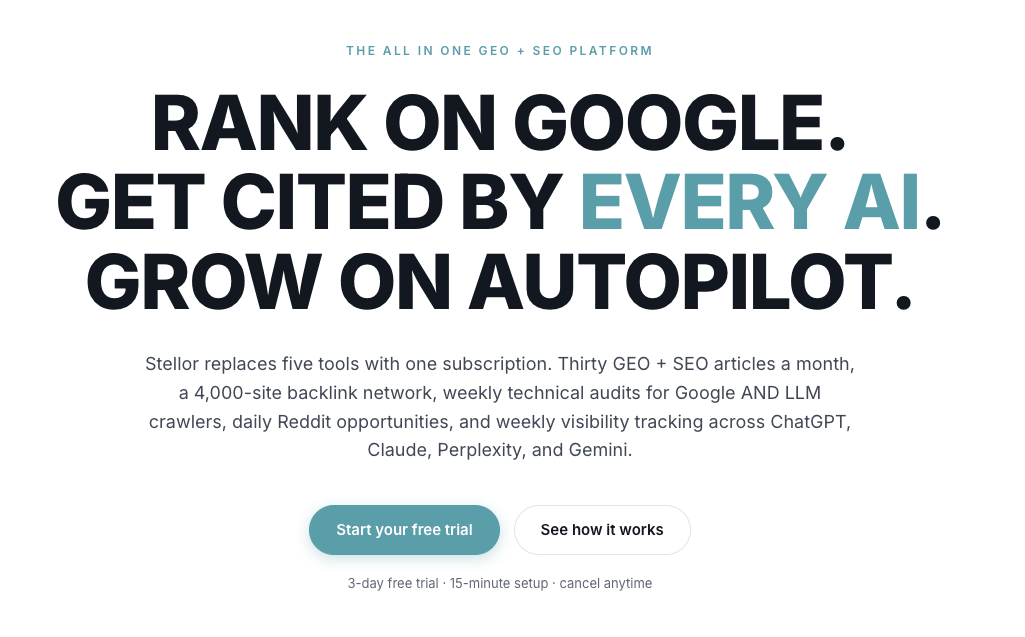
You get 30 GEO and SEO articles published monthly, an 11-point weekly technical audit, a 4,000-site backlink network, daily Reddit opportunity surfacing, and weekly LLM tracking across ChatGPT, Claude, Perplexity, and Gemini, all feeding into one dashboard instead of five logins. It’s built for businesses that need managed, scalable coverage rather than an internal team assembling observability tooling from scratch. Start with the 3-day free trial, no credit card required, and get your free AI Visibility Audit within 48 hours to see exactly where your brand stands across 25 buyer prompts today.
Sources
- Track, compare, and optimize your LLM prompts with Datadog Agent Observability | Datadog
- traccia-ai/traccia-py
- Data lineage for AI: Tracing training data, RAG sources, and agent inputs | Collibra
FAQ
What Is AI Prompt Tracking?
AI prompt tracking is the process of saving specific prompts, running them against AI models like ChatGPT and Gemini on a schedule, and logging whether and how your brand gets cited in the response.
How Is Prompt Tracking Different From Keyword Tracking?
Keyword tracking measures a fixed query against a stable ranking algorithm, while prompt tracking has to account for paraphrase variation, entity recall, and personalization across multiple AI models that source answers differently.
How Many Prompts Should a Pilot Include?
Most teams get the best signal-per-dollar starting with 50 to 200 prompts sampled weekly across models, based on Moz’s prompt tracking guidance, before scaling to broader coverage.
What Tools Support AI Prompt Tracking?
Options range from lightweight polling scripts to dedicated observability platforms like Datadog and Traccia, prompt registries like PromptLedger, and managed platforms like Trystellor that combine tracking with content and backlink actions.
Why Does Prompt Versioning Matter?
Without versioning, you can’t tell whether a citation change came from a prompt edit, a model update, or a shift in the underlying data the model retrieved, which makes the tracking data impossible to act on confidently.
How Often Should You Poll Tracked Prompts?
Weekly polling works for most brand and comparison prompts, while your top 5 to 10 highest-priority prompts benefit from daily polling to catch faster shifts in citation share.