

The fastest way to add a search channel to a referral-only business is this: claim your Google Business Profile, build one UTM-tagged landing page, and create a GA4 custom channel group for AI search traffic — in that order. You can expect your first search leads within 2–6 weeks from local SEO and paid campaigns, with a starting budget of $300–$1,200/month. As AbstraktMG notes, referrals are powerful but unpredictable, and running search channels in parallel is what makes growth predictable.
Here is the three-step micro plan:
- Quick local SEO fixes: Claim and fully optimize your Google Business Profile with NAP (name, address, phone), five photos, and a keyword-rich description.
- One landing page + UTM: Build a single service-and-location page with UTM parameters on every inbound link and a short lead-capture form with a hidden referral-type field.
- GA4 custom channel for AI search: Create a channel group that buckets AI referrer hostnames so ChatGPT, Perplexity, and Gemini traffic does not disappear into “Direct.”
For a deeper look at how AI search is changing local business discovery, the shift is already affecting how buyers find real estate agents before they ever call a referral.
Table of Contents
- What should you do in weeks 1–4 to get a search channel live?
- Which search channels should you prioritize first?
- How do you go from zero to your first search lead?
- What should your landing page and lead capture look like?
- How do you track search vs. referral leads accurately in GA4?
- How do you fold search leads into your referral workflows?
- What legal and compliance rules apply when you expand marketing channels?
- How does adding search channels affect your brand perception?
- Key Takeaways
- Why the referral-only model needs a search floor, not a search replacement
- Trystellor handles the parts of this guide that take the most time
- Useful sources
- FAQ
What should you do in weeks 1–4 to get a search channel live?
Move fast and keep it focused. The goal in the first month is not perfection — it is getting a trackable search presence live so you have real data.
Week 1: Google Business Profile
- Claim or verify your GBP listing at business.google.com.
- Set NAP consistently across your site and GBP.
- Add several relevant photos (exterior, headshot, neighborhood shots).
- Write a detailed description: “[Your Name] is a licensed real estate agent serving [City/Neighborhood]. Specializing in [buyer/seller/investment], with [X] years of local market experience. Referred by neighbors, trusted by families.”
- Collect three short testimonial snippets from past clients for use on your landing page.
Week 2: Landing page and on-site search
- Build one dedicated page targeting “[Your City] real estate agent” with a three-field form (name, email, phone) and a hidden UTM capture field.
- Add an on-site search widget. Cloudflare’s AI Search provides a step-by-step tutorial to embed a search bar, chat bubble, or modal in plain HTML. Alternatively, Google’s Programmable Search Engine offers a low-friction option with quick integration.
- Tag all outbound links with UTM parameters before the page goes live.
Week 3: GA4 and attribution
- Create a GA4 custom channel group named “AI Search” (full setup in Section 6).
- Add a visible “How did you hear about us?” dropdown to your form with options: Google Search, Referral, AI assistant (ChatGPT/Perplexity), Social, Other.
- Test every UTM link by clicking through and confirming the session appears in GA4 Realtime.
Week 4: Low-budget Google Ads test
- Run a branded local campaign: “[Your Name] real estate [City]” and “[City] real estate agent near me.”
- Set a modest daily budget and monitor cost-per-lead against your current referral close rate.
- Use this week’s data to decide whether to scale or pivot copy.
Pro Tip: Notify your top three referral partners by email or DM before you launch paid ads. A short note — “I’m testing some Google ads this month, so you may see my name pop up in search. Wanted you to know before your clients do” — preserves trust and often generates a referral on the spot.
Which search channels should you prioritize first?
Not every channel delivers at the same speed or cost. For a referral-only agent adding search for the first time, the priority order is: Google Business Profile, organic Google Search, AI answer engines, Google Ads, and on-site search. The table below maps each channel against the dimensions that matter most for your decision.
| Channel | Speed to First Lead | Typical Monthly Cost | Best For |
|---|---|---|---|
| Google Business Profile | a few weeks | Free (time only) | Local pack visibility, validation searches |
| Google Search (organic) | several months | — | Long-term authority, branded queries |
| Google Ads (branded/local) | about a week or two | moderate budget range | Fast volume, referral-influenced searchers |
| AI engines (ChatGPT, Perplexity, Gemini) | several weeks | — | Recommendation queries, trust validation |
| On-site search widget | Immediate | Free–$50/mo | Visitor retention, FAQ discovery |
| Content/FAQ pages (AEO) | 6 weeks or more | — | AI citation, long-tail queries |
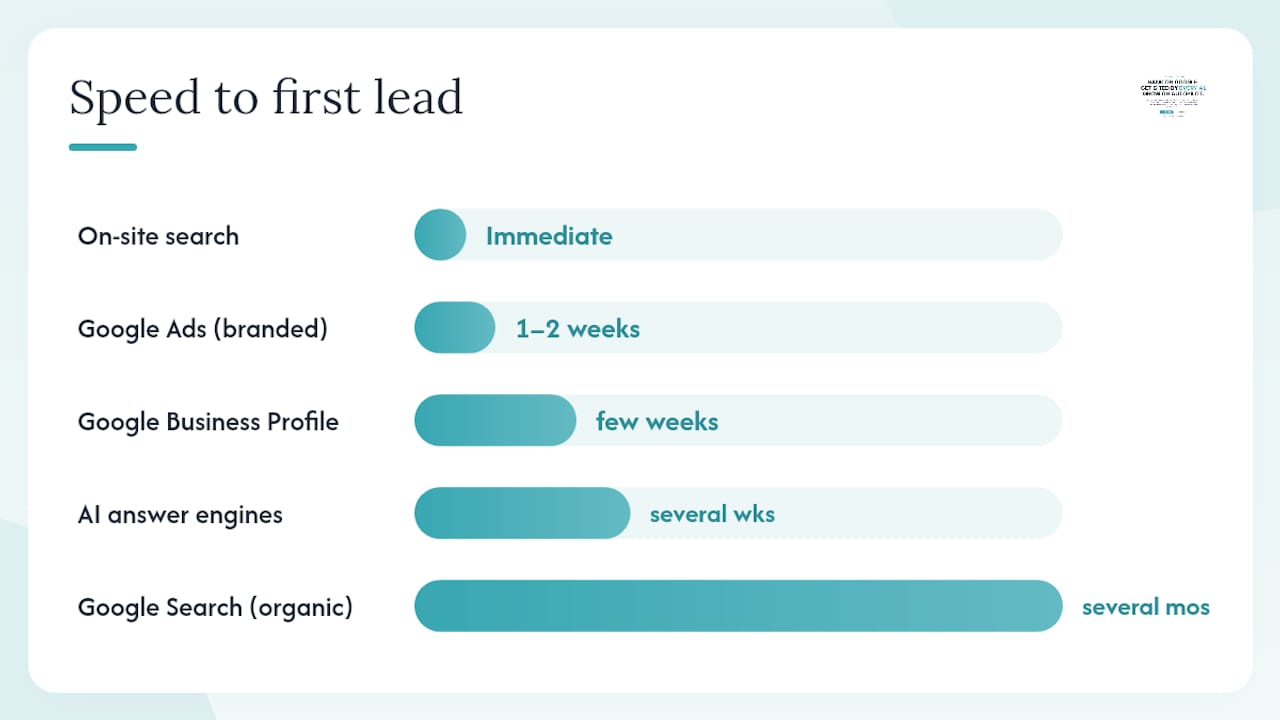
A few distinctions worth making. Google Business Profile and Google Ads convert referral-influenced searchers fastest because those buyers are already warm — they heard your name and Googled you to validate. Cold searchers, by contrast, respond better to educational content and FAQ pages that answer specific questions before asking for contact details. Top lead generation tactics for service businesses covers how to mix these channels without cannibalizing referral quality.
AI answer engines like ChatGPT, Perplexity, and Gemini are increasingly where buyers go first for agent recommendations. Getting cited there requires structured content, schema markup, and consistent NAP signals — the same foundation that drives Google rankings. UTM parameters on all inbound links let you track which channel actually delivered each lead, so you can compare search performance against your referral baseline from day one.
How do you go from zero to your first search lead?
Follow this sequence. Each step builds on the last, and skipping ahead creates tracking gaps that are hard to fix retroactively.
- Build your landing page. Target one service-and-location combination. Use the Google Cloud Search widget guide if you want an enterprise-grade on-site search; use Google’s Programmable Search Engine for a simpler embed.
Sample negative keywords for a local agent campaign: “real estate agent jobs,” “how to get a real estate license,” “real estate school [City],” “real estate agent salary,” “MLS login.”
What should your landing page and lead capture look like?
Your landing page does two jobs: it converts cold search traffic and it validates warm referral-influenced visitors. Those two audiences need slightly different signals, but one page can serve both with smart copy variants and a well-structured form.
Landing page element checklist:
- Headline variant A (referral-influenced): “Referred by a neighbor? Here’s what to expect.” Followed by a short testimonial quote above the fold.
- Headline variant B (cold search): “Find a local [City] agent — fast response, no pressure.”
- Three-field form: Name, Email, Phone. Keep it short; every additional field reduces conversions.
- Hidden fields:
utm_source,utm_medium,utm_campaign,utm_referrer_type(auto-populated by URL parameters). - Trust signals: Google review count and star rating, local association badge, one neighborhood-specific stat from NAR buyer/seller research.
- CTA button: “Request a free consultation” outperforms “Submit” by a wide margin in service-business testing.
UTM naming convention:
| Parameter | Referral-Influenced | Organic Search | AI-Referred | Paid Search |
|---|---|---|---|---|
| utm_source | chatgpt / perplexity | |||
| utm_medium | referral-search | organic | ai-referral | cpc |
| utm_campaign | referral-local | local-seo | ai-visibility | branded-local |
| utm_referrer_type | referral | search | ai-search | search |
As WhatConverts explains, tagging referral influence at the lead level is what lets you optimize search campaigns for referral-assisted conversions rather than treating every search lead as cold. Referral-driven leads need shorter conversion paths and stronger social proof because they arrive pre-disposed to trust you. A testimonial-first layout with a single CTA converts this segment better than a feature-heavy page.
How do you track search vs. referral leads accurately in GA4?
GA4’s default channel groups were built before AI search existed, so ChatGPT, Perplexity, and Gemini traffic typically falls into “Direct” or “Referral” with no distinction. The fix is a custom channel group, and it must be created before you start driving traffic — GA4 does not reprocess historical data.
Step-by-step GA4 channel group build:
- In GA4, go to Admin → Data Display → Channel Groups → Create new channel group.
- Name it “AI Search + Referral Split.”
- Add a new channel named “AI Search.” Set the condition: Session source matches regex
chatgpt\.com|chat\.openai\.com|perplexity\.ai|gemini\.google\.com|copilot\.microsoft\.com|claude\.ai|you\.com|phind\.com. - Place “AI Search” above both “Referral” and “Direct” in the channel order.
- Save and apply to your Acquisition reports.
| Hostname | Default GA4 Behavior | With Custom Channel |
|---|---|---|
| chatgpt.com | Direct or Referral | AI Search |
| perplexity.ai | Direct or Referral | AI Search |
| gemini.google.com | Direct | AI Search |
| claude.ai | Direct | AI Search |
| copilot.microsoft.com | Direct or Referral | AI Search |
For the full operational checklist on ordering channels and verifying capture, Kaizenaire.ai’s GA4 AI Referrals guide walks through each step with screenshots.
Lead-level tracking flow: Landing page → form submission with hidden UTM fields → CRM lead record tagged with channel and referral_flag → weekly cohort report comparing conversion rate and close rate vs. referral baseline.
Verification: Open a link from a ChatGPT result on your phone, land on your page, and check GA4 Realtime. If the session appears under “AI Search,” the channel is working. Set a 14-day calendar reminder to run this check again after your first campaign week.
Pro Tip: AI search frequently strips or alters referrer headers. Relying on GA4 hostname rules alone is not enough — always capture utm_referrer_type as a hidden form field so you have lead-level attribution even when the session-level data is incomplete. See AI visibility tracking for marketers for a full measurement framework.
How do you fold search leads into your referral workflows?
The risk when you add a search channel is not that referrals dry up — it is that you treat every new lead the same and lose the quality signal that made referrals valuable. The fix is routing, not volume.
Routing rules by lead type:
utm_referrer_type=referral: Route to senior agent queue; trigger a personal email within two hours; skip the long nurture sequence.utm_referrer_type=ai-searchorutm_medium=ai-referral: Route to standard queue; send a testimonial-heavy welcome email; follow up within 24 hours.utm_medium=cpc(cold paid): Route to standard queue; enroll in a five-email educational sequence before asking for a meeting.
Referral partner communication templates:
Email to referral partner when a search lead mentions their name: DM to referral partner when launching search campaigns: On timing: Boomerang’s referral program playbook recommends integrating referral asks into workflow triggers — after a positive milestone, after a closing, or after an NPS response — rather than broadcasting a general ask. When you are also running search campaigns, over-asking referral partners creates noise. Limit referral asks to two per client per year, tied to specific moments.
For strengthening your referral network while search ramps up, structured referral groups through the U.S. Small Business Administration’s referral group guidance and local Chamber of Commerce chapters provide a reliable parallel track. Running referral and search channels in parallel is also a model that works well in other service industries where trust-based pipelines face the same timing gaps.
What legal and compliance rules apply when you expand marketing channels?
Real estate marketing in the United States is regulated at the federal and state level, and adding search channels introduces new compliance touchpoints.
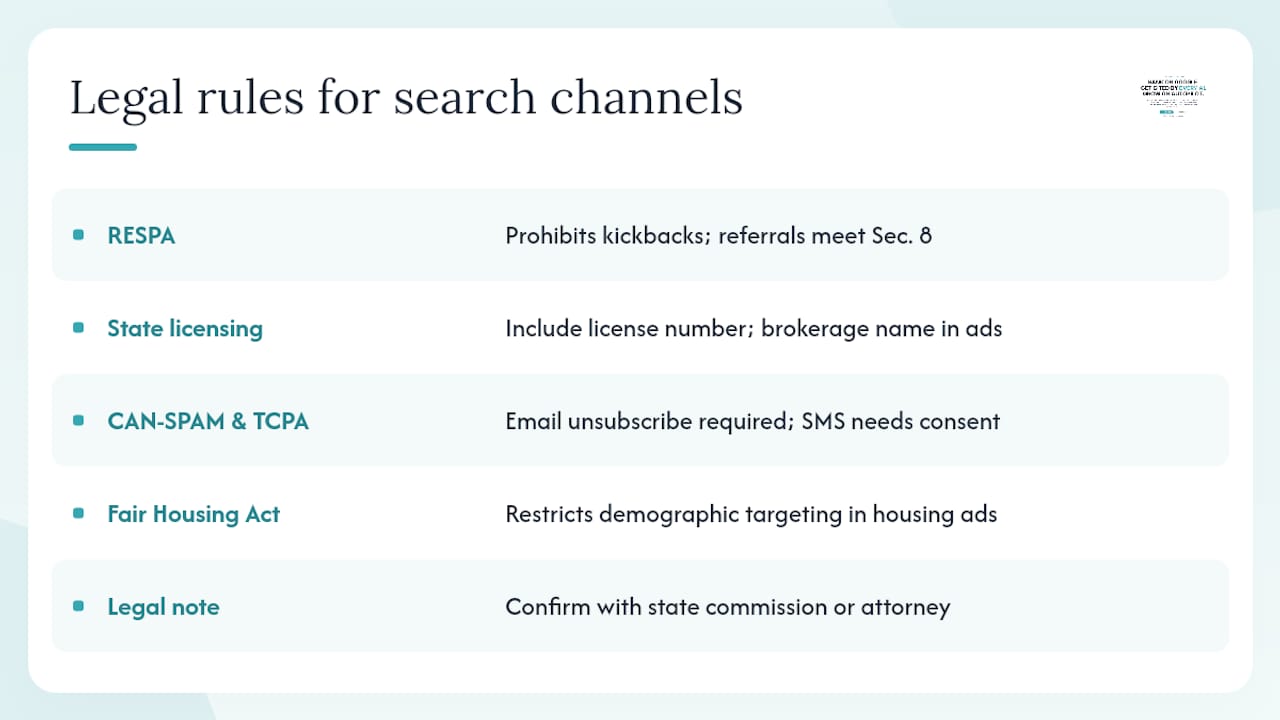
The RESPA (Real Estate Settlement Procedures Act) prohibits kickbacks and unearned fees in referral arrangements. If you pay for referrals — including through lead-generation platforms that charge per referral — the structure must comply with RESPA’s Section 8 requirements. Paid Google Ads and organic SEO are not referral fees under RESPA, but any arrangement where a third party receives compensation for directing a buyer to you requires legal review.
State licensing boards regulate advertising content. Most states require that all ads include your license number, brokerage name, and a non-deceptive description of services. This applies to Google Ads, GBP descriptions, and landing page copy. Check your state’s real estate commission rules before publishing any paid ad.
CAN-SPAM and TCPA govern email and SMS follow-up. Any automated nurture sequence triggered by a form fill must include an unsubscribe mechanism. SMS follow-up requires express written consent, which your form should capture explicitly.
Fair Housing Act compliance extends to digital advertising. Google Ads targeting by demographic categories (age, gender, zip code as a proxy for race) in housing-related campaigns is restricted. Use keyword targeting and location radius targeting rather than audience demographic filters for real estate campaigns.
This is general information, not legal advice. Confirm current rules with your state real estate commission or a licensed real estate attorney before launching campaigns.
How does adding search channels affect your brand perception?
Moving from referral-only to search-visible is a brand decision, not just a marketing one. Your referral network chose you partly because you were not competing for attention in the same channels as every other agent. That exclusivity has value, and it is worth protecting deliberately.
The practical risk is that paid ads can signal “I’m chasing volume” to referral partners who have been your advocates precisely because you were selective. The mitigation is positioning. Ads that lead with trust signals (“Referred by [Neighborhood] families since [Year]”) read differently than discount-driven copy. Your GBP description and landing page should reinforce the same brand voice your referral partners already associate with you.
On the AI engine side, being cited by ChatGPT or Perplexity as a recommended local agent tends to reinforce your authority rather than dilute it. When a referred client Googles your name and finds consistent, well-structured content across Google, AI answers, and your own site, that validation accelerates their decision. The perception risk runs the other way: agents who are invisible in search can appear less established to buyers who expect to find information before making contact.
The cleaner framing for your referral partners: you are not replacing their introductions, you are making sure that when their contacts Google your name, they find exactly what you want them to find.
Key Takeaways
Adding a search channel to a referral-only real estate business requires Google Business Profile as the first move, GA4 custom channel grouping for AI search attribution, and lead-level UTM tagging to compare search and referral performance cleanly from day one.
| Point | Details |
|---|---|
| Start with Google Business Profile | Claim, optimize with NAP and five photos, and collect testimonials before spending on ads. |
| Tag every lead at capture | Use UTM parameters and a hidden utm_referrer_type field so search and referral leads are separated in your CRM from the first form fill. |
| Build GA4 AI Search channel before launch | Create the custom channel group and place it above Referral and Direct; GA4 does not reprocess historical data. |
| Budget $300–$1,200/month for the first 90 days | Start conservative, hold experiments for 30 days or 50 leads, then scale what the close-rate data supports. |
| Trystellor automates the content and AI tracking layer | Trystellor publishes 30 GEO + SEO articles per month and tracks your citations across ChatGPT, Perplexity, and Gemini weekly, replacing the manual work this guide describes. |
Why the referral-only model needs a search floor, not a search replacement
The agents I see struggle most with this transition are the ones who treat search as a threat to their referral identity rather than a floor under it. Referrals will always be your highest-quality leads, but a pipeline built entirely on referrals stalls the moment your top three advocates get busy, move, or retire. Search does not replace that relationship capital — it fills the gaps between referral cycles so you are never in a dry month waiting for the phone to ring.
The GA4 measurement piece is where most agents underinvest. Without a custom channel group for AI search, you are flying blind on a channel that is already sending buyers to your competitors. The hostname list in Section 6 takes 20 minutes to configure and immediately shows you whether ChatGPT or Perplexity is sending traffic your way. That data alone changes how you prioritize content.
For agents who want to build this out at scale, Trystellor handles the content cadence and AI visibility tracking that makes the whole system compound over time.
Trystellor handles the parts of this guide that take the most time
The guide above works. The bottleneck for most agents is execution: writing 30 optimized pages, maintaining a backlink profile, running weekly technical audits, and tracking AI citations across ChatGPT, Perplexity, and Gemini every week. That is where Trystellor’s GEO + SEO platform replaces five separate tools with one subscription.
Trystellor publishes 30 GEO and SEO-optimized articles to your site every month, manages a 4,000-site backlink network, runs weekly technical audits covering both Google and AI crawler requirements, and tracks your citation status across every major AI answer engine. The AI Visibility Audit, delivered within 48 hours of setup, shows exactly which prompts your competitors are winning and which ones you should be earning. Pricing starts at $199/month with a three-day free trial and no credit card required. You keep all published content even if you cancel.
Start with the free AI Visibility Audit at trystellor.com/product and see where you stand in AI search before your next referral cycle begins.
Useful sources
- Cloudflare Developers — Add search to your website
- Google Cloud Search — Search widget guide
- Programmable Search Engine — About
- GA4 → AI search attribution: tracking ChatGPT and Perplexity referrals correctly · SolvSpot
- How to Set Up an ‘AI Referrals’ Channel in GA4 (Track ChatGPT Traffic) - Kaizenaire.ai
- How Marketers Turn Referrals Into Search Advantage — WhatConverts
- How to Build a Systematic Customer Referral Program (2026 Playbook) — Boomerang
- Referral lead generation: strategy, programs, and real limits — AbstraktMG
- How to grow your business with referral groups — U.S. Small Business Administration (SBA) blog
FAQ
What is a referral-only real estate agent?
A referral-only agent works exclusively with clients introduced by past clients, colleagues, or professional contacts, rather than advertising or cold outreach. Adding a search channel means creating a parallel inbound path through Google, AI answer engines, or paid ads while keeping referral relationships as the primary trust signal.
How do you build a strong referral network alongside search channels?
Focus referral asks on specific workflow moments — after a closing, after a positive milestone — and limit asks to two per client per year. Structured referral groups through local Chambers of Commerce or invitation-only business groups, as the SBA recommends, provide a reliable parallel track while search volume builds.
What are the three types of referrals in real estate?
The three common types are client referrals (past buyers or sellers introducing new contacts), professional referrals (attorneys, lenders, or other agents sending clients your way), and digital referrals (AI answer engines or review platforms recommending you based on your online presence). Adding a search channel primarily grows the third type while reinforcing the first two.
How long does it take to get leads from a new search channel?
Google Business Profile and Google Ads typically produce first leads within 1–3 weeks. Organic Google Search takes 2–4 months to build meaningful volume. AI engine citations (ChatGPT, Perplexity, Gemini) begin appearing within several weeks of publishing structured, schema-marked content. Stable CPL data for optimization requires a sufficient number of tracked leads, usually at the 60–90 day mark.
How do you track whether a lead came from search or a referral?
Use UTM parameters on every inbound link and a hidden utm_referrer_type field on your lead form. In GA4, create a custom channel group that places AI Search above Referral and Direct, using the hostname list for ChatGPT, Perplexity, Gemini, and other AI referrers. Push the channel value to your CRM at form submission so every lead record carries its source from day one.