

A well-run 90-day SEO plan clears technical blockers, ships targeted content, and builds initial authority. That combination moves priority pages into positions where they start earning impressions and early clicks. Month 1 is audit and foundation, Month 2 is content and on-page work, Month 3 is authority and measurement. Expect directional movement and early indexing gains, not a page-one finish for competitive head terms in 90 days.
TL;DR:
- Technical blockers, such as redirect chains and crawl errors, must be fixed within the first month to enable effective content development later.
- Content creation in month two should focus on answer-first pages optimized for AI-driven search, with clear briefs and schema markup.
- Outreach and link building in month three should target existing content assets, prioritize pages ranking between 11 and 20, and include local citations and reviews.
- Relying on automated tools streamlines technical audits, content publishing, and backlink outreach, reducing vendor coordination and speeding results.
- Continuous KPI tracking, especially weekly visibility checks across AI answer engines, is essential to measure progress and inform next steps.
Table of Contents
- Month 1: Audit, Baseline Metrics, and Quick Wins (Days 1-30)
- Month 2: Content Execution and On-Page Optimization (Days 31-60)
- Month 3: Outreach, Link Building, and Internal Linking at Scale (Days 61-90)
- Weekly and Monthly KPIs That Actually Predict Growth
- Common Mistakes That Derail a 90-Day SEO Roadmap
- Checklists and Templates You Can Use This Week
- How Stellor Runs a 90-Day Program From Audit to Citation
- Local SEO Moves That Belong in a 90-Day Plan
- Mobile Usability Issues That Core Web Vitals Won’t Catch
- When a 90-Day Sprint Is the Right Tool, and When It Isn’t
- Get Your 90-Day Plan Running Without the Five-Vendor Juggling Act
- Sources
- FAQ
Month 1: Audit, Baseline Metrics, and Quick Wins (Days 1-30)
The first 30 days set the ceiling for everything that follows. Skip the audit or rush it, and you’ll spend Month 2 building content on a foundation with cracks in it.
Start with a full crawl. Tools like Screaming Frog or Sitebulb will surface orphaned pages, redirect chains, duplicate titles, and broken internal links in a single pass. Before fixing anything, capture your baseline: indexed page count, Core Web Vitals pass rate, crawl error volume, and sitemap and robots.txt status. Without a baseline, you can’t prove progress at day 90.
Week 1 priorities, in order:
- Submit or resubmit XML sitemaps in Google Search Console.
- Fix redirect chains longer than one hop.
- Repair broken internal links flagged in the crawl.
- Compress hero images to WebP format to cut page weight.
- Confirm robots.txt isn’t blocking AI crawlers you want indexing your content.
A tight, prioritized audit checklist built for service businesses can save you from reinventing this process from scratch.
Keyword research and mapping happen in parallel. Group target terms by intent, then map each group to an existing page or flag it for a new content brief. This is also when you’ll catch keyword cannibalization, where two pages compete for the same query and split ranking signals instead of combining them.
By day 30, monitoring should be live: Google Search Console, GA4, a rank tracker, and a running weekly task list for anything the audit surfaced but didn’t get fixed.
Pro Tip: Fix indexing and crawl blockers before you write a single new page. Content built on top of a site Google can’t fully crawl is wasted effort, no matter how good the writing is.
Month 2: Content Execution and On-Page Optimization (Days 31-60)
Month 2 turns your keyword map into shipped pages. This is where most 90-day plans either build momentum or stall out on inconsistent output.
Every piece starts with an editorial brief: target keyword, search intent, suggested H2s, schema type, and internal links to existing cluster pages. Skipping the brief step is how teams end up with content that’s technically “published” but doesn’t actually target anything specific. Set a realistic cadence. Two to four pieces a week, sustained for four weeks, beats a burst of ten pieces that stalls out by week three.
On-page work runs alongside new publishing:
- Rewrite title tags for click-through, not just keyword inclusion.
- Structure pages with a clear H1 and logical H2 hierarchy.
- Lead every page with an answer-first paragraph that states the core point in the first two sentences.
- Add FAQ schema to pages that answer discrete questions.
Answer-first structure matters more in 2026 than it did five years ago. AI-driven search visibility depends on content that reads as answer-first, since language models and AI Overviews tend to pull short, self-contained answer capsules rather than parsing long buildup paragraphs.
This month is also when you clear the Core Web Vitals and UX issues your Month 1 audit flagged, prioritizing anything that blocks indexing or causes high bounce over cosmetic polish. A service and location content strategy built for how AI tools read pages will do more for citation rates than another round of keyword density tweaks.
Pro Tip: Write your FAQ answers the way you’d want them read aloud by a voice assistant. Short, direct, and complete in one or two sentences. That’s the exact shape AI Overviews prefer to quote.
Month 3: Outreach, Link Building, and Internal Linking at Scale (Days 61-90)
By day 60, you have a healthy technical foundation and a growing content footprint. Month 3 is where you convert that into authority and start proving the plan’s return.
Outreach in the final month should tie directly to the assets you just built:
- Pitch digital PR angles built around your new data or research pages.
- Find broken links on relevant resource pages and offer your new content as the replacement.
- Submit to niche resource pages and outreach to bloggers covering your space.
- Follow up systematically. Most link placements come from the second or third touch, not the first.
Internal linking deserves as much attention as external outreach. Audit your architecture and make sure every priority cluster has a clear hub page receiving links from supporting content, not the reverse.
Use your early ranking data to decide where to spend outreach effort. Pages sitting in positions 11 through 20 are the highest-return targets for additional links and promotion. They’re already close, and a modest authority bump is often enough to push them onto page one. A local link-building approach built for service businesses works well here, since it favors relevance over raw volume.
Close the quarter with a real retrospective: what shipped, what moved, what didn’t, and why. Update your priority matrix and use it to justify next quarter’s resourcing before momentum fades.
Weekly and Monthly KPIs That Actually Predict Growth
Vanity metrics feel good and predict nothing. The KPIs below split into leading indicators, which move fast and signal direction, and lagging indicators, which move slow and confirm results.
A practical reporting rhythm runs on three cadences: a 15-minute weekly ops check, a 30-minute monthly performance readout, and a 60-minute 90-day retrospective tied to OKRs.
- Your day-90 report should follow one structure: baseline, actions shipped, leading indicator movement, next-quarter decisions.
- Keep it to one page. Anyone in the business should be able to read it in five minutes and understand where the money went.
Measurable results like tracked KPIs for service businesses show what this reporting discipline looks like once it’s running for a full quarter.
Common Mistakes That Derail a 90-Day SEO Roadmap
Most 90-day plans fail from execution errors, not strategy errors. Watch for these four:
- Tactic lists with no measurable goals. A checklist of tasks isn’t a plan. Convert every item into an OKR with a number attached.
- Delaying technical fixes. Any blocker that prevents indexing must get fixed before content production starts, full stop.
- Chasing vanity metrics. Total traffic looks nice in a slide deck. Impressions and position 5-20 movement predict what happens next quarter.
- Ramping content volume at the cost of brief quality. Ten rushed briefs lose to four tight, well-mapped ones every time.
Pro Tip: If a task on your board doesn’t have a number attached to it, it’s a hope, not a goal. Rewrite it before you assign it.
Checklists and Templates You Can Use This Week
Standardizing these four artifacts is what separates a plan that runs smoothly from one that stalls in committee.
- 30/60/90 task checklist: owner, task, estimated effort, and due date for every item in this article.
- Editorial brief template: target keyword, intent, suggested H2s, schema type, internal links, word count target.
- Outreach checklist: prospect name, contact, page context, pitch angle, follow-up date.
- Priority matrix: score every task on impact (1-5) and effort (1-5), then sequence by highest impact-to-effort ratio first.
A downloadable roadmap and priority matrix built around impact-times-effort scoring will save you the setup time and give your team a shared reference from day one.
- Keep templates in a shared doc or project board where anyone on the team can add to the audit log without asking permission.
- Revisit and prune the priority matrix every two weeks. Stale priorities are worse than no priorities.
How Stellor Runs a 90-Day Program From Audit to Citation
Running this plan by hand across five tools is exactly the friction a 90-day sprint doesn’t have time for. Stellor’s weekly automated audits surface the same technical items covered in Month 1, crawl errors, Core Web Vitals failures, indexing gaps, with one-click fixes attached, so the audit phase takes days instead of weeks.
Month 2’s content volume problem gets solved by publishing cadence: Stellor ships 30 GEO and SEO-optimized articles a month, each built with the schema markup and internal linking structure that support cluster coverage and AI citation.
For Month 3, the platform’s 4,000-site backlink network and daily Reddit opportunity surfacing replace manual outreach with a running workflow, matching the AI-driven discovery patterns that increasingly shape which businesses get recommended.
- Weekly technical audits with one-click fixes
- 30 articles per month mapped to priority clusters
- Backlink network plus daily Reddit opportunities for outreach
- Weekly LLM visibility checks across ChatGPT, Claude, Perplexity, and Gemini
The KPI dashboard adds one metric most 90-day plans never track: weekly visibility checks across all four major AI answer engines, reported alongside traditional rank and traffic data.
Local SEO Moves That Belong in a 90-Day Plan
If your business serves a specific service area, local signals deserve their own line item in the plan, separate from general technical and content work.
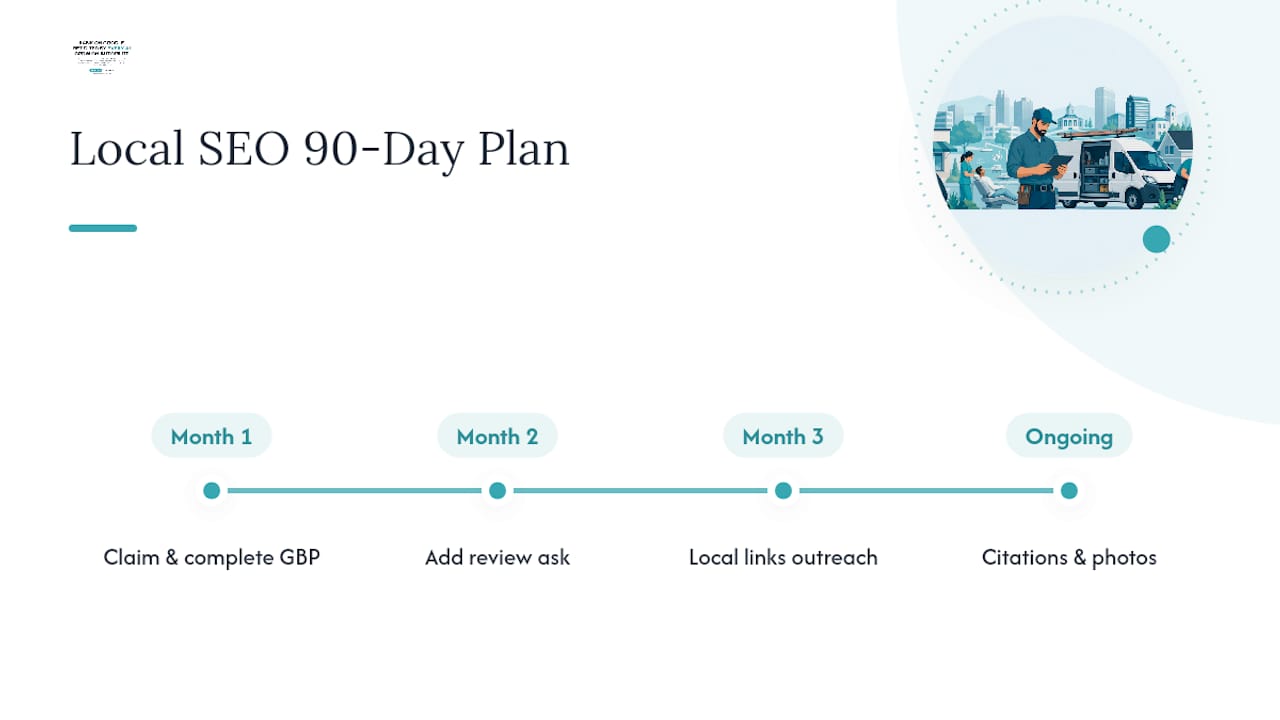
Claim and fully complete your Google Business Profile in Month 1, alongside the technical audit. Fill every field: categories, service areas, hours, attributes, and a business description that matches the language customers actually search with. Add photos regularly; profiles with recent photo activity tend to see stronger engagement in the local map pack.
Citation consistency matters more than most business owners expect. Your business name, address, and phone number need to match exactly across every directory, from major players to niche local ones. Inconsistent citations confuse both Google’s local algorithm and any AI tool trying to verify your business details before recommending you.
Review velocity, meaning the steady rate at which new reviews come in rather than one big push, is a stronger local ranking signal than review count alone. Build a simple ask-for-a-review step into your customer follow-up process during Month 2, and keep it running through Month 3 and beyond.
Local link building rounds this out. Sponsorships, local business associations, and community event pages all produce the kind of geographically relevant links that generic outreach can’t replicate. Fold this into your Month 3 outreach checklist rather than treating it as a separate initiative.
Mobile Usability Issues That Core Web Vitals Won’t Catch
Core Web Vitals measure loading speed and visual stability, but they don’t test whether a real person can actually use your site on a phone. That gap causes more lost conversions than most teams realize.
Run your priority pages through Google’s mobile-friendly testing during the Month 1 audit, and check manually for tap targets that sit too close together, text that requires pinch-to-zoom, and pop-ups that cover the full screen before a visitor has scrolled past the first paragraph. None of these show up in a Core Web Vitals score, but all of them push visitors back to search results, a behavior signal Google’s algorithm reads clearly.
Forms deserve particular attention. A contact form that’s easy to fill out on desktop can become a frustrating multi-tap ordeal on a five-inch screen. Test every conversion path on an actual phone, not just a browser resize.
Navigation menus that work well on desktop often collapse into unusable hamburger menus on mobile, burying the pages you most want visitors to find. Check that your priority cluster pages stay reachable within two taps from the mobile homepage.
When a 90-Day Sprint Is the Right Tool, and When It Isn’t
A 90-day plan works best when the blockers are clear and the team has real capacity to ship content on schedule. Give it a straightforward site with a defined technical problem list, and 90 days is enough time to see genuine movement.
It’s the wrong frame for an enterprise international migration or a site facing entrenched, well-funded competition. In those cases, set expectations for a multi-quarter program from the start, not a single sprint. The 90-day plan still has a role there: run it as the first quarter, then use the retrospective to fund quarter two with evidence instead of guesses. That’s the real value of the exercise, whether or not 90 days gets you to page one.
— Cole
Get Your 90-Day Plan Running Without the Five-Vendor Juggling Act
Most teams try to run this plan across a content writer, a link-building service, a technical auditor, and separate AI tracking, and the coordination overhead eats the timeline before Month 1 even ends. Stellor replaces that whole stack with one $199-a-month platform built around the exact three-phase structure this article covers.

You get weekly automated audits with one-click fixes for Month 1, 30 published articles a month for Month 2’s content push, and a 4,000-site backlink network, plus daily Reddit opportunities for Month 3’s authority work. Weekly LLM visibility tracking across ChatGPT, Claude, Perplexity, and Gemini runs the entire time, so you see AI citation movement alongside your traditional rankings instead of guessing at it separately.
This setup fits agencies running plans for multiple clients and in-house teams without the headcount to run five tools manually. Onboarding takes about 15 minutes to capture your services, locations, and brand voice, and you get a free AI Visibility Audit within 48 hours of signing up.
Start with the Stellor product page and take the 3-day free trial. No card required.
Sources
For structured data and sitemap fundamentals, Google Search Central is the primary reference, straight from the source that ranks your pages. For loading and interactivity benchmarks, web.dev’s Core Web Vitals documentation covers the exact thresholds your Month 1 baseline should target. For contractors and home service businesses tackling crawlability issues specifically, this local SEO ranking guide walks through the technical side in more depth.
- A 90-day SEO playbook for AI-driven search visibility — Search Engine Land
- SEO Strategy Template 2026: Complete Planning Guide — Digital Applied
FAQ
What should be included in a 90-day SEO plan?
A complete plan includes a technical audit and baseline metrics in Month 1, content production and on-page optimization in Month 2, and link outreach plus internal linking in Month 3, all tied to weekly and monthly KPI tracking.
Is SEO still worth it in 2026?
Yes. Organic search still drives the majority of website discovery, and AI-driven search visibility has added a second citation channel on top of traditional rankings rather than replacing them.
What is an SEO plan?
An SEO plan is a prioritized, time-bound set of technical, content, and authority-building actions designed to improve a site’s organic search rankings and, increasingly, its citation rate in AI answer engines.
What is the 30-60-90 rule applied to SEO?
It’s a phased execution model: days 1-30 cover audit and technical fixes, days 31-60 cover content and on-page work, and days 61-90 cover outreach, link building, and measurement, mirroring the same structure sales teams use for new-role ramp-up plans.
How fast can I see SEO results in three months?
Early signals like indexing and impressions typically appear in 4 to 6 weeks, while meaningful organic traffic growth usually takes 3 to 6 months depending on your site’s existing authority and competition.
Can a platform like Stellor run my entire 90-day plan?
Stellor covers technical audits, content publishing, backlink outreach, and AI visibility tracking in one subscription, which maps directly to the Month 1 through 3 structure most teams would otherwise assemble from separate vendors.