

The right range runs from 200 to 2,000 words, and the deciding factor is intent, not habit. A quick-conversion lead page needs 200 to 500 words. A standard service page runs 500 to 1,000. A consultative or high-ticket service deserves 1,000 to 2,000. Visitors read about 20 to 28% of page text on average, so whatever length we pick has to be scannable, tested, and built around the decision the reader is trying to make.
TL;DR:
- Extend a page when buyers need compliance details, phased options, full case studies, or answers to questions that higher ranking competitors already address.
- Allocate 30 to 80 words to the hero, 50 to 150 to the summary, and explain scope or pricing in 100 to 400 word blocks.
- Write the hero last, then use short paragraphs, descriptive subheads, and bullets for three or more parallel points to help visitors scan.
- Track conversions first, use scroll depth and time on page as context, and set a decision threshold before testing page variations across consistent templates.
- Add relevant Service, LocalBusiness, or FAQ markup, validate it with Google’s Rich Results Test, and check speed and mobile usability.
Table of Contents
- 1. Practical word-count benchmarks by page type and buying stage
- 2. How to allocate words across a service page
- 3. Formatting and writing rules that let readers scan and still convert
- 4. Technical signals that help your content surface
- 5. How to measure and test page length decisions
- 6. How Stellor helps teams produce, publish, and test service pages at scale
- Where length decisions actually come down to judgment
- Build and test the right length without doing it by hand
- FAQ
- Sources
1. Practical word-count benchmarks by page type and buying stage
Word count should follow the buyer’s mental distance from “yes,” not a round number pulled from a competitor’s page.
A lead-capture or contact-style service page works best at 200 to 500 words. These pages serve visitors who already know what they want: a phone number, a quote form, a booking button. Padding this page with backstory slows down the exact action we’re trying to trigger.
A standard service page, the kind most small and mid-sized businesses publish for each core offering, performs well at 500 to 1,000 words. That space covers what the service includes, who it’s for, pricing context, and a proof point or two, without burying the call to action under paragraphs nobody asked for.

A consultative or complex service, think legal, medical, financial, or anything with a long sales cycle, justifies 1,000 to 2,000 words. Readers researching a $15,000 roof replacement or a malpractice consultation want detail before they’ll pick up the phone.
Signals that your page needs to run longer:
- The service involves compliance, licensing, or regulatory detail buyers expect you to explain.
- You have case studies or before/after results worth walking through in full.
- The deliverable has multiple phases or options that need separate explanation.
- Competitors ranking above you are answering more of the buyer’s questions on-page.
2. How to allocate words across a service page
Once you’ve picked a target, the skeleton matters more than the total. A 900-word page with the wrong allocation underperforms a 700-word page that puts weight where attention actually lands.
- Hero and value statement: 30 to 80 words, one clear promise, one CTA.
- Quick summary and bullets: 50 to 150 words that let a scanning visitor grasp the offer in five seconds.
- Detail blocks: process, scope, and pricing context in chunks of 100 to 400 words each, never one unbroken block.
- Proof and micro case studies: short, data-first snippets rather than long narrative testimonials.
- FAQ or snippet area: tight Q&As sized to answer one question each, which also gives you a shot at featured snippets.
Pro Tip: Write the hero last. Once the detail sections are done, you’ll know exactly which single benefit deserves the first 50 words.
3. Formatting and writing rules that let readers scan and still convert
Length only works when the page is built for scanning, not reading top to bottom. NN/g’s reading research found that visitors read about 28% of the words on an average page, and most of that attention goes to the first paragraphs.
Visitors read roughly 20 to 28% of the text on a typical page, according to NN/g, which means the opening lines of every section carry most of the weight.
To work with that behavior instead of against it:
- Front-load conclusions: state the outcome before the explanation.
- Write one idea per paragraph, and keep paragraphs short.
- Use bulleted lists for anything with three or more parallel items.
- Bold the numbers, prices, and outcomes a skimming reader needs to catch.
- Use descriptive H3 subheads as signposts so readers can jump straight to the section that answers their question.
NN/g’s eyetracking work also found that clear information architecture and specific subheads pull scanners into deeper reading of the sections that match what they came for.
4. Technical signals that help your content surface
Word count does the talking, but technical setup decides whether anyone besides the visitor ever sees it. A few checks matter for every service page:
- Add Service, LocalBusiness, or FAQ JSON-LD markup where relevant, and confirm it with Google’s Rich Results Test.
- Keep meta titles and descriptions tight, and test variations rather than guessing once and moving on.
- Check page speed and mobile usability, especially on longer pages, and lazy-load heavy images.
- Review Search Console’s generative AI control if you want your content eligible for AI-generated summaries rather than excluded from them.
For a fuller rundown of what to check before publishing, our essential SEO audit checklist for local service businesses covers the items that most often get skipped.
5. How to measure and test page length decisions
A target word count is a hypothesis, not a finish line. Treat it that way:
- Track conversion rate, contact form submissions, calls, bookings, as the primary metric, and watch micro-conversions like scroll-to-CTA clicks for early signal.
- Use scroll depth and time on page as context for what’s happening, never as proof that a page is working.
- Run A/B tests: short hero versus long hero, collapsed versus expanded FAQ, full case study versus a summary version.
- Set a decision threshold in advance, such as keeping the longer version only if conversions improve with results you can trust, not a one-week blip.
This is also where a consistent template pays off. Testing hero length or FAQ depth across one page tells you almost nothing; testing it across dozens of service pages built on the same skeleton gives you a real answer.
6. How Stellor helps teams produce, publish, and test service pages at scale
Getting one page’s word count right is manageable by hand. Getting it right across every service and location page, then proving it with data, is a production problem. Stellor publishes 30 GEO and SEO-optimized pages a month on a consistent template, runs weekly technical audits that keep schema and page speed in check, and tracks how often ChatGPT, Claude, Perplexity, and Gemini cite the pages we publish. Our service page SEO guide walks through how we apply templates and schema at that volume.

Where length decisions actually come down to judgment
Longer copy feels safer because it looks thorough, but thoroughness isn’t the goal: a decision is. When a lead page converts well at 300 words, adding detail to reach a round number usually trades momentum for the illusion of completeness.
Before adding bulk copy, run three checks: does this paragraph answer a question the buyer actually has, does removing it change what the reader decides, and does the page still make sense if read only for 20 seconds. If any answer is no, cut rather than pad.
— Cole
Build and test the right length without doing it by hand
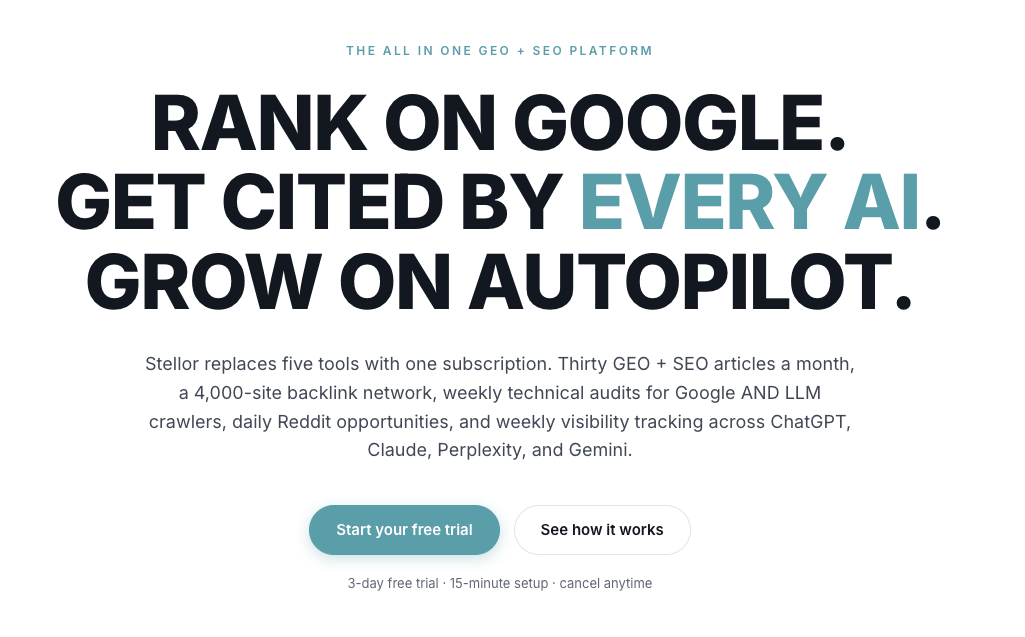
We publish multiple GEO and SEO-optimized service, location, and FAQ pages regularly, built on a consistent framework that allows testing of formatting aspects across your site. Regular technical audits help maintain schema, speed, and mobile usability, while our backlink network supports authority signals for search engines, and LLM tracking reveals AI citation patterns.
If you’re also managing other content types alongside service pages, our local SEO guide for service businesses and our piece on using AI to boost local visibility cover the surrounding signals that affect whether any of this gets seen.
- Thirty managed pages a month, one consistent template, ready to A/B test.
- Weekly audits and schema automation so longer pages stay crawlable.
- LLM visibility tracking across four major AI answer engines.
Start a 3-day free trial, no card required, or run the numbers first on our ROI calculator.
FAQ
How do I find out how many words are on a website?
Open the page, select all the text in the body content, and paste it into a word processor’s word count tool, or use a free online word counter and paste in just the visible copy, not the navigation or footer. Browser extensions built for writers and SEOs can also scan a live URL directly.
What is the best blog length for SEO in 2026?
Blog length depends on search intent the same way service page length does, so there’s no single ideal count for every post. The benchmarks in this piece apply specifically to service pages; a separate evaluation of top-ranking blog posts for your exact query is the more reliable way to size a blog article.
How many words normally fit on a page?
A standard printed page holds roughly 500 words in a typical font and spacing, but web pages don’t have a fixed page boundary, so the useful comparison is word count by section, not by page. For service pages, the ranges in this article (200 to 2,000 words depending on intent) are the more relevant benchmark.
How do I get word count in pages?
Most word processors, including Google Docs and Microsoft Word, show both total word count and estimated page count under a word count or tools menu. For web content, convert word count to an approximate page equivalent by dividing by around 500 words per page, then treat that figure as a rough guide rather than a layout rule.
Sources
- How little do users read? — NN/g
- Structured Data Markup Helper — Google Search Central
- Search generative AI control — Google Search Central