

TL;DR:
- An underperforming SEO agency fails to connect their activities to your business results, providing vague reports and no clear ROI.
- Effective agencies offer transparent access to analytics, focus on qualified leads and conversions, and deliver measurable progress aligned with your goals.
An underperforming SEO agency is defined by one consistent failure: its work does not connect to your business outcomes. You see reports full of traffic numbers and keyword rankings, but qualified leads stay flat, revenue from organic search does not grow, and no one at the agency can explain why. Recognizing the signs your SEO agency underperforms early saves you months of wasted budget and gives you the data you need to demand better results or find a stronger partner.
Good agencies tie every activity directly to business results like qualified leads and revenue, and they are transparent about what they can and cannot control. That standard is the measuring stick for everything in this guide.
1. What are the main signs your SEO agency underperforms?
Poor SEO agency performance rarely announces itself loudly. It shows up as a slow drift: reports that look busy but say nothing, rankings that move without producing calls or form fills, and conversations that feel reassuring but lack specifics.
The most common red flags in SEO agencies include:
- Vague or templated reports that repeat the same format every month regardless of what changed
- No baseline established at the start of the engagement, making it impossible to measure progress
- No access to your own analytics, including Google Analytics 4 (GA4) or Google Search Console
- Focus on activity counts such as posts published or links built, rather than outcomes like conversions
- Branded traffic presented as a win, when growth in searches for your company name reflects marketing spend, not SEO
- Promises of guaranteed rankings, which no agency can deliver because no one controls Google’s algorithm precisely
- Repeated unchanged reports even when results stall for multiple months in a row
- Missing deliverables with no explanation or accountability
Each of these signals a disconnect between what the agency does and what your business actually needs. The pattern is worth recognizing early.
Pro Tip: Ask your agency to draw a direct line from their last three deliverables to a specific business result. If they cannot do it in one clear sentence per deliverable, that is your answer.

2. How to assess your SEO agency’s reporting and transparency
Transparent reporting is the clearest indicator of a trustworthy SEO partner. A good agency gives you direct access to GA4 and Google Search Console, not screenshots or exported PDFs that they control. You should be able to log in yourself and verify every number they present.
Understanding what good SEO reporting looks like helps you spot the gaps faster. The table below shows the difference between strong and weak reporting practices.
| Characteristic | Good SEO reporting | Poor SEO reporting |
|---|---|---|
| Data access | Client has direct GA4 and Search Console access | Agency shares screenshots or locked dashboards |
| Metrics reported | Organic conversions, lead quality, non-branded clicks | Raw traffic, total impressions, keyword position lists |
| Explanation of results | Clear narrative connecting work to outcomes | Numbers presented without interpretation |
| Response to stalled results | Strategy adjustment with documented reasoning | Same report repeated with no comment |
| Link building transparency | Named domains, outreach context, quality rationale | Link count only, no domain or quality detail |
| Timeline honesty | Realistic projections with stated assumptions | Vague promises or short-term guarantees |
Reporting that only shows brand-term rankings or raw impressions without conversion data is a clear sign of poor performance. Reports should connect numbers directly to money-related outcomes, not just activities like publishing posts or building links. If your monthly report does not include organic conversions, demo requests, or qualified lead counts, ask for them in writing.
A monthly SEO reporting cadence built around Google Search Console visibility, GA4 conversions, and CRM lead quality gives you an objective view of agency results. Without that structure, you are evaluating effort, not impact.
3. Which performance metrics truly matter when evaluating your SEO agency?
Vanity metrics are the most common way underperforming agencies hide weak results. Total traffic, average position, and domain authority scores all look impressive in a slide deck. None of them tell you whether SEO is growing your business.
The metrics that actually matter are:
- Non-branded impressions and clicks: Growth here means new audiences are finding you, not just people who already know your name
- Organic conversions: Form fills, phone calls, and purchases that originate from organic search sessions in GA4
- Qualified lead volume: Cross-referenced between GA4 and your CRM to confirm that organic visitors become real prospects
- Demo requests or consultation bookings: The clearest signal that SEO is reaching buyers with intent
- Conversion rate by landing page: Reveals whether traffic is targeted or just inflated by irrelevant queries
Focusing on vanity metrics like traffic alone without showing lead quality or conversion results is misleading and common in underperforming agencies. Tracking visitor behavior, conversion events, and connecting SEO activities to sales or demo requests is the standard a real partner meets.
Cross-check your GA4 data against Google Search Console and your CRM every month. If organic sessions are rising but CRM-sourced leads from organic are flat, the traffic is not qualified. That gap is a direct indicator of weak SEO results.
Pro Tip: Set a 90-day review milestone with your agency at the start of the engagement. Define the specific conversion metrics you will use to judge progress, and get those targets in writing before work begins.
SEO results require months, not weeks, to show clearly. A good agency sets reasonable timeline expectations upfront. If yours promised fast results or avoids discussing timelines, that is a warning sign worth addressing directly.
4. Common agency behaviors that signal underperformance
Some agency behaviors cross from poor performance into deceptive practice. Knowing the difference helps you decide whether to renegotiate or walk away.
Watch for these specific patterns:
- Guaranteed #1 rankings: No agency controls Google’s rankings. This claim signals incompetence or deception, and it usually hides a lack of real progress underneath.
- Secret methods or special Google relationships: Google does not give agencies preferential ranking access. Any agency claiming otherwise is misleading you.
- Fixed link counts with no quality control: Promising 50 links per month without specifying domain relevance, authority, or outreach method is a red flag. Link quality matters far more than volume.
- Billing with no defined deliverables or KPIs: If your contract does not specify what gets delivered each month and how success is measured, you have no basis for accountability.
- Thin content published at scale: Bad agencies churn out thin content or buy low-quality spam links, which can lead to Google penalties and long-term damage to your site’s visibility.
- Refusing to say no: A top-performing SEO agency is willing to tell you when a requested task will not deliver positive ROI. An agency that agrees to everything without pushback is not acting as a strategic partner.
The last point is worth sitting with. An agency that never challenges your requests is not protecting your results. Real partners push back when the strategy is wrong.
5. How to build your own SEO agency performance checklist
You do not need to rely on your agency’s self-reported data to know whether they are performing. A structured monthly scorecard built from three sources gives you an independent view.
Start with Google Search Console. Pull non-branded impressions and clicks for the past 90 days and compare them to the prior period. Growth here confirms the agency is reaching new audiences. Flat or declining non-branded performance after six months is a concrete indicator of weak SEO results.
Layer in GA4 conversion data. Filter organic sessions and check which pages generate the most conversions. If the agency’s published content is not appearing in this list, the content strategy is not aligned with buyer intent. This is one of the clearest measurable SEO results checks you can run yourself.
Finally, cross-reference with your CRM. Tag leads by source and check what percentage of closed deals originated from organic search over the past quarter. If that number is not growing alongside your SEO investment, the agency’s work is not reaching buyers who convert.
This three-source check takes about 30 minutes per month. It gives you the data to have a specific, evidence-based conversation with your agency rather than relying on their framing of results.
Key takeaways
An SEO agency that cannot connect its work to qualified leads, organic conversions, and non-branded search growth is underperforming, regardless of how polished its reports look.
| Point | Details |
|---|---|
| Demand conversion data | Reports must show organic conversions and lead quality, not just traffic or rankings. |
| Verify data access | You should have direct access to GA4 and Google Search Console at all times. |
| Watch for deceptive claims | Guaranteed rankings and secret methods are signs of an incompetent or dishonest agency. |
| Build your own scorecard | Cross-check Search Console, GA4, and CRM data monthly to assess results independently. |
| Set written KPIs upfront | Define specific conversion targets in your contract before work begins to create accountability. |
What I have learned from watching agencies fail their clients
I have reviewed enough SEO agency relationships to spot the pattern quickly. The agencies that consistently underperform share one trait: they optimize for the appearance of activity rather than the reality of results. They publish content, build links, and send reports. But they never ask whether any of it is moving the needle on revenue.
The uncomfortable truth is that many business owners let this continue for too long because SEO feels complicated and the agency sounds confident. Confidence is not competence. The moment an agency cannot tell you which specific piece of work drove which specific outcome, you are paying for theater.
The fix is simpler than most people expect. Require a written deliverables list each month. Require access to your own analytics. Require a conversion number in every report. And when results stall, require a documented explanation and a strategy change, not a reassurance.
I also think the in-house SEO priority checklist framework is worth reviewing even if you use an agency. Understanding what a strong SEO operation looks like internally makes you a far better client and a much harder one to mislead.
The agencies worth keeping are the ones that tell you when something is not working before you have to ask. That honesty is rare, and it is the clearest sign you have found a real partner.
— Cole
How Trystellor helps you track SEO performance independently
If you are questioning whether your agency is delivering, you need your own visibility into the data. Trystellor is a GEO and SEO platform that gives you weekly technical audits, backlink tracking across a 4,000-site network, and LLM visibility monitoring across ChatGPT, Claude, Perplexity, and Gemini. It publishes 30 SEO-optimized articles per month to your CMS and tracks exactly which AI prompts your business wins or loses each week.
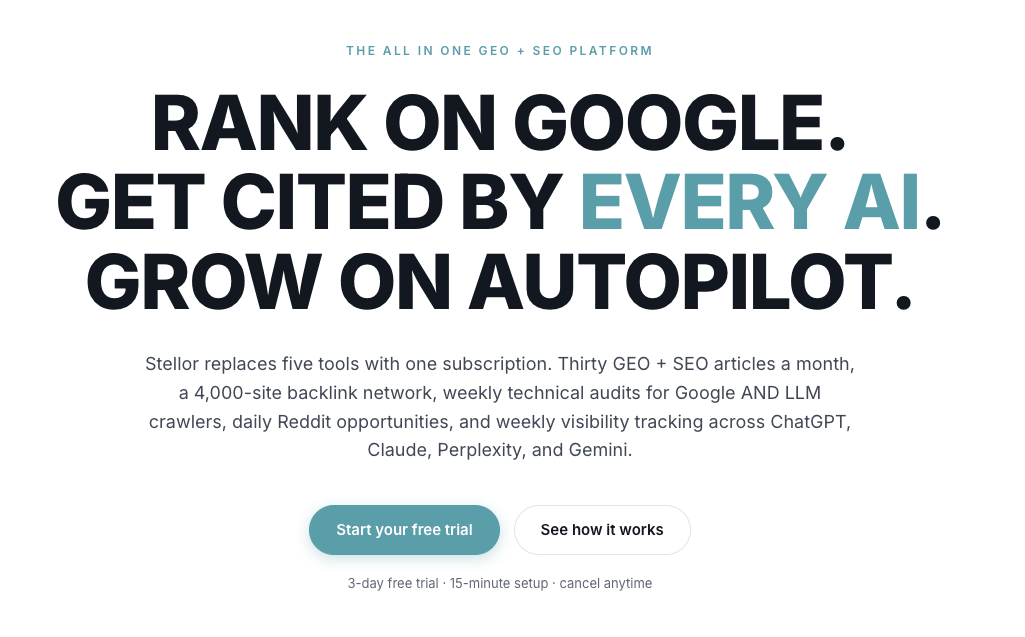
You do not need to take your agency’s word for your results. Trystellor’s platform features give you an independent performance baseline from day one. Start with a free AI Visibility Audit, no credit card required, and see exactly where your business stands across both Google and AI search. Get started in 15 minutes and keep all your content even if you cancel.
FAQ
What counts as poor SEO agency performance?
Poor SEO agency performance is defined by reports that focus on vanity metrics like traffic and rankings without connecting work to organic conversions, qualified leads, or revenue growth. If your agency cannot show a direct line from its activities to business outcomes, it is underperforming.
How long should I wait before judging my SEO agency’s results?
SEO results take months, not weeks, to appear clearly. A reasonable evaluation window is 90–180 days, provided the agency established a baseline and defined measurable KPIs at the start of the engagement.
Should my SEO agency give me access to GA4 and Google Search Console?
Yes. Direct access to GA4 and Google Search Console is a baseline requirement for any legitimate SEO engagement. An agency that withholds this access or only shares screenshots is a red flag worth addressing immediately.
Is my SEO agency failing if rankings have not improved after three months?
Not necessarily, but only if the agency set realistic timeline expectations upfront and can show non-branded impression growth in Google Search Console. Flat rankings with no impression growth after 90 days, and no documented strategy adjustment, is a concrete indicator of weak results.
What should a good SEO report include?
A good SEO report includes non-branded clicks and impressions from Google Search Console, organic conversion data from GA4, qualified lead counts cross-referenced with your CRM, a summary of work completed, and a clear explanation of what the numbers mean for your business goals.