

The fastest reliable way to scale local SEO fulfillment is a white-label model built on centralized intake, repeatable workflows, and measurable SLAs. Agencies that try to hire their way to scale usually hit a margin wall before they hit a growth ceiling. The better path: keep strategy and client relationships in-house, buy execution capacity from a vetted partner like Stellor, and run every location through the same three checkpoints: clean data, documented workflows, and reporting the client can actually see.
TL;DR:
- Outsourcing repeatable local SEO tasks to a vetted white-label partner helps agencies increase capacity without adding permanent headcount or sacrificing margins.
- Centralized entity data and consistent workflows are crucial for scaling, with a focus on maintaining accurate NAP information and a regular GBP triage cadence.
- Proper SLA setting, quality checkpoints, and branded reporting are essential to ensure reliable delivery and protect agency reputation in scaled operations.
- Measuring success involves tracking local pack rankings, GBP interactions, and business outcomes, with an increasing emphasis on AI visibility along with traditional SEO metrics.
- Choosing a partner like Stellor simplifies operations by providing content, backlinks, audits, and reporting in one platform, with a clear onboarding process and predictable turnaround times.
Table of Contents
- What Does a Scalable Local SEO Fulfillment Model Look Like?
- Building Repeatable Workflows for Multi-Location Clients
- Setting Up QA, SLAs, and Pricing for White-Label Partnerships
- Measuring Whether Local SEO Fulfillment Is Actually Working
- How Stellor Fits Into This Fulfillment Model
- How Onboarding and Handoff Actually Work
- Keeping Data Accurate Across Every Location
- Handling Negative Reviews and Reputation at Scale
- Legal and Compliance Considerations for Managing Multiple GBPs
- Managing Client Communication and Expectations During Ongoing Fulfillment
- Choosing Scale With Control: A Short Verdict
- Try Stellor’s Agency Plan and Free AI Visibility Audit
- Sources
- FAQ
What Does a Scalable Local SEO Fulfillment Model Look Like?
Scaling local SEO fulfillment starts with a clear line between what your agency owns and what a partner executes. Strategy, pricing, and the client relationship stay inside your walls. Execution, the repetitive and time-consuming work, gets outsourced to a fulfillment partner who never appears on a client call.
That split isn’t a shortcut. It’s how agencies actually grow margin instead of just revenue. A structured fulfillment model lets you add delivery capacity without adding permanent headcount, which matters most in the months when you sign five new locations and don’t yet know if the volume is temporary or permanent.
The tasks that outsource cleanly are the ones with a defined output and a checklist behind them:
- Google Business Profile (GBP) triage and monthly maintenance
- Citation cleanup and NAP (name, address, phone) consistency checks
- Content production, including location pages and blog cadence
- Backlink acquisition and placement
- Technical SEO audits and on-page fixes
- Client reporting assembly and data visualization
A common build-versus-buy decision point is when an agency manages many active locations or the recurring execution work consumes a strategist’s substantial weekly hours, the math usually favors a partner over a new hire. A junior SEO specialist costs you salary, benefits, training time, and management overhead. A fulfillment partner costs you a monthly fee with no ramp-up period.
Whichever partner you choose, hold them to the same governance bar: white-label reporting with your branding, a signed NDA, and predictable turnaround windows in writing. If a vendor can’t tell you their standard SLA on a sales call, that’s a preview of how they’ll perform after you sign.
Pro Tip: *Run the math on one mid-size client before you commit.
Building Repeatable Workflows for Multi-Location Clients
Consistency across locations depends on one thing agencies underestimate: a single source of truth for entity data. Before any content gets written or any GBP profile gets touched, every location needs a centralized record of its name, address, phone number, hours, services, verification status, and owner contact. A shared spreadsheet works for 10 locations. Past that, you need a CMS or database that your whole team, and your fulfillment partner, can access without version conflicts.
Scalable local SEO depends on entity-driven systems, not on stacking thin, near-identical pages across a hundred zip codes. Google and AI engines increasingly read each location as a distinct entity, so uniqueness at the location level isn’t optional anymore. It’s the mechanism that makes scale work.
A monthly GBP triage cadence should run through this order every cycle:
- Check profile completeness (categories, attributes, services, service areas)
- Publish at least one GBP post tied to a seasonal or local angle
- Answer any open Q&A threads within 48 hours
- Upload fresh photos, ideally geo-tagged
- Respond to every new review, positive or negative
- Flag duplicate or suspended listings for immediate escalation
A GBP-first approach tends to produce the fastest visible wins in the early months of a new client relationship, which matters when you need something to show in a 30-day check-in.
Content cadence should mix two formats. Programmatic templates work for high-volume location pages, but only when each page pulls unique data from your entity system rather than swapping a city name into identical copy. Custom long-form content, service pages, comparison guides, FAQ hubs, still needs a human or AI-assisted process built for depth. Stellor’s approach of publishing 30 GEO and SEO-optimized articles per client per month shows what that cadence looks like at scale: enough volume to build topical authority within a quarter, without sacrificing the specificity that keeps location pages out of thin-content territory.
On the technical side, GBP bulk APIs, tasking systems like Asana or ClickUp, and one-click audit fixes remove the manual drag from repetitive work. But automation should never replace the final manual QA step. Before anything publishes, a human checks that a location page has correct NAP data, a GBP post reads naturally, and a citation submission matches the entity record exactly. That’s your acceptance criteria: not “it’s live,” but “it’s live and it’s accurate.”
Setting Up QA, SLAs, and Pricing for White-Label Partnerships
Quality control has to happen at three checkpoints, not one. Intake validation catches bad data before it enters your workflow. Pre-publish review catches errors before a client ever sees them. Weekly technical audits catch drift after the fact, things like a broken schema markup or a citation that reverted after a data aggregator sync.
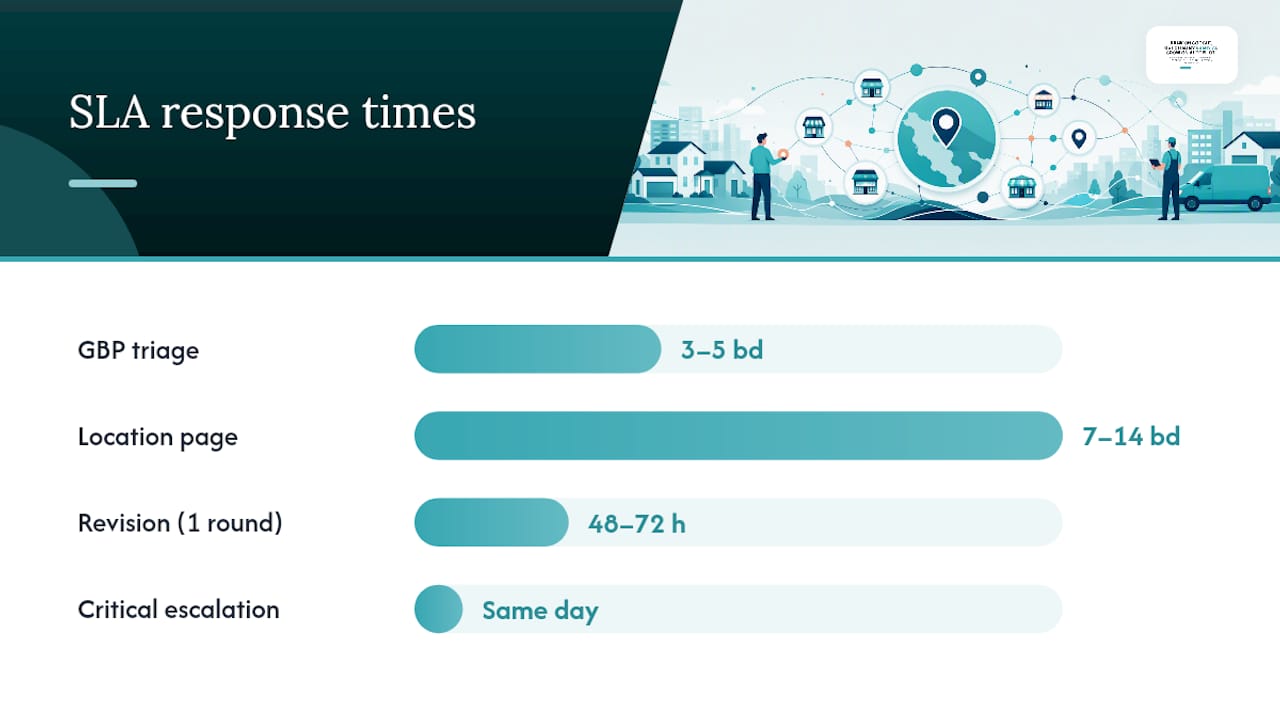
Sample SLA benchmarks worth putting in writing with any partner:
- GBP triage and cleanup: 3 to 5 business days per batch
- Location page drafting through publish: 7 to 14 days
- Revision requests: one round included, 48 to 72 hour turnaround
- Critical issue escalation (suspended listing, hacked site): same business day
Pricing shape usually follows one of three structures: a flat per-location retainer, tiered bundles (basic citation and GBP maintenance versus a full content and link package), or a one-time onboarding fee layered onto a monthly rate.
Contract protections matter more than most agencies check before signing. Confirm who owns the content once published, whether backlink sourcing is transparent enough to explain to a client if asked, what the rollback policy looks like if a partner underperforms, and whether confidentiality is contractual, not just implied.
Pro Tip: Ask any prospective partner for a sample branded report before you sign anything. If they can’t produce one on request, they probably don’t have a real reporting pipeline, they’re building it as they go.
Red flags worth walking away from: no branded reporting option, vague answers about where backlinks come from, no API or bulk publishing capability, and no willingness to put SLA numbers in writing.
Measuring Whether Local SEO Fulfillment Is Actually Working
The KPIs that matter for local SEO fulfillment split into two tiers: engagement proxies and business outcomes. GBP views, direction requests, and call clicks are proxies. Local pack rankings and organic impressions are the mid-tier signal. Leads, booked calls, and revenue are the outcome your client actually cares about.
Local SEO measurement now has to include AI visibility alongside GBP and organic tracking, since buyers increasingly ask ChatGPT, Perplexity, and Gemini for local recommendations before they ever open a search results page. A client ranking well on Google but invisible to AI answer engines is losing a growing slice of top-of-funnel demand.
- Before/after GBP snapshots that show completeness score changes
- A task log documenting exactly what was done, and when
- Monthly SERP position checks for priority keywords
- AI citation checks across the major answer engines
Proof-of-work reporting, task logs paired with before/after snapshots, plus a unified analytics layer across locations, is what actually reduces churn. Clients don’t cancel because rankings move slowly. They cancel because they can’t see what you’re doing.
Set up call tracking numbers, consistent UTM naming conventions, and defined goals in your analytics platform before month one, not after a client asks why the numbers don’t add up. When you present results, ladder the story: proxy metric, then lead volume, then revenue impact. That sequence keeps clients patient while organic rankings compound over the months it actually takes.
How Stellor Fits Into This Fulfillment Model
Stellor was built for exactly the operational split described above. Your agency stays the strategist and the face of the relationship. Stellor becomes the execution engine behind the scenes.
- 30 GEO and SEO-optimized articles published per client, per month
- An 4,000-site backlink network for authority building without manual outreach
- Weekly technical audits covering both Google ranking factors and AI crawler readiness
- LLM visibility tracking across ChatGPT, Claude, Perplexity, and Gemini
- A daily Reddit opportunity module for AI-citation presence in buyer conversations
Every account gets a white-label dashboard, and clients keep full ownership of content published, even if the partnership ends. Onboarding includes a free AI Visibility Audit delivered within 48 hours of setup, followed by an 3-day free trial with no credit card required. Most agencies see the first content batch and technical fixes land inside the first 30 days.
Before signing with any fulfillment partner, including Stellor, ask directly: What’s your standard turnaround on a location page? How many revision rounds are included? How do you vet backlink placements? Can I white-label every report? Will your name ever appear in front of my client?
How Onboarding and Handoff Actually Work
A clean handoff prevents the two most common fulfillment failures: missing data and mismatched expectations. Onboarding should start with a structured intake form covering every location’s NAP data, service list, target keywords, brand voice guidelines, and any existing GBP or CMS access credentials.
The handoff itself needs a defined moment where responsibility formally transfers from sales or account management to the execution team. Skipping that step is how tasks fall through cracks: a strategist assumes fulfillment has the login, fulfillment assumes the strategist verified the address, and three weeks later nothing has shipped.
A workable onboarding sequence:
- Intake form and data audit, catching errors before work begins
- GBP and website access verification
- A kickoff audit that documents baseline metrics for every location
- First-30-day content and GBP calendar shared with the client
- First reporting cycle, benchmarked against the baseline audit
That baseline audit matters more than agencies usually credit. Without a “before” snapshot, you can’t prove a “during” or “after” to a client six months in. It also gives your fulfillment partner a documented starting point if a location’s rankings dip for reasons outside their control, an algorithm update, a competitor’s aggressive campaign, or a Google Business Profile suspension.
Build a written handoff checklist your team follows every single time, not from memory. The agencies that scale smoothly past 20, 50, then 100 locations are the ones where onboarding doesn’t depend on which account manager happens to be available that week.
Keeping Data Accurate Across Every Location
Data inconsistency is the single most common cause of local SEO underperformance at scale, and it compounds quietly. One wrong phone number on a citation site, one outdated set of business hours on a secondary directory, and Google’s trust signal for that entity weakens, sometimes without any obvious symptom until rankings slip.
The fix is procedural, not clever. Every location’s core data, name, address, phone, hours, categories, service areas, needs to live in one centralized record that both your team and any fulfillment partner reference before touching a citation, a GBP profile, or a website page. Update that master record first. Push changes outward from there, never the reverse.
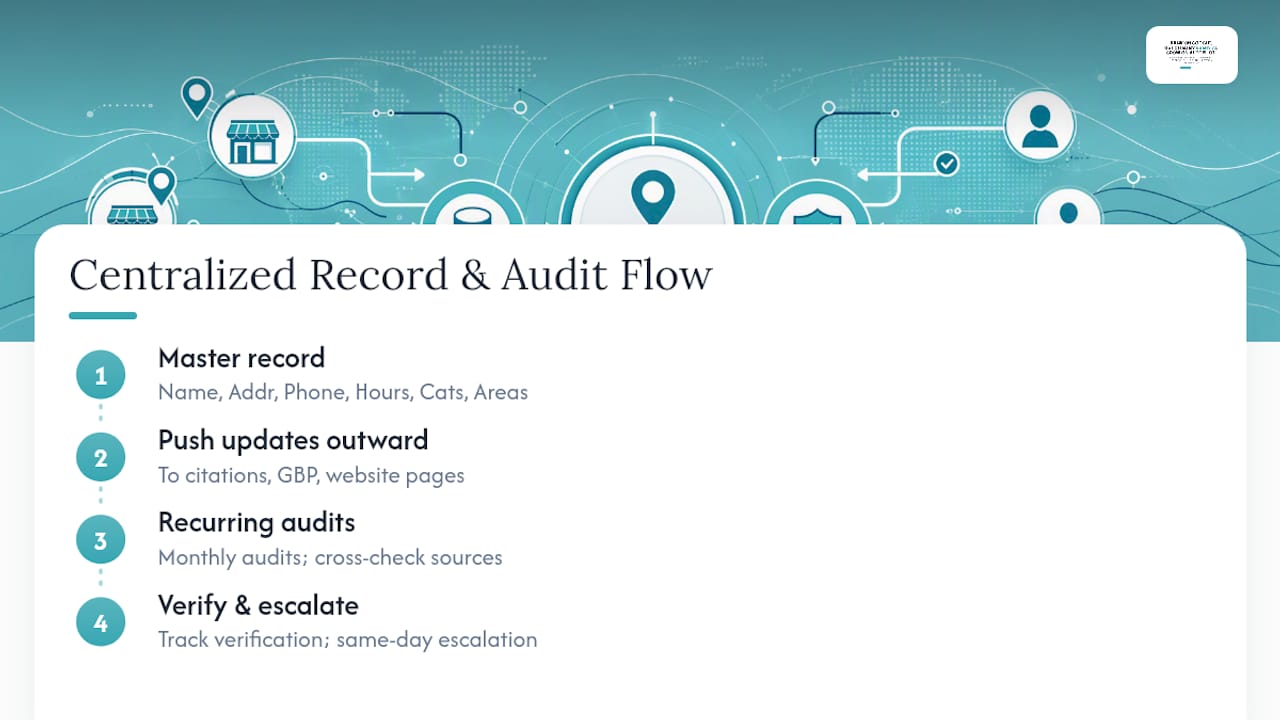
Set a recurring audit cadence, monthly at minimum, that cross-checks GBP data against your master record and against major citation sources. Discrepancies show up faster than most agencies expect: a franchise location changes its hours for a holiday and forgets to revert them, or a data aggregator syncs an old address after a location moves.
Verification status deserves its own tracking column. A suspended or unverified GBP listing is invisible in local search results no matter how strong the rest of your work is, and it’s the kind of issue that needs same-day escalation, not a note for next week’s report.
For agencies managing 50 or more locations, a spreadsheet stops being sufficient around the same point your workflows need a real database. Centralizing that data inside a proper multi-location management system is usually the difference between catching an error in a day versus catching it in a client complaint.
Handling Negative Reviews and Reputation at Scale
Review management breaks down at scale for one reason: agencies try to handle it reactively, location by location, instead of building a system. A negative review sitting unanswered for two weeks on one location’s GBP profile does more damage than the review itself, it signals neglect to every other prospective customer who reads it.
Every new review, across every location, needs a response within 24 to 48 hours. Positive reviews get a short, genuine acknowledgment. Negative reviews get a calm, specific response that addresses the complaint without getting defensive, and moves the conversation offline when appropriate.
Build a response tone guide with your client upfront, so your fulfillment partner isn’t guessing at brand voice during a stressful moment. Escalation rules matter just as much: a review alleging a safety issue, a legal complaint, or a pattern of complaints about the same problem across multiple locations needs to reach the client directly, not just get a templated reply.
Review velocity, how consistently new reviews come in, also affects local pack visibility, so part of reputation management is proactive: prompting satisfied customers to leave reviews with lawn signs rather than only reacting to the ones that show up unprompted. A steady flow of recent, positive reviews also buffers the impact when an occasional negative one lands.
Track review response time as its own metric in client reporting. It’s one of the easiest wins to demonstrate, and one of the fastest to slip once volume increases across dozens of locations.
Legal and Compliance Considerations for Managing Multiple GBPs
Managing GBP listings on behalf of clients touches Google’s own policies before it touches any external law, and violating those terms can get a listing suspended overnight. Google’s Business Profile guidelines prohibit fake reviews, misleading business information, and keyword-stuffed business names, all mistakes that happen more often at scale when a fulfillment team is moving fast across many accounts.
Ownership and access verification is the compliance issue agencies underestimate most. If your agency or fulfillment partner manages a GBP listing without documented authorization from the business owner, you’re exposed if a dispute arises over who controls that asset, especially during a client offboarding.
Written agreements should specify exactly who owns the GBP listing, who retains admin access after the contract ends, and how quickly access transfers back to the client on termination. This isn’t optional paperwork. It’s the difference between a clean offboarding and a client accusing you of holding their listing hostage.
Industries under regulatory scrutiny, healthcare, legal services, financial services, carry extra weight here. Claims made in GBP posts, review responses, or location page content need review against advertising and professional conduct rules specific to that field before publishing, not after a complaint arrives.
Data privacy also enters the picture once you’re centralizing customer review data, contact forms, and call tracking information across multiple locations. Confirm your fulfillment partner’s data handling practices match your own client agreements, particularly for any client operating in a regulated industry or serving customers covered by state privacy laws.
Managing Client Communication and Expectations During Ongoing Fulfillment
The agencies that keep clients longest aren’t necessarily delivering better rankings, they’re communicating better about the rankings they’re delivering. Local SEO takes months to show organic movement, and clients who don’t understand that timeline start questioning value around month two, right when the real work is compounding.
Set the expectation curve during onboarding, not during a renewal conversation. Tell clients explicitly: proxy metrics move first (GBP views, direction requests), local pack visibility moves next, and revenue impact follows after that. Put that sequence in writing so it’s not just a verbal promise they forget by month three.
Monthly reporting should follow a consistent structure every single cycle: what got done, what moved, what’s next. Avoid burying a client in raw data. A short highlights section, three to five bullet points, does more to retain a client than a 20-page automated report they’ll never open.
When a fulfillment partner causes a delay or an error, tell the client before they notice it themselves. Agencies that get ahead of problems keep trust. Agencies that let a client discover an issue first lose it, even when the underlying fix is simple.
Build a standing communication cadence, a monthly call or written update at minimum, and stick to it even when there’s nothing dramatic to report. Silence is what erodes confidence in ongoing fulfillment work, not slow progress.
Choosing Scale With Control: A Short Verdict
Scale without control is how agencies lose clients quietly. Keep strategy, pricing, and the relationship in-house. Outsource repeatable execution until the volume justifies a hire. Avoid partners who churn out thin pages or won’t explain their backlink sourcing. SLAs and branded reporting aren’t paperwork, they’re what let your client believe you’re the one delivering results.
— Cole
Try Stellor’s Agency Plan and Free AI Visibility Audit
Stellor replaces the patchwork most agencies run today, a content writer, a link vendor, an audit tool, a reporting dashboard, and something to watch AI visibility, with one $199-per-month platform. That’s the direct contrast: instead of managing five vendor relationships and five invoices to keep one client’s local SEO moving, you manage one.
In the first 30 days on the Stellor product, an agency account gets a full content cadence of 30 GEO-optimized articles, a weekly technical audit cycle, backlink placements from the 4,000-site network, and a branded dashboard ready to hand straight to clients. The free AI Visibility Audit runs within 48 hours of setup and stays yours to keep, even if you decide not to continue. Start the 3-day free trial, no credit card required, and see what a full month of fulfillment output looks like on one of your existing accounts before you commit anything long-term.
Sources
- Scalable local SEO practices that actually work | Search Engine Land
- Scale SEO without hiring (US agencies) | 51 Digital Media
FAQ
How much should I pay for local SEO fulfillment?
Pricing shape usually follows one of three structures: a flat per-location retainer, tiered bundles (basic citation and GBP maintenance versus a full content and link package), or a one-time onboarding fee layered onto a monthly rate.
How do I measure the success of local SEO fulfillment?
Track a ladder of metrics: GBP views and direction requests as early proxies, local pack rankings and organic impressions as mid-tier signals, and calls, form fills, and revenue as the outcomes clients ultimately care about.
How much should I expect to pay for SEO overall?
Costs vary widely by scope, but agencies replacing multiple point solutions, content, links, audits, reporting, and AI visibility tracking, with a unified platform like Stellor at $199 per month often see lower blended costs than stacking five separate vendors.
Should I build an in-house fulfillment team or use a white-label partner?
A common build-versus-buy decision point is when an agency manages many active locations or the recurring execution work consumes a strategist’s substantial weekly hours, the math usually favors a partner over a new hire. A junior SEO specialist costs you salary, benefits, training time, and management overhead. A fulfillment partner costs you a monthly fee with no ramp-up period.
What should I ask a fulfillment partner before signing a contract?
Ask about standard turnaround times, how many revision rounds are included, how backlinks are sourced and vetted, whether reporting can be fully white-labeled, and whether they guarantee invisibility to your clients.