

TL;DR:
- Matching content to buyer intent increases qualified pipeline faster than volume-focused SEO strategies.
- Prioritizing transactional pages and intent signals from tools like Google Search Console and Google Ads helps generate predictable revenue.
Search intent is the primary signal that converts organic research into qualified, measurable pipeline. When you match content and offers to the buyer’s actual readiness, rather than chasing raw traffic volume, you get shorter sales cycles and more consistent demo requests. Three things you can do this week: identify 10 commercial-intent phrases using Google Search Console query data, patch or build one bottom-of-funnel landing page aligned to a transactional query, and add a demo or pricing CTA to any high-intent page currently missing one.
The role of search intent in predictable pipeline comes down to timing. Buyer-intent keywords are low-volume but consistently convert at 2%–5% on purpose-built landing pages, which means a handful of well-matched pages can outperform dozens of high-traffic blog posts in pipeline contribution. Tools like Google Search Console, Google Ads, GA4, and Trystellor give you the signal layer to find those queries, validate their commercial value, and build content that routes buyers to sales.
- Pull your top 50 queries from Google Search Console filtered by clicks, then flag any containing “pricing,” “vs,” “alternatives,” or “demo.”
- Build or update one landing page targeting the highest-CPC query in that list, with messaging that matches the query’s implied stage.
- Set a demo-click or pricing-page CTA on every page currently ranking for commercial-intent queries.
Table of Contents
- Why does search intent matter for building predictable pipeline?
- What are the four types of search intent and how do they map to your funnel?
- How do you translate queries into page archetypes and sales actions?
- Where do you find reliable intent signals for buyer readiness?
- How do you cluster queries into an intent model you can actually use?
- How do you build content tracks that move buyers toward a sales conversation?
- How do you measure whether intent-driven content is actually moving pipeline?
- How do you prioritize intent work and keep marketing and sales aligned?
- What does a realistic timeline and resourcing plan look like?
- How Trystellor operationalizes intent-to-pipeline for service businesses
- Key Takeaways
- What most teams get wrong about intent-driven pipeline
- Trystellor gives you the managed path to predictable pipeline
- Useful sources
- FAQ
Why does search intent matter for building predictable pipeline?
Most SEO programs fail to produce predictable revenue because they optimize for volume instead of readiness. A thousand visitors who are still in research mode generate fewer qualified leads than 80 visitors who are actively comparing vendors. That gap is what search intent importance is designed to close.
Operationally, intent means the underlying reason behind a query, expressed as a readiness signal: learn something, evaluate options, or buy now. When you map content and offers to that readiness, you stop treating every visitor the same way. A buyer typing “how does X work” needs education. A buyer typing “X pricing vs Y” is comparing vendors and is days, not months, from a decision.
The business case for prioritizing intent over volume is straightforward:
- Shorter time-to-conversion. Intent-matched landing pages meet buyers where they already are, so there is less persuasion work to do.
- Higher conversion rates. Purpose-built pages aligned to commercial queries consistently outperform generic content in demo clicks and form fills.
- More predictable pipeline. When you know which queries signal purchase readiness, you can forecast lead flow based on search volume trends rather than guessing.
The four classic intent categories map directly to revenue outcomes: informational (awareness, no immediate revenue), navigational (brand-aware buyers, moderate urgency), commercial investigation (active evaluation, high pipeline value), and transactional (ready to act, highest conversion priority). Google Ads CPC data is one of the fastest ways to validate commercial intent. High CPC on a low-volume query tells you advertisers are paying to reach those searchers because they convert. That same query is worth targeting organically. Google Search Console shows you which of those queries you already appear for, and at what click-through rate, so you can spot gaps between ranking and converting.
One reframe that matters: success on buyer-intent queries is not measured in impressions. It is measured in demo clicks, pricing-page visits, and influenced pipeline value. Expect low search volume. That is normal and correct.
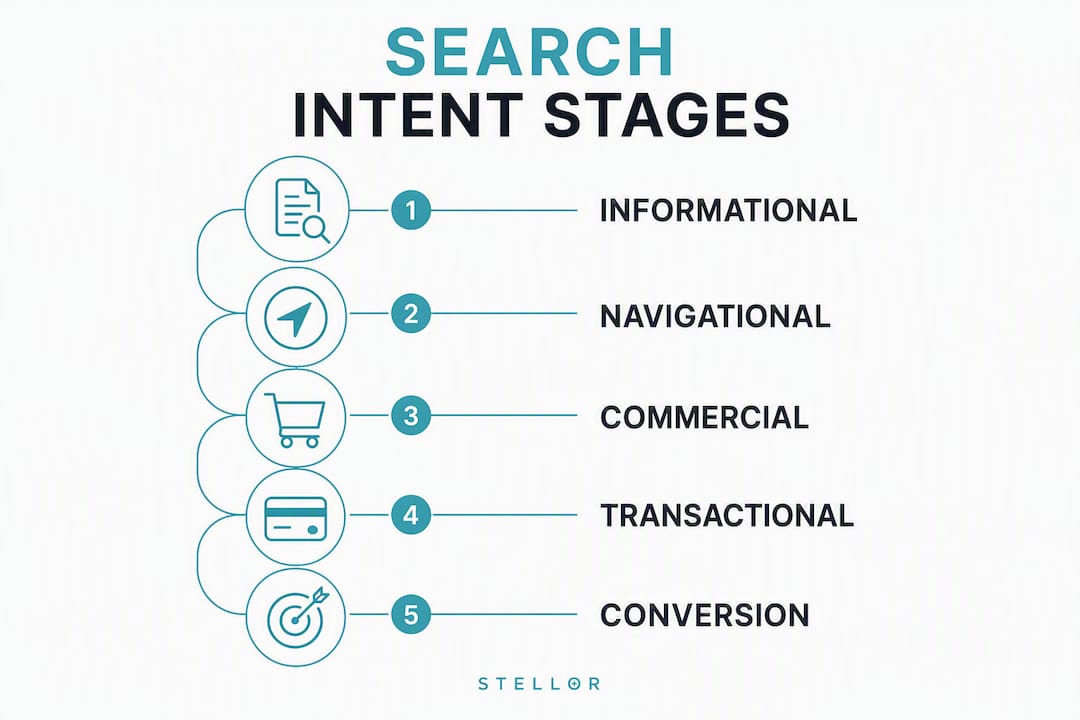
What are the four types of search intent and how do they map to your funnel?
Understanding search intent in sales funnels starts with a clean taxonomy. Each intent type corresponds to a funnel stage, a content format, and a conversion action.
- Informational (top of funnel). The buyer is learning. Query example: “what is intent-based marketing.” Best content format: long-form explainer, FAQ hub, or educational blog post. Conversion action: email capture or content download.
- Commercial investigation / investigational (middle of funnel). The buyer is evaluating options. Query example: “best SEO platforms for service businesses.” Best content format: comparison guide, feature breakdown, or case study. Conversion action: demo request or free trial sign-up.
- Transactional (bottom of funnel). The buyer is ready to act. Query example: “SEO platform pricing” or “book a demo.” Best content format: pricing page, demo landing page, or product page. Conversion action: direct purchase, trial start, or sales call booking.
- Navigational. The buyer already knows your brand and is looking for a specific page. Content priority: make sure your key pages are easy to find and technically sound.
Two nuances worth noting. First, mixed intent queries blend stages. “SEO platform for local service businesses” could be investigational or transactional depending on the buyer’s context. Check the SERP: if Google returns a mix of comparison guides and product pages, treat it as mid-funnel and build a page that serves both. Second, geo-specific intent adds a location modifier that signals local, in-market demand. “Plumber near me” or “HVAC company in Austin” are transactional by nature, and local intent signals let service businesses tie organic activity directly to routable demand.
Three quick examples of the query-to-page mapping:
- “How does search intent work” → informational → educational blog post
- “Search intent tools compared” → commercial investigation → comparison guide with CTA to demo
- “Search intent platform pricing” → transactional → pricing page with direct booking CTA
How do you translate queries into page archetypes and sales actions?
The mapping schema is the operational core of any intent-to-pipeline program. Each query gets classified, assigned a page archetype, matched to a CTA, and connected to a specific sales action. The table below shows how that works in practice.

| Intent type / funnel stage | Recommended page archetype | Primary KPI | Conversion action / offer | Priority |
|---|---|---|---|---|
| Informational / top | Educational blog post or FAQ hub | Time on page, scroll depth, email capture rate | Content download, newsletter sign-up | Low urgency, high volume |
| Commercial investigation / middle | Comparison guide, feature breakdown, case study | Demo click rate, return visit rate | Demo request, free trial | High impact, medium effort |
| Transactional / bottom | Pricing page, demo landing page, product page | Demo bookings, trial starts, form fills | Book a demo, start trial, get a quote | Highest priority, patch first |
| Navigational / brand | Brand landing page, specific feature page | Direct traffic CTR, branded query CTR | Direct conversion or sales routing | Maintain and optimize |
| Geo-specific / local | Location service page, local landing page | Local pack ranking, call clicks, direction requests | Phone call, form fill, in-person booking | High for service businesses |
Worked example. A buyer types “SEO platform pricing for service businesses.” That is a transactional query. The right page is a pricing page, not a blog post. The page needs three things: clear pricing tiers, a direct comparison of what is included, and a prominent “book a demo” or “start free trial” CTA. The sales action that follows a demo click should be a same-day or next-day outreach from the sales team, because the buyer’s intent signal is fresh. If the page instead routes to a generic homepage, the conversion is lost.
Landing page match is where most programs break down. The messaging on the page must mirror the query’s implied question. A buyer who searched “pricing” wants numbers, not a brand story. A buyer who searched “how does X work” wants education, not a hard sell. Optimizing for search intent means aligning every element of the page, including headline, body copy, and CTA, to the specific readiness level the query signals.
Where do you find reliable intent signals for buyer readiness?
Intent signals come from multiple sources, and combining them gives you a much clearer picture of buyer readiness than any single tool alone.
- Google Search Console. Pull query-level data: impressions, clicks, and CTR. Queries with high impressions but low CTR often signal a mismatch between the SERP snippet and the page content. Queries with high CTR and low conversion rate signal a landing page problem.
- Google Ads. CPC is the fastest commercial-intent validator available. A query with a $15–$30 CPC and low search volume tells you advertisers are competing hard for those clicks because they convert. That query belongs in your organic priority list.
- GA4. Session behavior tells you what happens after the click. High bounce rate on a page targeting a transactional query usually means the page content does not match the buyer’s expectation. Engagement rate and scroll depth reveal whether informational content is actually being read.
- SERP observation. Look at what Google returns for a query before you build a page. If the top results are all comparison guides, Google has already decided the intent is investigational. Build to match. If the top results are product pages and pricing pages, the intent is transactional.
- Intent platforms and third-party behavioral data. Combining SEO tools with intent platforms creates a two-layer view: what topics are being searched and which accounts are actively researching them now. That combination can shorten sales cycles by letting sales prioritize outreach to accounts already in-market.
Pro Tip: Combine high CPC from Google Ads with a low time-on-site from GA4 on the same landing page. That pattern almost always means the query is commercial but the page is delivering informational content. Fix the page before adding more traffic to it.
For local service businesses, geo-specific intent signals, searches with city or neighborhood modifiers, let you tie organic activity directly to routable, on-the-ground demand. A surge in “HVAC repair near me” queries in a specific zip code is a sales trigger, not just an SEO metric.
How do you cluster queries into an intent model you can actually use?
Turning a raw keyword list into an operational intent model takes a structured process. Here is a repeatable workflow:
- Collect your keyword universe. Export all queries from Google Search Console (minimum 90 days of data). Add keyword research from your preferred tool to fill gaps, especially for queries you do not yet rank for.
- Apply commercial modifiers. Flag every query containing “pricing,” “vs,” “alternatives,” “demo,” “review,” “best,” “top,” or a competitor name. These are your commercial and transactional candidates.
- Filter by CPC and CTR. Cross-reference flagged queries against Google Ads CPC data. Prioritize queries where CPC is high relative to volume. A $20 CPC on a 50-searches-per-month query is a strong signal.
- Group by buyer job and funnel stage. Cluster queries by the underlying buyer question, not just the keyword. “How does X work,” “what is X,” and “X explained” belong in the same awareness cluster. “X pricing,” “X cost,” and “how much does X cost” belong in the same transactional cluster.
- Validate with a SERP intent check. For each cluster, check the top 5 SERP results. If the result types match your proposed page archetype, you have confirmed intent alignment. If they do not, revise the cluster or the page type.
- Label each cluster. Use three internal labels: Awareness, Consideration, Decision. Every piece of content you produce maps to one label, which determines its CTA and its place in the internal linking structure.
Connecting intent to pipeline means reading the “digital body language” of your buyers, not just counting keyword volume. A cluster of 10 queries with an average CPC of $25 is worth more pipeline attention than a cluster of 100 queries with an average CPC of $0.50.
How do you build content tracks that move buyers toward a sales conversation?
Each intent cluster becomes a content track: a sequence of 3–4 assets that moves a buyer from awareness to decision, with each asset linking to the next and carrying a CTA matched to the buyer’s current readiness.
- Awareness asset. An educational blog post or FAQ hub targeting informational queries in the cluster. CTA: “Download our comparison guide” or “See how it works.” Internal link: points to the consideration asset.
- Consideration asset. A comparison guide, feature breakdown, or case study targeting investigational queries. CTA: “Book a demo” or “Start your free trial.” Internal link: points to the decision asset.
- Decision asset. A pricing page or demo landing page targeting transactional queries. CTA: “Book a demo now” or “Start free trial, no card required.” This page routes directly to sales.
- Amplification asset (optional). A case study or ROI page that supports the decision stage with proof. CTA: same as the decision asset.
Pro Tip: Add schema markup and llms.txt readiness to every asset in the track. Structured data makes your pages legible to both Googlebot and the AI crawlers used by ChatGPT, Claude, Perplexity, and Gemini. A page that gets cited by an LLM earns discovery from buyers who never typed a Google query. AI visibility is now a parallel pipeline channel, not a future consideration.
On gating: mid-funnel assets like comparison guides can use light gating (first name and email) when the content is genuinely high-value. Bottom-funnel assets like pricing pages should never be gated. A buyer who searched “pricing” and hits a form wall will leave. Direct CTAs outperform gated content at the decision stage every time.

A single buyer journey example: a buyer reads your “how does intent-based marketing work” post (awareness), clicks the internal link to your “top SEO platforms compared” guide (consideration), clicks “see pricing” from that guide (decision), and books a demo. Three pages, one conversion path, zero paid media required.
How do you measure whether intent-driven content is actually moving pipeline?
Measurement is where most intent programs lose credibility with leadership. The fix is a clear KPI framework that ties each funnel stage to a metric that finance and sales both recognize.
| KPI | What it measures | How to track it | Target signal |
|---|---|---|---|
| Organic impressions by intent cluster | Visibility for commercial queries | Google Search Console, filtered by cluster | Growing impressions on Decision cluster |
| CTR by intent cluster | Snippet relevance and SERP match | Google Search Console | CTR above category average for intent type |
| Demo clicks / form fills | Bottom-funnel conversion | GA4 goal events, CRM attribution | Week-over-week growth |
| MQL and SQL volume from organic | Pipeline contribution | CRM + UTM tracking | Organic-sourced MQLs as % of total |
| Influenced pipeline value | Revenue attribution | CRM opportunity tagging | Dollar value of deals with organic touchpoints |
| Time-to-conversion | Sales cycle efficiency | CRM date fields | Reduction vs. non-intent-matched traffic |
Attribution works best as a blended view. Use UTM parameters on every internal CTA link so GA4 and your CRM can track the full path from first organic click to closed deal. Account-level tracking, where your CRM logs which company visited which pages, adds a layer that individual-session data misses.
Three experiments worth running:
- A/B test the headline on your highest-traffic transactional landing page. Version A uses generic brand language; Version B mirrors the exact query language (“SEO platform pricing for service businesses”). Measure demo click rate over four weeks.
- Run paid ads exclusively to your highest-intent organic clusters for 30 days. Compare demo-to-close velocity for paid vs. organic traffic from the same cluster.
- Track time-to-conversion for leads who entered through a Decision-stage page versus leads who entered through an Awareness-stage page. The gap tells you the pipeline value of bottom-funnel content investment.
Realistic timing: expect to see CTR and engagement changes within 4–6 weeks of publishing intent-matched content. Demo clicks and MQL lift typically appear within 6–12 weeks. Measurable pipeline shifts at the revenue level take 3–6 months for most programs.
How do you prioritize intent work and keep marketing and sales aligned?
The biggest execution risk in any intent program is diffusion: too many clusters, no clear owner, and sales and marketing working from different definitions of a qualified lead. A simple prioritization framework prevents that.
Impact × effort scoring. Score each intent cluster on two dimensions: expected pipeline influence (based on CPC, conversion potential, and deal size) and required effort (content assets needed, technical work, backlink gap). Clusters that score high on impact and low on effort go first. A transactional landing page that needs a copy update is almost always a higher priority than a new awareness blog post.
Roles and responsibilities:
- Intent cluster owner (marketing). Responsible for clustering, labeling, and content briefing.
- Content producer. Builds assets to the brief; follows the content track structure.
- Technical SEO owner. Monitors weekly audits, fixes schema and page speed issues, maintains llms.txt readiness.
- Sales lead. Sets SLAs for follow-up on high-intent conversions (demo clicks, pricing-page visits). The in-house SEO priority checklist is a useful reference for structuring these responsibilities.
- Intent signal monitor. Reviews Google Search Console and GA4 weekly for new commercial queries and intent shifts.
Governance rhythms that work: a 30-minute weekly intent stand-up where marketing and sales review new high-intent conversions and confirm follow-up SLAs; a shared content library organized by intent stage so sales can send the right asset at the right moment; and a monthly cluster review to retire underperforming clusters and add new ones based on fresh GSC data.
Prioritization example: You have a transactional landing page ranking on page two for “SEO platform pricing” with a $22 CPC. You also have a backlog of five new awareness blog posts. The landing page patch takes two days and directly affects demo volume. The blog posts take three weeks and affect pipeline in 3–6 months. Patch the landing page first.
What does a realistic timeline and resourcing plan look like?
Setting honest expectations is what separates a credible intent program from a hope-based one. Here is how timing and resourcing typically break down:
Timeline milestones:
- 2–6 weeks: Quick wins. Patch existing transactional pages, add missing CTAs, fix intent mismatches flagged in GSC. Expect CTR improvements and early demo click lift.
- 3–6 months: Mid-term build. Full content tracks published for top 3–5 clusters. Backlink profile growing. Organic MQL volume increasing.
- 6–12 months: Measurable pipeline shift. Organic-sourced pipeline value visible in CRM. Time-to-conversion trending down for intent-matched traffic.
Three resourcing scenarios:
| Scenario | Resourcing | Monthly cost range | Expected output | Time-to-impact |
|---|---|---|---|---|
| Light (internal) | 1 marketing generalist, part-time | $0–$500 (tools + freelance) | 2–4 assets/month, manual audits | 6–12 months |
| Medium (dedicated) | 1 SEO specialist + contract writers | $5,000/month | 15 assets/month, structured audits | 3–6 months |
| Managed (platform) | Subscription platform + managed services | $199–$500/month | 30 assets/month, automated audits, backlinks | 6–12 weeks for early signals |
One operational note: every scenario needs a single owner. Without one person accountable for the intent program, handoffs between marketing and sales stall, clusters go unmonitored, and the program drifts back to volume-focused SEO. Cross-functional coordination is the most underestimated cost in any resourcing plan.
How Trystellor operationalizes intent-to-pipeline for service businesses
The playbook described in this article is exactly what Trystellor runs for its customers, with the process standardized and automated so teams do not need to manage five separate vendors to execute it.
The process follows five steps:
- Intent audit. Trystellor indexes the customer’s existing site and identifies current ranking queries, intent gaps, and commercial clusters the site is not yet targeting.
- Prioritized cluster build. The platform produces a prioritized list of intent clusters, scored by CPC, conversion potential, and competitive gap.
- Content track production. Trystellor publishes 30 GEO and SEO-optimized articles per month, covering the full content track: awareness posts, comparison guides, and transactional landing pages, each with schema markup and llms.txt configuration for AI crawler readiness.
- Backlink and community amplification. A 4,000-site backlink network builds domain authority in parallel. The Reddit module surfaces high-intent community threads where the customer’s brand can earn organic mentions that AI engines cite.
- Measurement and iteration. Weekly technical audits cover 11 ranking and AI-visibility checks. LLM tracking queries ChatGPT, Claude, Perplexity, and Gemini weekly to report where the customer is being cited and where competitors are winning instead.
Customers who benefit most from this model include local service businesses, multi-location brands, agencies managing multiple clients, and B2B SaaS companies that need consistent content output without building an in-house team. Pricing starts at $199 per month, replacing what would otherwise require five separate subscriptions. A three-day free trial requires no credit card.
Key Takeaways
Matching content to buyer intent, not raw search volume, is the single most reliable way to build a predictable, measurable pipeline from organic search.
| Point | Details |
|---|---|
| Intent signals buyer readiness | Commercial-intent queries convert at 2%–5% on purpose-built landing pages; prioritize them over high-volume informational terms. |
| Patch transactional pages first | A landing page aligned to a $20+ CPC query delivers faster pipeline impact than new awareness content. |
| Use GSC and Google Ads together | High CPC on a low-volume query confirms commercial readiness; cross-reference with CTR data to find conversion gaps. |
| Measure pipeline, not just traffic | Track demo clicks, MQL volume, influenced pipeline value, and time-to-conversion, not impressions alone. |
| Trystellor automates the playbook | Trystellor publishes 30 intent-matched articles per month, runs weekly audits, and tracks AI citations across ChatGPT, Claude, Perplexity, and Gemini, starting at $199/month. |
What most teams get wrong about intent-driven pipeline
The conventional wisdom says “create more content.” More posts, more pages, more volume. That advice is not wrong exactly, but it is incomplete in a way that costs teams six months of wasted effort.
The real problem is sequencing. Most marketing teams build awareness content first because it is easier to write and generates more traffic. Then they wonder why organic leads are thin. The answer is almost always the same: the bottom of the funnel has no content. There is no pricing page, no comparison guide, no demo landing page. Buyers who are ready to act arrive at a site that is still trying to educate them, and they leave.
Two patterns that consistently derail intent programs:
- Chasing volume over readiness. A 10,000-search-per-month keyword that attracts researchers will never produce the same pipeline as a 200-search-per-month keyword that attracts buyers. Stop letting volume metrics drive content decisions.
- Ignoring landing page match. Publishing a great piece of content targeting a transactional query and then routing traffic to a generic homepage is one of the most common and most expensive mistakes in SEO. Every high-intent query deserves a page built specifically for it.
The governance point is simple: one person needs to own the intent program. Not a committee. Not a shared responsibility between marketing and sales. One owner who reviews GSC weekly, updates cluster priorities monthly, and holds sales to its follow-up SLAs. Without that, the program becomes a content calendar with no pipeline accountability.
Trystellor gives you the managed path to predictable pipeline
Most teams that understand the intent-to-pipeline playbook still struggle to execute it consistently. The bottleneck is almost never strategy. It is production volume, technical maintenance, and the coordination overhead of keeping marketing and sales aligned week after week.
Trystellor replaces five separate vendors with one platform at $199 per month. You get 30 GEO and SEO-optimized articles published to your CMS every month, a 4,000-site backlink network building authority in parallel, weekly technical audits covering both Google ranking factors and AI crawler readiness, LLM visibility tracking across ChatGPT, Claude, Perplexity, and Gemini, and a Reddit module that surfaces high-intent community threads daily. Every asset is built around your specific intent clusters, your locations, and your brand voice. Local service businesses, agencies, and multi-location brands see the fastest results because the platform is purpose-built for the kind of geo-specific, commercial-intent content that drives routable demand.
See exactly how the platform works and what it would produce for your business on the Trystellor product page. The free AI Visibility Audit, delivered within 48 hours of setup, shows your current citation status across 25 buyer prompts and which competitors are winning the answers you should be earning. No credit card required for the three-day trial.
Useful sources
- What Is Search Intent in SEO? The Ultimate Guide — Search Engine Land’s foundational guide covering intent categories and the 3Cs framework for matching content type, format, and angle to query intent.
- Buyer Intent Keywords: Stop Chasing Vanity Traffic and Build Real Pipeline — Practical breakdown of how commercial-intent queries convert and how to use CPC as a validation signal for organic targeting.
- Connecting Search Intent to Pipeline: The Guide — Operational playbook for clustering keywords by buyer behavior and mapping clusters to funnel stages and revenue outcomes.
- How to Build a Predictable Marketing Strategy — Framework for mapping buyer journeys and assigning content assets to each stage, with specific guidance on mid- and bottom-funnel prioritization.
- Local SEO for service businesses: rank faster and win more — Trystellor’s guide to building intent-matched content for local service verticals, with GEO-specific examples.
- In-house SEO team priority checklist for 2026 — Operational checklist for prioritizing intent-driven content work across in-house teams, including roles, governance rhythms, and impact-vs-effort scoring.
- Google Search Central — Primary reference for technical SEO requirements, schema markup standards, and crawl readiness guidelines that support intent-matched content.
- Schema.org — The canonical structured data vocabulary used to make pages legible to both Google and AI crawlers.
FAQ
What is search intent and why does it matter for pipeline?
Search intent is the underlying reason behind a query, expressed as a readiness level: learn, evaluate, or buy. It matters for pipeline because matching content and offers to that readiness produces higher conversion rates and shorter sales cycles than targeting queries by volume alone.
What are the four main types of search intent?
The four types are informational (learning), navigational (finding a specific brand or page), commercial investigation (evaluating options), and transactional (ready to act). Each maps to a funnel stage and a corresponding content format and CTA.
What are the 3 C’s of search intent?
The 3 C’s are content type (what format the page takes, such as a blog post or product page), content format (how it is structured, such as a guide or comparison), and content angle (the specific angle or hook the page takes). Matching all three to the dominant intent in the SERP is what earns rankings and conversions.
What is the 80/20 rule in SEO as it applies to intent?
Applied to intent-driven SEO, the 80/20 principle means roughly 20% of your intent clusters, specifically the commercial and transactional ones, will drive the majority of your qualified pipeline. Prioritizing those clusters before expanding into awareness content is the fastest path to measurable pipeline impact.
How long does it take to see pipeline results from intent-driven content?
Early signals like CTR improvements and demo click lift typically appear within 4–6 weeks of publishing intent-matched content. MQL volume and influenced pipeline value become measurable within 6–12 weeks, with clear revenue-level shifts appearing in the 3–6 month range for most programs.