

White label SEO is the right move for most agencies that need to add SEO revenue without hiring a full team, and the wrong move for agencies that can’t or won’t vet their fulfillment partner properly. One thing doesn’t change no matter who does the work behind the scenes: your agency’s name is on the invoice, so you own the outcome in the client’s eyes.
- Verdict: Use white label SEO when you have client demand but not the headcount, budget, or specialization to fulfill in-house.
- Fact 1: Most white label partners can start delivery within one to two weeks of signed onboarding.
- Fact 2: Standard agency resale markup runs 2x to 3x wholesale cost, with 45% to 65% gross margin as the target band.
- Note: The white label provider does the work, but your agency remains accountable for results, communication, and quality.
Key Takeaways
White label SEO succeeds when agencies pair a properly vetted partner with active monthly quality checks, and fails when pricing or promises substitute for verification.
| Point | Details |
|---|---|
| Time to launch | Most white label partners begin delivery within one to two weeks of signed onboarding. |
| Pricing bands | Wholesale runs $300–$900 local, $900–$2,500 mid-market, $2,500+ ecommerce/enterprise, resold at 2x–3x. |
| Biggest risk | Unvetted link sourcing and AI-only content without editorial review cause most partnership failures. |
| Contract essentials | Every agreement needs IP ownership, indemnity, and clear termination terms in writing. |
| Hybrid alternative | Stellor pairs an automated content and backlink engine with weekly AI visibility tracking across ChatGPT, Claude, Perplexity, and Gemini. |
Table of Contents
- Benefits of Using White Label SEO for Agencies
- Drawbacks and Risks of White Label SEO
- How Do You Vet a White Label SEO Partner?
- What Do White Label SEO Providers Actually Charge?
- Operational Integration: Onboarding, SLAs, and Reporting
- Risk Management and Quality Controls to Require
- When Should You Build In-House Instead?
- What Do Real White Label SEO Partnerships Look Like?
- Legal Considerations in White Label SEO Agreements
- Should You Actually Add White Label SEO to Your Agency?
- Is White Label SEO Right for Your Agency?
- Sources
- FAQ
Benefits of Using White Label SEO for Agencies
The upside is straightforward: you get SEO revenue without the fixed cost of an SEO department. Building that department in-house, with a senior strategist, a content lead, and a link builder, typically runs past $300,000 a year in salaries alone, before tools or turnover. White label flips that into a variable cost tied directly to client revenue.
Here’s what agencies actually gain when they add white label SEO to their service list:
- Scalability without payroll risk. You add or drop client volume without hiring or firing, which matters most when SEO demand is seasonal or unproven.
- Faster retainer launches. Because the fulfillment infrastructure already exists, most partners can start work within one to two weeks of contract signing.
- Access to specialists you couldn’t otherwise afford. Named senior strategists, dedicated link builders, and technical auditors come bundled into the wholesale price.
- Branded deliverables that read as your own work. Reports carry your logo and domain, not a subcontractor’s.
- Better margins when priced right. A properly marked-up retainer clears 45% to 65% gross margin with minimal internal labor.
Agencies switching to branded, automated reporting have reported significant time savings on manual reporting and meaningful reductions in client churn, according to data from Whatagraph. That single change, from manual spreadsheets to a branded, automated report, often has more impact on retention than the SEO work itself. The other quiet win: cross-selling SEO into your existing client base generally costs less than acquiring new SEO-only clients, since the trust and billing relationship already exist.
Drawbacks and Risks of White Label SEO
None of this comes free of risk. The most common failure mode isn’t fraud. It’s an agency that never checks what it’s actually reselling.
- You lose direct visibility into execution. You can’t watch link building or content production happen in real time, so you’re relying on the partner’s word until deliverables show up.
- Quality varies wildly between providers. Some outsource content to AI with zero editorial review, or use private blog networks (PBNs) and other low-cost link schemes that put your client’s domain at risk of a Google penalty.
- Internal workload doesn’t disappear, it shifts. QA, client-facing rewrites, and troubleshooting bad deliverables still land on your desk.
- Client expectations can outrun reality. A partner that promises specific rankings, or a salesperson who repeats that promise to a client, sets your agency up for a conversation you don’t want to have in month three.
The Grovant research on this is blunt: poor vetting is the single biggest driver of white label failures, more than pricing, more than turnaround time.
Pro Tip: Never let a white label partner talk directly to your client, and never let your sales team quote a specific ranking position. Guarantees on rankings are a red flag regardless of who is delivering the work.
How Do You Vet a White Label SEO Partner?
Vet a white label partner the way you’d vet a co-founder, not a vendor. The relationship touches your client roster, your brand reputation, and your Google standing all at once.
Run every prospective partner through this sequence before signing:
- Ask for sample reports and a named senior strategist. If nobody can name who’s actually doing the strategic work, that’s your answer.
- Request a referring-domain list from recent link campaigns. A legitimate partner shares this without hesitation.
- Verify link sourcing methodology directly. Ask how they evaluate a placement, because editorial relevance, traffic signals, and anchor-text patterns matter more than domain authority alone when spotting PBN-style link farms.
- Confirm SLAs, revision windows, and escalation contacts in writing before the first invoice.
- Negotiate pricing, IP ownership, and termination terms up front, not after a dispute starts.
Watch for these red flags during procurement calls:
- Wholesale pricing under $300 a month for an active retainer.
- Vague deliverable descriptions (“SEO optimization,” “link building package”) with no specifics.
- Any guarantee of a specific ranking position or timeline.
- Reluctance to share sample referring domains or past client reports.
An essential SEO audit checklist gives you a concrete baseline to compare against whatever the partner claims to deliver.
What Do White Label SEO Providers Actually Charge?
Wholesale pricing in this space clusters into three bands by scope. Local SEO for a single-location business typically runs $300 to $900 a month wholesale. Mid-market accounts with multiple locations or competitive keywords land at $900 to $2,500. Ecommerce and enterprise scopes start at $2,500 and climb from there, based on the pricing structure most white label providers publish.
The math on a $2,500 wholesale retainer: mark it up 2.4x to $6,000 retail, and you clear roughly $3,500 in gross margin per client per month, before accounting/sales overhead. That’s the 45% to 65% margin band most agencies target.
- Local scope: $300–$900 wholesale, resell at $700–$2,000.
- Mid-market scope: $900–$2,500 wholesale, resell at $2,000–$6,000.
- Ecommerce/enterprise: $2,500+ wholesale, resell at $5,000+.
Anything priced well under these floors is subsidizing itself somewhere, usually in the link building. Real link acquisition and senior editorial review set a practical cost floor that cheap providers can’t hit without cutting corners.
Operational Integration: Onboarding, SLAs, and Reporting
Getting a white label partnership running smoothly is mostly a checklist problem, not a talent problem.
- Onboarding takes one to two weeks for access setup, keyword research, and baseline audits before content or link work begins.
- Define ownership clearly: your account manager handles all client communication; the partner handles fulfillment and internal status updates to you.
- Require fully branded reporting, meaning a custom domain, your agency’s email address on notifications, and narrative sections you can edit before they reach the client.
- Set a monthly QA checkpoint where you personally review deliverables before they go out under your name.
A measurable SEO results framework helps you decide which numbers actually belong in that client-facing report versus which ones are internal noise.
Pro Tip: Put the QA checkpoint on your calendar as a recurring meeting, not a “when I have time” task. The month you skip it is usually the month something slips.
Risk Management and Quality Controls to Require
Contracts and habits, not trust, are what protect your agency here.
- Require referring-domain evidence with live URLs for every link placement claimed in a report.
- Insist on named content authors and a documented editorial review step before anything publishes under a client’s brand.
- Run a monthly spot check: pick three claimed deliverables at random and verify they actually exist and match the report.
- Put a quality SLA, an indemnity clause for black-hat practices, and clear exit terms into every partner contract.
Pro Tip: A small pilot with one client, checked monthly for three straight months, surfaces most provider problems before they touch your full roster, a pattern confirmed across agency vetting guidance.
When Should You Build In-House Instead?
In-house makes more sense when a client demands audit access, when procurement rules require it (common with enterprise and government contracts), or when SEO volume is high and steady enough to justify fixed payroll. A priority checklist for building an in-house SEO team walks through exactly when that threshold is crossed.

A hybrid model splits the difference: keep a named senior strategist on staff for client-facing strategy and QA, and outsource fulfillment. This is where Stellor fits for many agencies. It runs 30 GEO and SEO articles a month per client, a 4,000-site backlink network, weekly technical audits, and daily Reddit engagement, plus weekly AI visibility tracking across ChatGPT, Claude, Perplexity, and Gemini. That last part matters: roughly 37% of consumers now start product and service searches inside an AI tool rather than Google. Evaluate any partner, Stellor included, on deliverable ownership, transparent sourcing, and measurable citation outcomes, not promises.
What Do Real White Label SEO Partnerships Look Like?
The success pattern is consistent across agencies that get white label right: they pick a partner based on transparency, run a small pilot, and scale only after verification. An agency adding SEO to an existing web design roster, for instance, typically sees the fastest payback because it’s cross-selling to clients who already trust the brand rather than cold-acquiring new SEO buyers.

The failure pattern is just as consistent. An agency signs with the cheapest wholesale provider it can find, skips sample-report review, and doesn’t ask who’s writing the content or sourcing the links. Three months later, a client’s rankings drop after a Google core update flags a spammy link profile the agency never saw coming, because nobody checked referring domains before the campaign started. The agency loses the client and, worse, the referral relationship that client would have provided.
The difference between those two outcomes rarely comes down to the provider’s actual capability. It comes down to whether the agency treated procurement as a real due-diligence process or as a quick vendor search. A partner offering a genuine SEO for plumbers or local services growth strategy will happily walk you through their actual process; one that can’t or won’t explain its methodology in specific terms is telling you something important before you’ve even signed.
Legal Considerations in White Label SEO Agreements
Every white label contract needs four things spelled out in writing before the first payment: IP ownership, indemnity, termination terms, and confidentiality around the fulfillment relationship.
IP ownership determines who owns the content, backlinks, and reports once the contract ends. Some providers claim rights to work product if payment lapses; your contract should state the client’s site and content remain the client’s property regardless of provider status.
Indemnity clauses protect your agency if the provider’s tactics get a client’s site penalized. Without this, your agency absorbs full liability for a partner’s black-hat shortcuts, even ones you didn’t authorize or know about.
Termination terms need clear notice periods (30 days is standard) and a data handoff process, so you’re not stuck mid-contract with a provider who’s underperforming.
White-labeling confidentiality matters legally and practically. Most contracts require you not to disclose the fulfillment partner’s identity to your client, which protects both parties but also means your agency needs its own documentation trail independent of the provider, in case a dispute or client audit ever requires proof of what was actually delivered and when.
Should You Actually Add White Label SEO to Your Agency?
The honest answer is that white label SEO works when agencies treat vetting as seriously as they’d treat hiring a full-time strategist, and fails when they treat it as a quick line-item to fill a service gap. The economics favor white label for most small and mid-size agencies. The risk sits entirely in procurement discipline, not the model itself.
Run a small pilot first. Check three deliverables a month for ninety days before you scale a partner across your client roster.
Is White Label SEO Right for Your Agency?
Stellor gives agencies a transparent alternative to the vetting headache this article just walked through: instead of chasing referring-domain lists and hoping a wholesale partner’s content team is actually senior, you get 30 published articles a month, a 4,000-site backlink network, and weekly technical audits inside one dashboard you can see into directly, including a reseller-friendly setup built for agencies managing multiple client accounts.
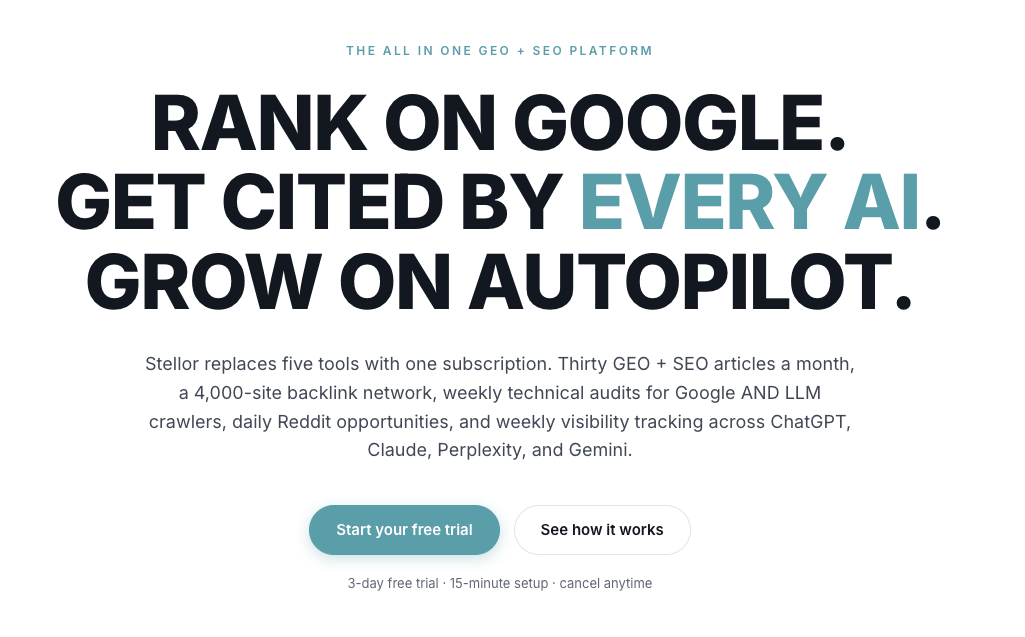
What separates this from a typical white label arrangement is the visibility layer: weekly reports show exactly which AI tools are citing your client, which competitors are winning those same prompts, and where your Reddit engagement is landing, so you’re never relying on a partner’s word for what got delivered. The Stellor product page breaks down the full feature set, and a three-day free trial with no credit card required lets you run the small pilot this article recommends before committing a single client retainer to it.
Sources
For technical reference, see Google Search Central and Schema documentation on structured data standards.
- White Label SEO Guide for Agencies | Grovant
- White Label SEO: The 2026 Marketer’s Guide | Web Tonic™
- Whatagraph — white label reporting tool
FAQ
What Is a White Label SEO Agency?
A white label SEO agency is a fulfillment provider that does SEO work, content, links, audits, and reporting, under your agency’s brand, so your client never sees who actually performed the work.
What Are the Disadvantages of White Labeling SEO?
The main disadvantages are losing direct visibility into execution, inheriting quality risk from low-cost link tactics or unreviewed AI content, and absorbing internal QA workload even though the fulfillment is outsourced.
Is an SEO Agency Worth It for a Small Business?
For most small businesses without in-house SEO expertise, a professional SEO agency is worth it if it delivers measurable results and transparent reporting; the same vetting standards that apply to white label partners apply here too.
What Is the 80/20 Rule in SEO?
The rule in SEO generally refers to the idea that a small share of pages, keywords, or backlinks drives most of a site’s organic traffic and rankings, so prioritizing high-impact pages beats spreading effort evenly.
How Much Should Agencies Mark Up White Label SEO?
Can Stellor Work as a White Label Solution for Agencies?
Yes, Stellor offers a reseller-friendly model that gives agencies automated content, backlinks, and AI visibility tracking under one transparent subscription, which agencies can present as their own service or use to supplement existing fulfillment.